
The Honda Civic equipped with the 1.5-liter turbocharged engine has captured a massive following across the United States. Drivers deeply appreciate its impressive fuel economy, nimble handling, and surprisingly punchy acceleration. Whether it is a daily commuter driving through heavy traffic or an enthusiast hitting the weekend highways, this generation of the Civic is everywhere. However, a growing mechanical concern has begun circulating through automotive forums, repair shops, and owner groups. Head gasket failure on the 1.5T engine platform is turning into a serious headache for many drivers. Spotting the early warning signs of this issue is the single best way to protect your car and prevent a catastrophic engine failure that costs thousands of dollars.
Why the 1.5-Liter Turbo Engine is Vulnerable
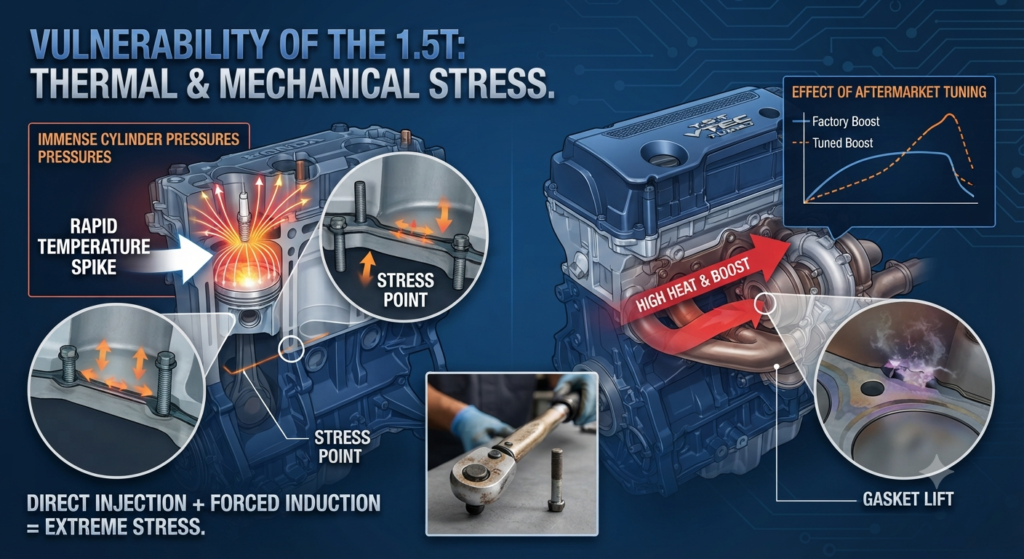
To understand why head gasket failures happen on this platform, you have to look closely at how the engine operates. The 1.5L turbo is a compact, high-output power plant that relies heavily on direct injection and forced induction. These technologies create immense cylinder pressures and rapid temperature spikes inside the combustion chamber. Under heavy throttle or prolonged highway driving, factory head bolts face severe thermal and mechanical stress.
Furthermore, a significant portion of US owners love to modify their cars. Adding aftermarket performance tunes such as Ktuner or Hondata increases boost pressure well beyond factory specifications. While this unlocks exciting power gains, it also pushes the stock head gasket right to the edge of its design limits. When you combine higher boost levels with minor cooling system inefficiencies or trapped air pockets, the gasket seal eventually compromises, leading to the dreaded leak.
Top 5 Symptoms of a Blown Head Gasket on the 1.5T
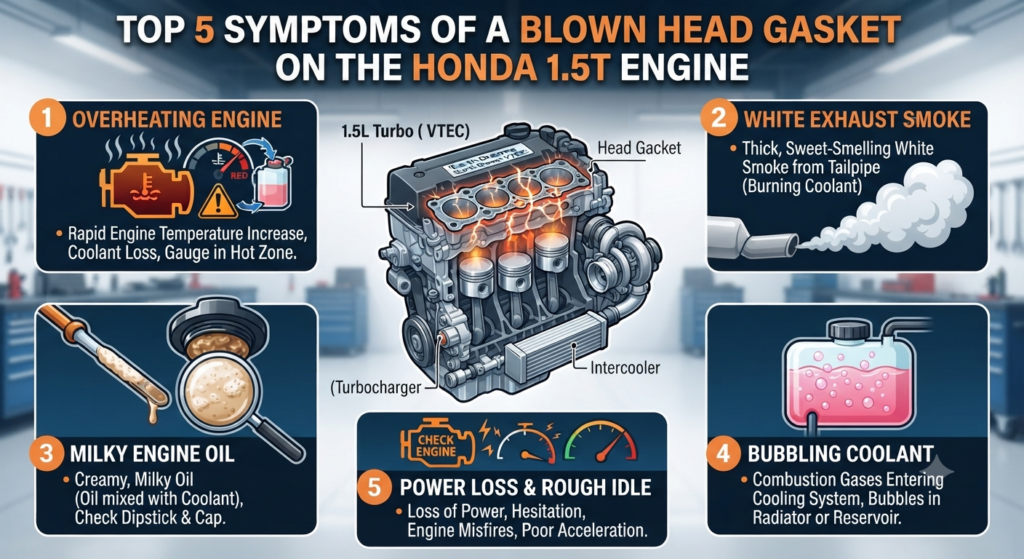
Recognizing a failing head gasket early on can save you from severe engine damage. Unlike older engines that might instantly mix oil and coolant into a milkshake consistency, the 1.5T often fails in very specific, subtle ways. Watch out for these primary warning signs during your daily drives.
Unexplained Coolant Loss Without Puddles
One of the most frustrating early symptoms is a constantly dropping coolant level in your reservoir tank. You might open your hood on a Saturday morning and notice the coolant is below the minimum line, even though you topped it off just a week ago. Naturally, you crawl underneath the car searching for a puddle, but the ground is completely bone dry. There are no external leaks coming from the radiator, water pump, or hoses. The mystery deepens until you realize where the liquid is actually going. Coolant is quietly seeping past the damaged gasket and entering the combustion chamber, where it vaporizes and exits through the exhaust system.
Cold-Start Misfires and Rough Idle
If your Civic shakes violently for thirty seconds every single morning when you first start it up, pay close attention. Once the engine reaches normal operating temperature, the rough idle mysteriously disappears and the car runs smooth as silk. This behavior is a classic signature of a 1.5T head gasket leak. When the engine sits turned off overnight, microscopic gaps in the gasket allow pressurized coolant to slowly leak onto the top of the piston. When you turn the key in the morning, the spark plug struggles to fire through that pool of liquid until the engine burns it off completely.
Persistent Check Engine Light and Misfire Codes
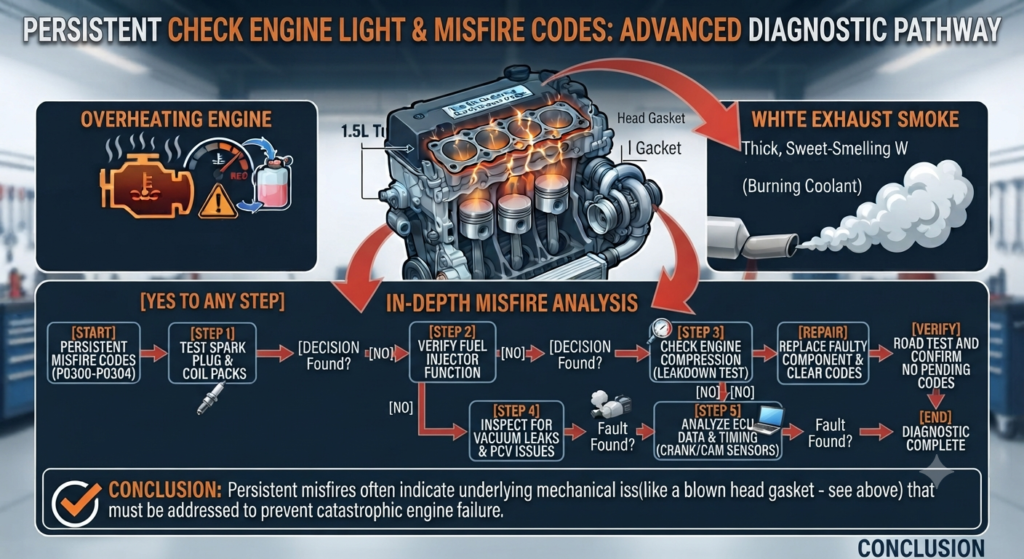
A failing head gasket will almost always trigger your dashboard check engine light. If you scan your car with an OBD2 reader, you will likely see codes ranging from P0300 for random multiple misfires, down to P0301, P0302, P0303, or P0304 indicating misfires on specific cylinders. Many car owners make the mistake of assuming these codes mean their ignition system is failing. They clear the codes, but within a few days or weeks, the check engine light returns with the exact same warnings because the underlying root cause has not been resolved.
Sweet Exhaust Smell or White Smoke
Pay close attention to what comes out of your tailpipe during morning startups or when you accelerate hard. If you notice a distinct, sweet, syrupy smell lingering in the air behind your car, that is a major red flag. That sweet odor comes from burning ethylene glycol, which is the primary chemical in engine coolant. You might also catch a noticeable puff of white smoke or heavy vapor coming from the exhaust pipe long after your engine has finished its normal cold-start warmup cycle.
Bubbles in the Coolant Reservoir Tank
When the combustion chamber loses its seal, high-pressure gases generated during the ignition cycle escape directly into the cooling system. If you safely open your coolant overflow tank while the engine is running and warm, you may see a steady stream of tiny bubbles rising to the surface. This happens because combustion gases are continuously pushing their way through the cooling passages, displacing air and creating pressure pockets that can eventually cause your engine to overheat.
The Diagnostic Trap to Avoid
When car owners experience rough idles and check engine lights, they often rush to the nearest quick-lube shop or generic mechanic. Uninformed technicians frequently fall into a costly diagnostic trap. They assume the misfires are caused by worn-out spark plugs, failing ignition coils, or clogged fuel injectors. They will charge you hundreds of dollars to replace these components, only for the check engine light to return a few days later. Do not let shops throw parts at your car blindly. If you are experiencing unexplained coolant loss alongside cylinder misfires, you must direct your mechanic to test the head gasket directly.
How Professionals Confirm the Issue
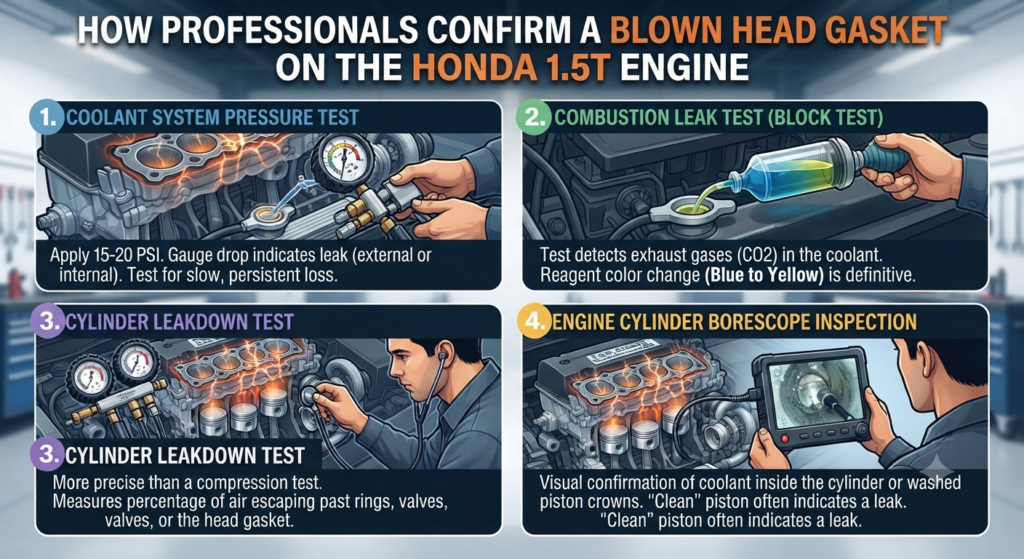
Before authorizing an expensive repair, you need definitive proof that the head gasket is indeed the culprit. Professional mechanics use three primary methods to confirm a failure on the 1.5T engine.
The Cooling System Pressure Test
Mechanics use a specialized hand pump to pressurize the radiator and cooling system up to factory specifications while the engine is turned off. If the pressure gauge starts dropping steadily, it proves there is a leak somewhere in the system. Since there are no external puddles on the floor, the pressure drop confirms that the coolant is escaping internally through the cylinder head gasket.
The Combustion Gas Block Test
This is one of the most reliable tests available. The mechanic places a special diagnostic tool filled with blue chemical fluid directly over the open radiator or coolant reservoir. As the engine runs, air is drawn through the fluid. If the blue fluid changes color to yellow or green, it provides undeniable proof that exhaust gases are present inside your cooling system, confirming a blown head gasket.
Borescope Cylinder Inspection
For a visual confirmation, technicians remove the spark plugs and insert a slender digital borescope camera down into the cylinders. By looking at the top of the pistons, they can spot what mechanics call steam cleaning. A cylinder that has been constantly exposed to leaking coolant will look suspiciously clean and washed out compared to the others, removing any doubt about the engine’s internal condition.
Repair Costs in the United States
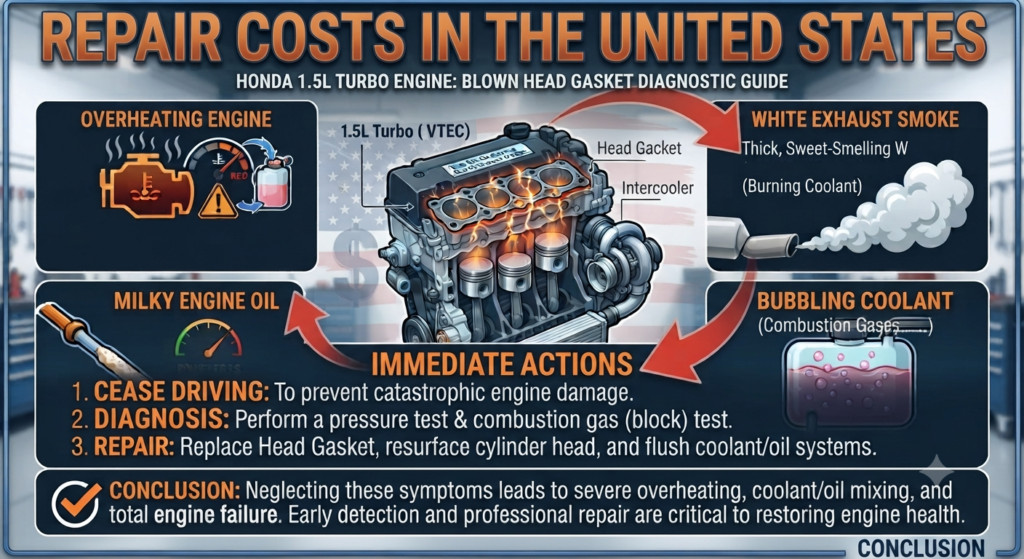
Dealing with a blown head gasket is never cheap, particularly on modern direct-injection turbocharged engines. In the United States, independent automotive shops typically charge anywhere from two thousand to three thousand dollars for a complete head gasket replacement job. If you take your Civic to an official Honda dealership, the quote can easily exceed four thousand dollars due to higher labor rates.
The vast majority of this expense comes from labor rather than parts. Tearing down the 1.5T engine, removing the cylinder head, sending it out to a machine shop to ensure it is perfectly flat, and reinstalling everything with new gaskets and head bolts takes many hours of meticulous work. However, attempting to ignore the problem or delaying the repair will only result in warped cylinder heads, severe overheating, and the ultimate need for a complete engine replacement, which costs significantly more.
Conclusion
Catching a Honda Civic 1.5T head gasket failure early is the ultimate key to protecting your financial investment. Pay close attention to your daily driving habits, monitor your coolant reservoir levels regularly, and never ignore recurring cold-start misfires. If you spot the warning signs discussed in this guide, schedule a professional block test immediately. Taking prompt action keeps your Civic running smoothly and ensures you stay safely on the road without breaking the bank.