
Driving a Compact Car in America
Driving a compact car in the United States comes with daily challenges. Drivers constantly navigate tight multi-story parking garages in bustling downtown areas, narrow city streets, and packed parallel parking spots. Because of this, knowing your vehicle’s agility is essential before buying or hitting the road.
The Honda Civic has long been a favorite for city commuters, college students, and small families across America. A major reason for its enduring popularity is how remarkably easy it is to maneuver in tight spaces. This comprehensive guide breaks down the exact turning radius dimensions of the Honda Civic so you know what to expect behind the wheel in every driving scenario.
Understanding Turning Radius Basics
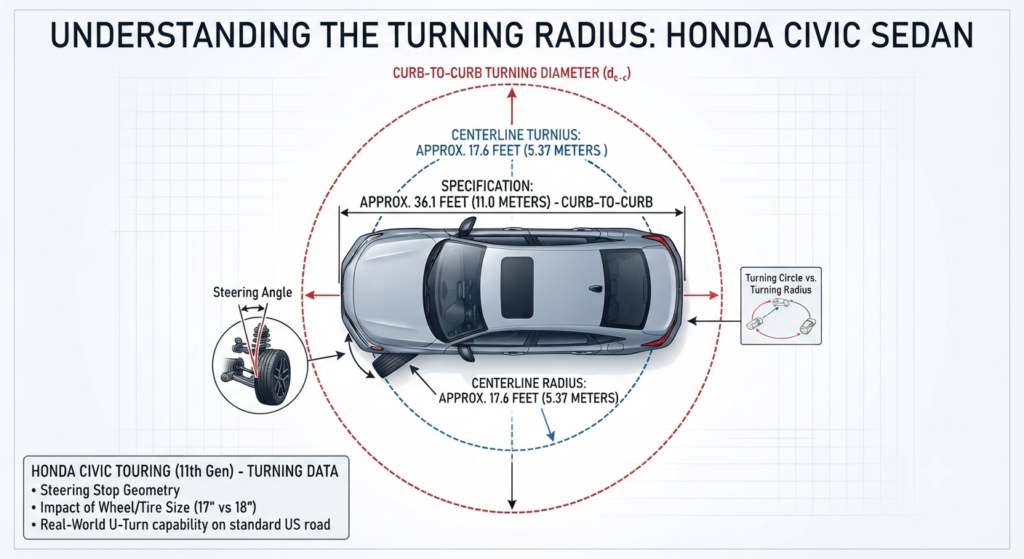
Before diving into specific Honda Civic measurements, it helps to understand what turning terms actually mean. Many drivers confuse turning radius with turning diameter, while automotive manufacturers often list technical metrics that can seem confusing at first glance:
- Turning Radius:
Measured from the exact center line of the vehicle to the outer edge of the circular path it traces. - Turning Diameter:
The total wall-to-wall or curb-to-curb width required for the car to complete a full 180-degree U-turn.
When you look at specifications for parking or making U-turns on US roadways, you are generally looking at the curb-to-curb turning diameter. Knowing this measurement prevents you from misjudging tight corners and helps you park with absolute confidence.
Honda Civic Turning Radius: The Core Numbers
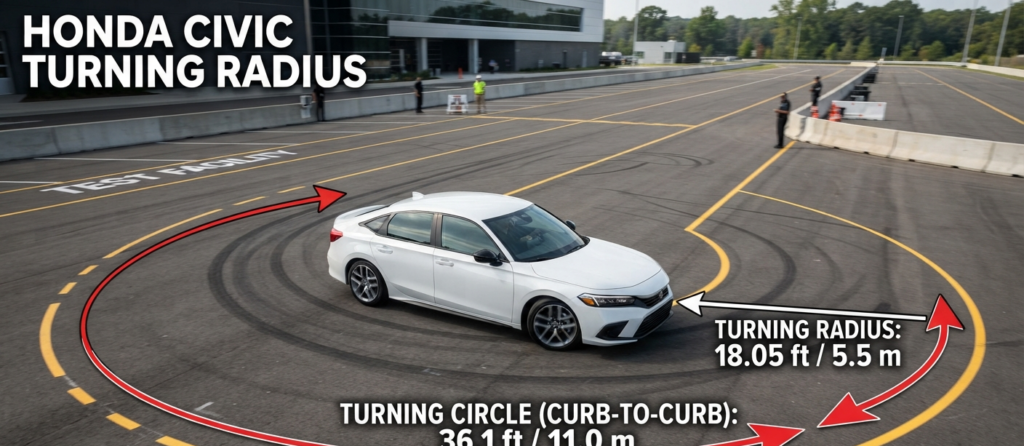
When researching steering performance for modern vehicles, accuracy matters. For the modern Honda Civic, the standard curb-to-curb turning diameter is approximately 36.1 feet.
This means you need a little over 36 feet of open roadway space to pull off a complete U-turn without having to reverse. A 36-foot turning circle places the Civic firmly in the sweet spot for compact sedans:
- Wide enough to maintain stable and predictable handling at highway speeds.
- Tight enough to let you dart through congested urban environments without breaking a sweat.
Turning Radius Breakdown by Generation
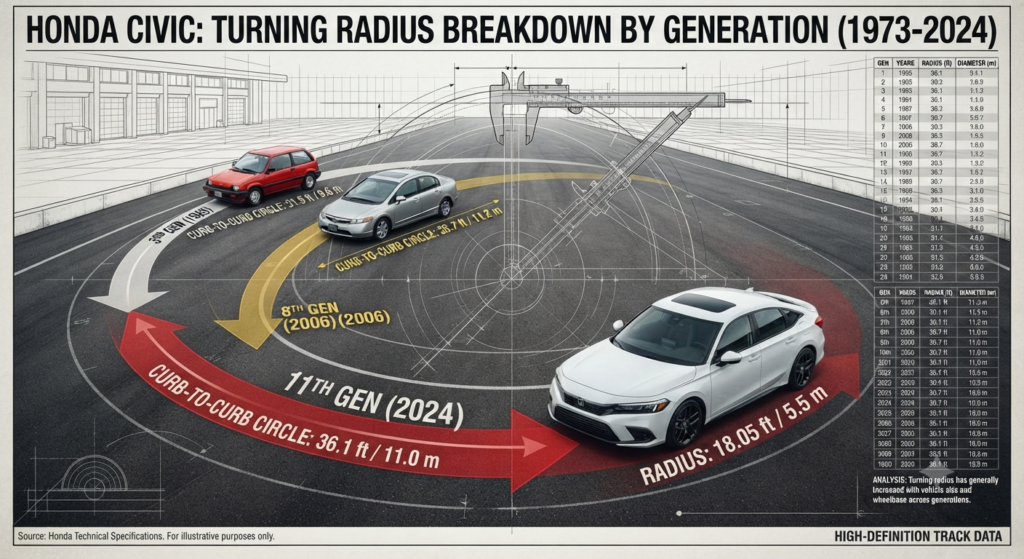
Vehicle dimensions shift slightly as automotive generations evolve. Whether you are buying a brand-new model from a dealership or looking at used vehicle options on the US market, turning specifications vary by model year:
11th Generation (2022 to Present)
- Sedan: Features a consistent curb-to-curb turning diameter of 36.1 feet.
- Hatchback: Ranges between 36.1 and 38.1 feet depending on the specific trim level and factory wheel package installed on the vehicle.
10th Generation (2016 to 2021)
- Sedan and Coupe: Typically sits right around 35.4 feet, offering slightly sharper low-speed agility due to minor body length differences.
- Hatchback: Requires up to 37.4 feet for a full U-turn due to a slightly stretched rear overhang and unique suspension tuning.
How Wheel Size Impacts Your Turning Circle
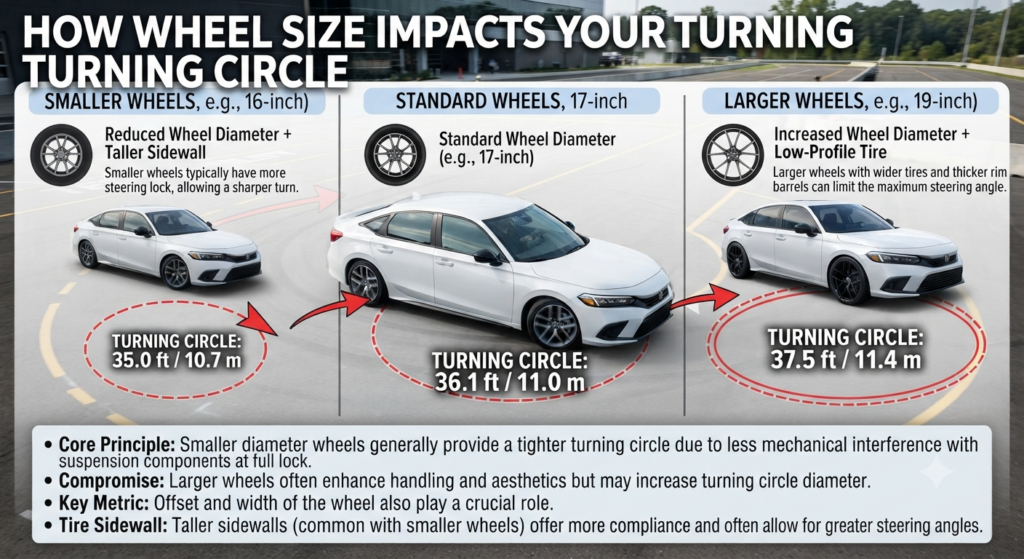
Not all Honda Civics turn the exact same way on the pavement. The specific trim level you choose plays a hidden role in how tight your car can maneuver:
- Base Models: Usually come equipped with smaller 16-inch alloy wheels and taller sidewall tires.
- Performance Trims: Higher trims like the Sport, Si, or Sport Touring come equipped with larger 18-inch wheels and wider low-profile tires.
Because wider tires take up more physical space inside the wheel well, manufacturers install specific steering stops. These steering stops prevent the rubber from rubbing against inner chassis components during sharp turns. As a direct result, sportier trims often have a slightly wider turning circle than base models. If sharp U-turns are your top priority, keep this minor difference in mind when choosing your car trim.
Real-World Driving: What 36 Feet Means For You

Numbers on a specification sheet are helpful, but how does a 36-foot turning diameter actually feel on a normal road?
- Tight Parking Garages: US parking structures are notoriously cramped and stressful. A 36-foot turning circle allows you to smoothly navigate spiral ramps in downtown garages without nervously scraping your front bumper or hitting your alloy rims against concrete pillars.
- Residential U-Turns: Standard two-lane residential streets in American suburbs give you just enough room to pull off a clean U-turn. You will rarely need to execute a frustrating three-point turn unless you find yourself stuck in an unusually narrow alleyway or dead end.
- Parallel Parking: City driving in major metropolitan hubs like New York, Chicago, or San Francisco requires quick steering response and precise spatial awareness. The Civic’s compact wheelbase combined with its tight turning geometry makes sliding into tight parallel spots smooth and stress-free.
Honda Civic vs. Key Competitors

How does the Civic stack up against other popular compact cars commonly found on the US market? A specification review helps put its maneuverability into proper perspective:
| Vehicle Model | Approximate Turning Diameter |
| Honda Civic | 36.1 Feet |
| Toyota Corolla | 35.6 to 38.0 Feet |
| Mazda 3 | 36.7 Feet |
| Hyundai Elantra | 35.4 Feet |
The Honda Civic sits right in the competitive middle of its class, balancing highway cruising stability with agile city maneuverability better than many of its direct rivals.
Tips for Improving Low-Speed Maneuverability

Even with a great turning radius, tight spaces can sometimes cause minor driving stress. You can use a few practical driving habits to maximize your Civic’s agility:
- Master Your Mirror Angles: Properly adjusted side mirrors give you a clear view of your rear wheels and the curb line. This visual feedback ensures you never misjudge your distance while completing sharp parking maneuvers.
- Understand Momentum and Steering Input: Avoid turning your steering wheel all the way to the lock while the car is completely stationary. Turning the wheel while slowly rolling forward reduces mechanical wear on your steering rack and makes tight turns feel much smoother.
- Regularly Check Tire Pressure: Under-inflated tires increase rolling resistance and can subtly alter vehicle handling dynamics. Keeping your tires inflated to factory specifications ensures your steering response remains crisp and predictable at all times.
Conclusion
The Honda Civic successfully balances interior passenger space with nimble handling better than most cars in its class. With a standard turning diameter of roughly 36 feet, it handles tight US city streets, busy commercial parking lots, and cramped residential areas with total ease.
Always take a test drive in the specific trim level you want to experience its steering feedback firsthand before making your final purchase decision!