
Honda Civics are globally legendary for their sheer mechanical endurance. It is common to see them crossing the two hundred thousand mile mark on their original factory engines and transmissions.
However, no production vehicle is completely immune to the laws of physical wear and tear. Once your odometer crosses the one hundred twenty thousand mile threshold, specific component vulnerabilities begin surfacing across various production generations.
Recognizing these trouble spots early saves you from catastrophic roadside breakdowns. More importantly, it helps you budget intelligently for preventative maintenance before minor wear turns into a massive engine rebuild.
Why Honda Civics Wear Out Differently By Generation
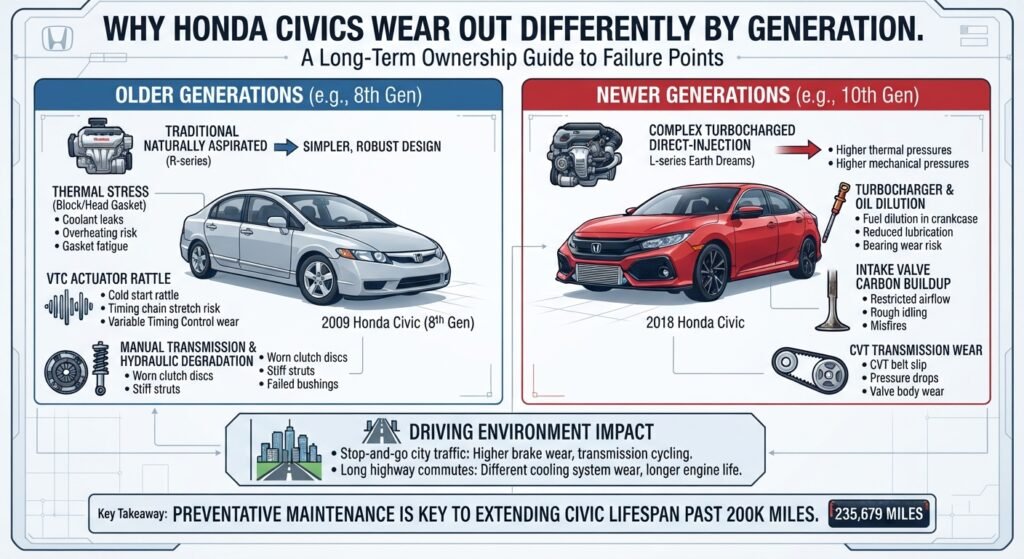
Not all high-mileage Civics experience identical mechanical failures. Older vehicle generations rely heavily on traditional, naturally aspirated powerplants. Newer models, by contrast, utilize complex turbocharged direct-injection engines that operate under much higher thermal and mechanical pressures.
Your daily driving environment also plays a massive role in component degradation. Stop-and-go urban traffic in densely populated cities creates entirely different wear patterns on transmissions, brakes, and cooling systems compared to long, steady highway commutes.
Understanding your specific Civic generation helps you pinpoint exact trouble spots. For instance, a 2009 eighth-generation model requires a completely different maintenance checklist than a 2018 tenth-generation turbo model.
Top Mechanical Failure Points in High Mileage Civics
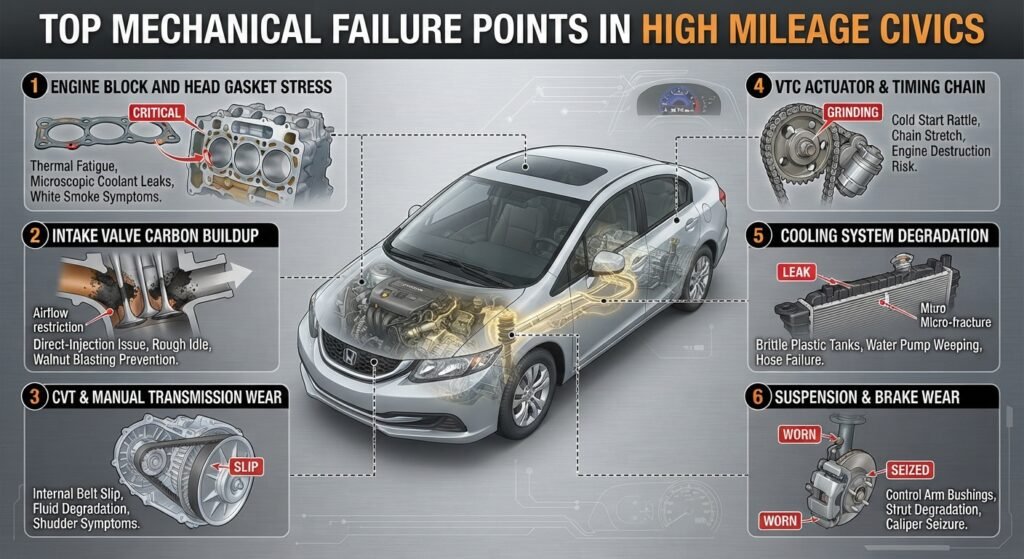
1. Engine Block and Head Gasket Stress
Thermal fatigue builds up steadily over many years of continuous heating and cooling cycles. Older aluminum engine blocks and cast-iron cylinder heads expand and contract at different rates, sometimes causing microscopic coolant leaks around the gasket sealing surface.
- Symptoms:
You might notice sweet-smelling white exhaust smoke or experience unexplained coolant loss without any visible puddles forming on your garage floor. - Prevention:
Ignoring minor coolant consumption inevitably leads to severe engine overheating, warped cylinder heads, and compromised compression. Check your coolant overflow reservoir weekly.
2. Turbocharger and Oil Dilution Issues
Tenth and eleventh-generation Civics feature the highly efficient 1.5-liter turbocharged direct-injection engine. However, these motors occasionally suffer from fuel mixing into the engine crankcase oil, a phenomenon known as oil dilution.
- Symptoms:
Unburnt gasoline slips past piston rings during short winter trips when the engine fails to reach full operating temperature. This thinned oil reduces lubrication effectiveness and accelerates internal bearing wear. - Prevention:
Check your engine oil dipstick regularly. If your oil level appears to rise above the maximum mark or smells strongly of gasoline, change your oil immediately and take longer highway trips to allow the engine to burn off excess fuel vapors.
3. Intake Valve Carbon Buildup
Because direct-injection systems spray fuel straight into the combustion chamber rather than the intake runners, gasoline no longer washes over the back of the intake valves.
- Symptoms:
By one hundred thousand miles, heavy carbon crust builds up behind the valves, restricting airflow. This restriction causes rough idling, sluggish throttle response, and random engine misfires. - Prevention:
Professional walnut blasting or manual chemical cleaning restores lost horsepower and smooths out idle quality.
4. CVT and Manual Transmission Wear
Continuously Variable Transmissions demand strict fluid change intervals to survive past high-mileage milestones. Neglecting fluid swaps past one hundred thousand miles causes severe internal belt slip, pressure drops, and valve body wear.
- Symptoms:
You might feel a noticeable shudder, hesitation, or jerky engagement when accelerating from a dead stop. Manual transmission models on Si trims usually face worn-out clutch discs, pilot bearings, and synchronized gear wear instead. - Prevention:
Drain and fill your transmission fluid every thirty thousand to forty thousand miles without exception.
Electrical and Ancillary System Breakdowns
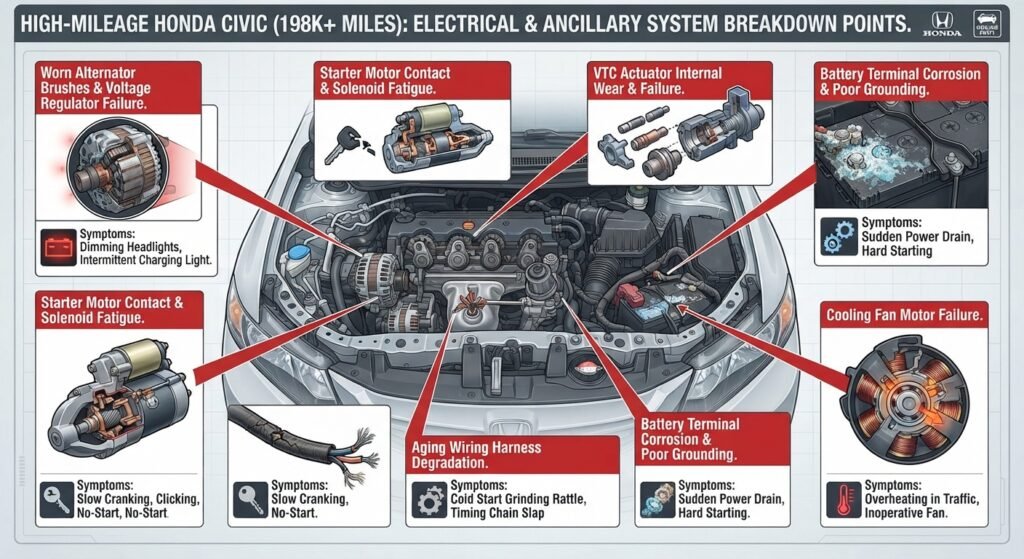
1. VTC Actuator and Timing Chain Stretch
Eighth and ninth-generation models frequently develop a harsh, grinding rattle noise specifically on cold engine startups. This abrasive rattle originates from a failing Variable Timing Control actuator.
- Symptoms:
A loud metallic clatter lasting two to three seconds right after turning the key. If left unaddressed, the constant slapping motion stretches the timing chain beyond its safe operational limit. - Prevention:
A snapped timing chain destroys valves and pistons instantly upon contact. Replacing a failing VTC actuator early protects your entire motor from catastrophic failure.
2. Alternator and Starter Motor Fatigue
High-mileage electrical accessories draw constant, heavy power loads from aging wiring harnesses and aging battery terminals. Factory alternators and starter motors eventually wear down their internal copper brushes.
- Symptoms:
Sudden battery drain, dimming headlights at idle, or intermittent dashboard charging system warning lights. - Prevention:
Test your charging system output and battery health during routine oil changes to prevent unexpected towing bills.
3. Cooling System Component Degradation
Factory plastic radiator end tanks and thermostat housings become brittle after years of extreme temperature fluctuations. Tiny micro-fractures develop over time, leading to slow coolant weeping and sudden pressure drops.
- Symptoms:
Crusty white or green residue around radiator seams and hose connections. Water pumps also start weeping coolant through their mechanical weep holes around one hundred fifty thousand miles. - Prevention:
Replace aging rubber radiator hoses, thermostats, and plastic radiators proactively before they burst under high highway operating pressures.
Suspension, Steering, and Braking Wear at High Mileage
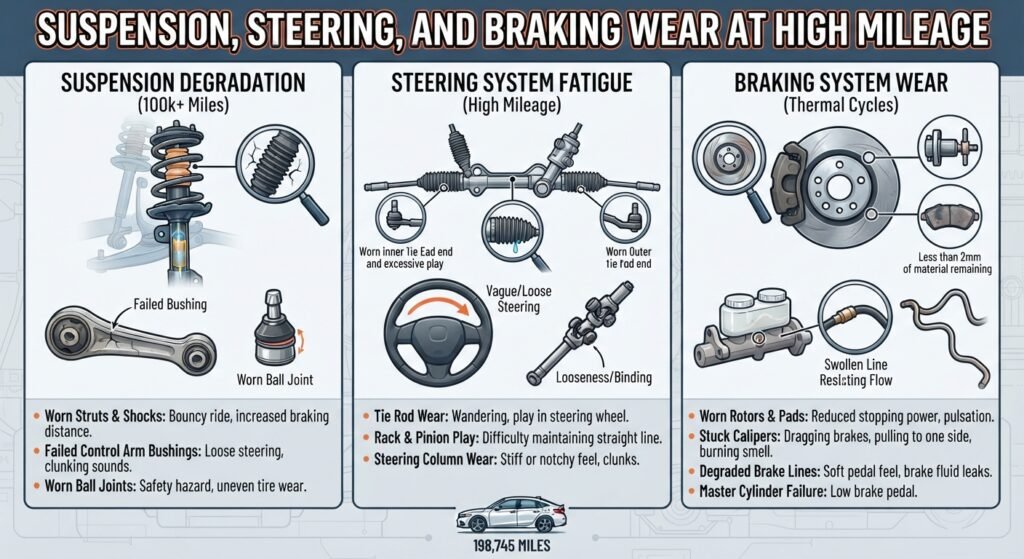
1. Worn Control Arm Bushings and Ball Joints
Rubber suspension bushings dry out, crack, and tear over extended periods of road exposure. Once these foundational bushings fail, your steering wheel starts feeling loose, vague, or prone to wandering across highway lanes.
- Symptoms:
Clunking or popping noises when going over speed bumps or sharp driveway dips, accompanied by uneven front tire wear. Worn lower ball joints also present an extreme safety hazard if they separate completely.
2. Strut and Shock Absorber Degradation
Factory hydraulic dampers lose their internal gas pressure and damping fluid around one hundred thousand miles.
- Symptoms:
Your ride quality becomes excessively bouncy over road undulations, and emergency braking distances increase because the tires lose solid contact with the pavement surface. - Prevention:
Replacing all four struts and mounting assemblies restores proper handling control and ensures predictable cornering stability.
3. Brake Master Cylinder and Caliper Seizure
High-mileage braking systems endure thousands of intense thermal cycles. Flexible rubber brake lines can swell internally over time, acting like miniature check valves that cause brake calipers to stick and continuously drag against the rotors.
- Symptoms:
You might notice your car pulling heavily to one side while driving, or smell burning brake pads after a short city commute. - Prevention:
Regularly bleed old brake fluid, inspect calliper slide pins, and replace seized callipers promptly to keep your stopping power sharp and safe.
The Cost-Benefit Verdict: Is Fixing Your High-Mileage Civic Worth It?

Investing two thousand dollars into major mechanical repairs feels painful when your vehicle has already depreciated significantly. You must carefully weigh the cost of a replacement transmission or head gasket against current market replacement values.
If your vehicle’s structural chassis is completely rust-free and the interior remains clean, repairing the mechanical issue almost always beats buying an expensive new car with high monthly payments. A properly repaired Honda easily delivers another five years of dependable, worry-free daily commuting.
Conclusion
Keeping a high-mileage Honda Civic running smoothly requires dedication, proactive inspection, and attention to detail. Changing your engine oil, transmission fluid, and coolant on strict schedules prevents most major mechanical disasters before they start.
Listen closely to unusual mechanical noises and address dashboard warning lights immediately rather than ignoring them. With proper care, maintenance, and timely part replacements, your trusted Civic will easily cross the two hundred fifty thousand mile milestone and beyond.