
Nothing kills a spirited drive quite like that awful metallic crunch when you pull the shifter back. If you drive a Honda Civic Si, you probably know this exact heartbreak.
Sliding from second to third gear is supposed to feel like a knife through warm butter, but instead, it often brings an unwanted mechanical protest. This issue has haunted the Civic Si family for years, especially on high-revving models where drivers love to push the envelope.
When your shifter suddenly refuses to slide smoothly into that next gate, frustration sets in fast. But ignoring the crunch won’t make it disappear—it only leads to accelerated wear inside your gearbox and a much heavier repair bill down the road.
Fortunately, you can tackle this issue before it spirals out of control. Let’s break down why this happens and walk through every fix, ranked from the easiest garage tricks to heavy-duty overhauls.
Why Does the Civic Si Grind From 2nd to 3rd Gear?
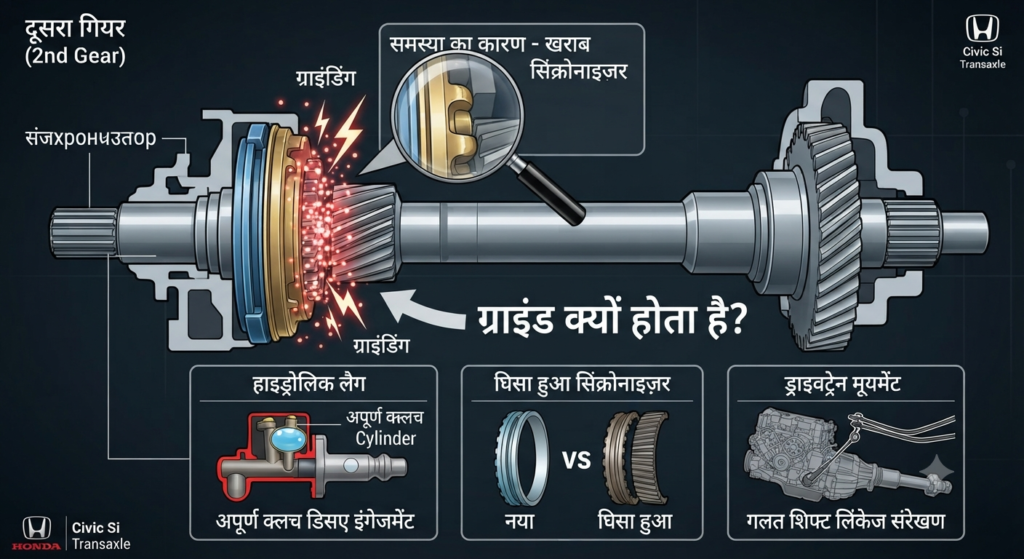
To fix a problem, you have to understand it. Manual transmissions rely heavily on synchronizers (synchros) to match rotational speeds between gears before they lock together.
When you bang through gears at high RPMs, those brass or carbon-lined synchros work overtime. Over years of aggressive driving, they wear down. Once they lose their friction grip, the gear teeth clash instead of meshing smoothly hence, the dreaded grind.
However, the synchros aren’t always the sole culprit. Consider these common factors:
- Degraded Fluid: Factory manual transmission fluid breaks down under extreme heat over time, losing its ability to protect internal components during rapid shifts.
- Hydraulic Lag: If your clutch system has hydraulic issues, it won’t fully disengage. If the clutch disc stays slightly engaged, the transmission input shaft keeps spinning, making clean gear selection nearly impossible.
- Drivetrain Movement: Excessive engine and transmission movement under heavy load can throw your shift linkage out of alignment.
Step-by-Step Fixes: From Easiest to Advanced
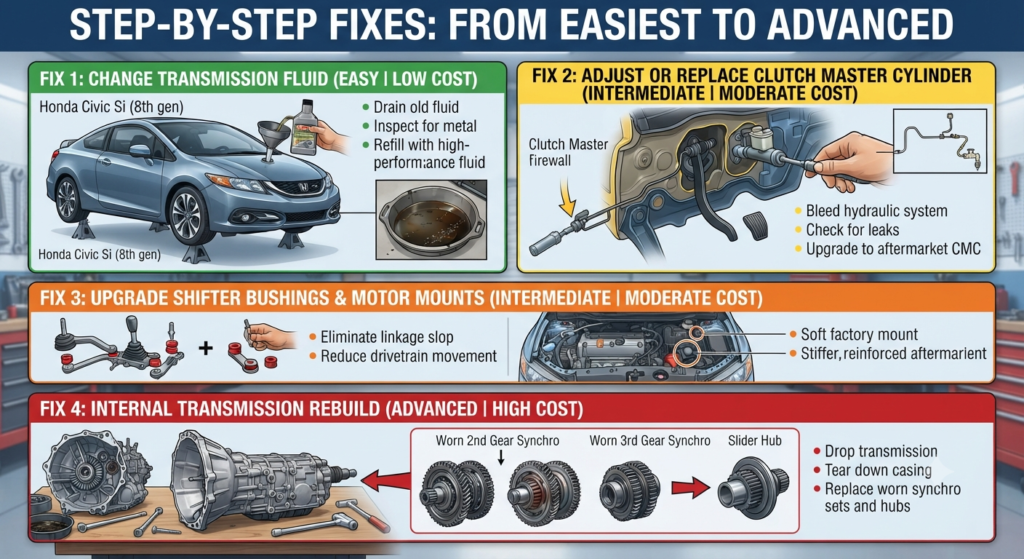
Fix 1: Change Your Transmission Fluid
- Difficulty: Easy | Cost: Low
Fresh fluid is always the best place to start. Factory fluid degrades rapidly after thousands of miles of heavy use, and draining the old oil often reveals fine metallic flakes sitting at the bottom of the case.
Switching to a high-performance aftermarket fluid can instantly smooth out rough shifts. Many Civic Si enthusiasts swear by specialized blends like Amsoil Synchromesh or custom friction modifier cocktails to restore a crisp shifting feel. Jacking up the car, draining the old fluid, and pumping in fresh oil takes less than an hour and solves minor synchronization issues for many owners instantly.
Fix 2: Adjust or Replace the Clutch Master Cylinder
- Difficulty: Intermediate | Cost: Moderate
Hydraulic pressure dictates how cleanly your manual transmission operates. If your clutch master cylinder is failing, it won’t build enough pressure to completely disengage the clutch.
- Does your clutch pedal feel spongy?
- Does the bite point sit too low to the floorboard?
Start by bleeding the clutch hydraulic system to clear out trapped air bubbles. If bleeding doesn’t cut it, replace the stock master cylinder with an upgraded aftermarket unit. Upgraded units provide consistent pressure, ensuring your clutch fully disengages on every single shift.
Fix 3: Upgrade Shifter Bushings and Motor Mounts
- Difficulty: Intermediate | Cost: Moderate
Sometimes the transmission internals are completely fine, but external parts are throwing off your alignment.
Factory rubber shifter bushings flex significantly under heavy acceleration, pulling the shift cables out of proper alignment with the transmission. Upgrading to solid polyurethane shifter cable bushings eliminates that unwanted cabin play.
Similarly, worn rear motor mounts allow the entire engine and transmission assembly to rock back and forth. Installing stiffer motor mount inserts keeps the drivetrain stable during hard gear changes, ensuring your shift linkage hits the dead center of the third-gear gate every time.
Fix 4: Internal Transmission Rebuild
- Difficulty: Advanced | Cost: High
If you’ve swapped the fluid, adjusted the hydraulics, and upgraded your bushings with zero improvement, the damage is internal.
Severe, ongoing grinding eventually wears down the actual synchronizer teeth until they are completely rounded off. At this stage, you’ll likely experience annoying gear pop-outs or complete lockouts.
Fixing this requires dropping the transmission out of the car and tearing down the casing entirely. A professional mechanic (or an experienced DIYer with a garage and a shop manual) will need to replace the worn 2nd and 3rd gear synchro sets and slider hubs. While it’s pricey, it provides a permanent, factory-fresh fix.
Advanced Diagnostic Checklist for Persistent Issues
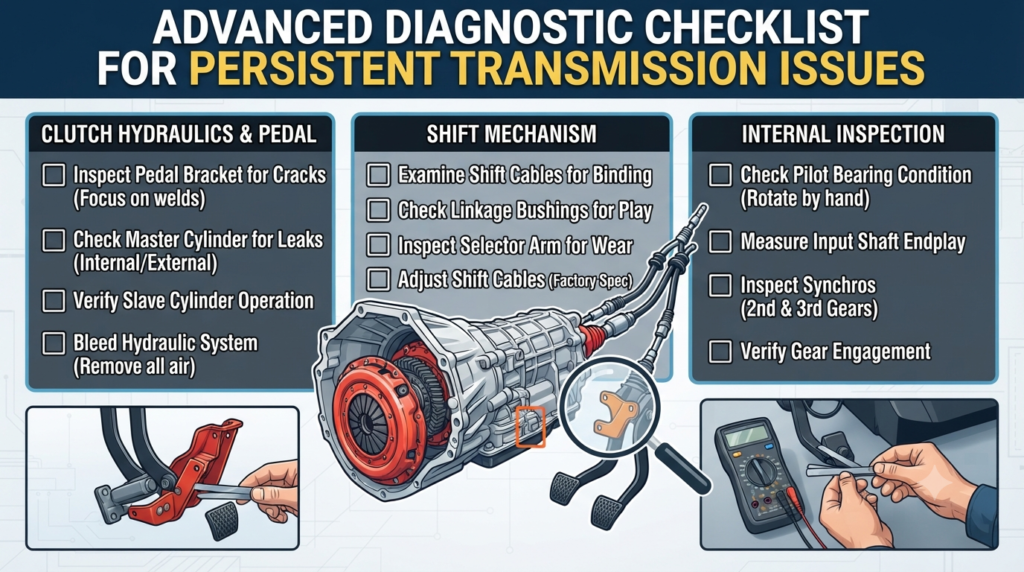
If standard fixes don’t cure your stubborn transmission grind, you need a systematic approach to rule out hidden mechanical gremlins:
- Inspect the Pedal Bracket:
Check your clutch pedal assembly bracket under the dashboard for hairline cracks. A cracked bracket flexes when pressed, preventing full hydraulic stroke and clean gear separation. - Examine Shift Cables:
Look closely at your shift linkage cables for physical binding, sharp bends, or frayed sections. - Check the Pilot Bearing:
If your car is high-mileage, a seizing pilot bearing inside the flywheel will keep the input shaft turning even with the clutch pedal fully depressed.
Taking time to check these secondary components can save you from buying parts you don’t actually need.
Preventative Habits to Protect Your Gearbox
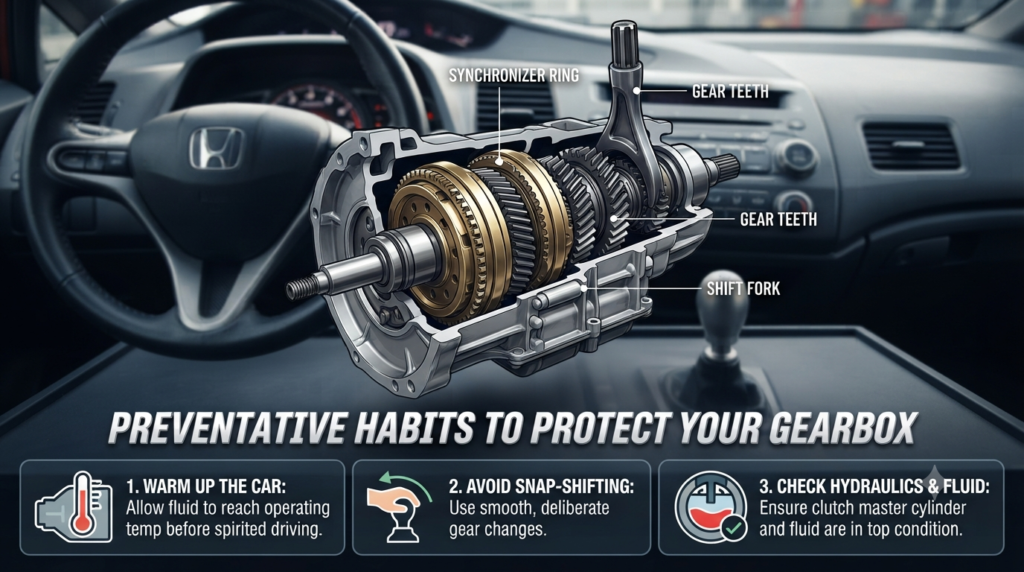
Fixing your transmission is only half the battle. To keep it healthy long-term, you need to adjust your driving style:
- Warm Up the Car:
Always allow your car to reach proper operating temperature before driving aggressively. Cold transmission fluid is thick, forcing the synchros to work twice as hard to match speeds. - Ditch Snap-Shifting:
Avoid slamming the gear lever into place as fast as humanly possible. Use a smooth, deliberate motion that gives the synchronizers adequate time to do their job. - Respecting the mechanical limits of your gearbox will save you hundreds if not thousands of dollars in future repair bills.