
For driving enthusiasts looking for a fun daily driver that won’t empty their bank account, the Honda Civic Si has always been a go-to choice. It brings sharp handling, a practical cabin, and a slick manual transmission that keeps you fully connected to the road.
Yet, many drivers feel the car leaves plenty of performance on the table right out of the box. Strict government emissions laws and corporate fuel economy standards force manufacturers to keep factory engine maps overly conservative.
This leads many owners to a classic automotive crossroads: do you keep the engine completely stock to preserve absolute reliability, or is it time to flash a Stage 1 tune and unlock some real power?
Factory Performance: What a Stock Civic Si Can Do
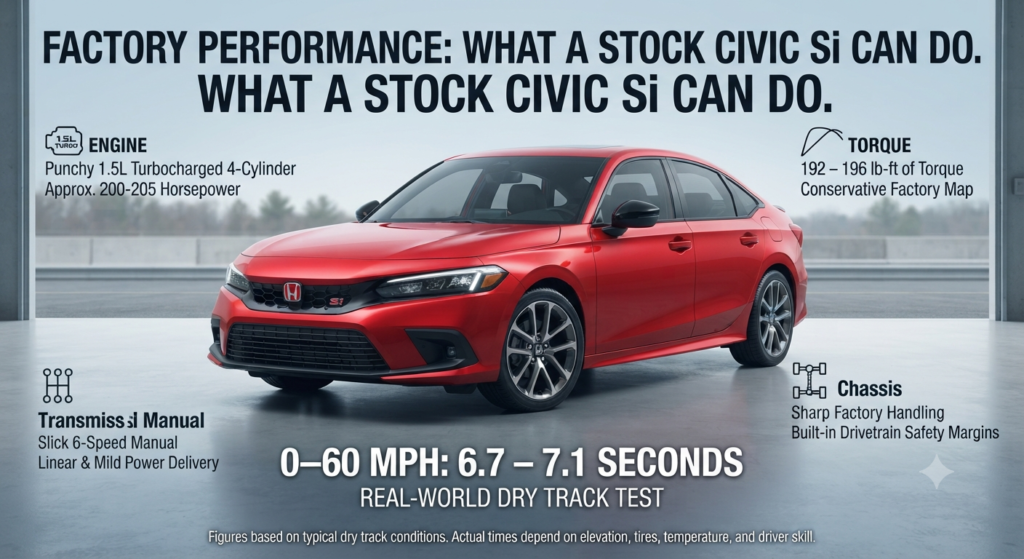
Modern Civic Si models rely on a punchy 1.5-liter turbocharged four-cylinder engine. From the factory, this motor pushes out roughly 200 to 205 horsepower and around 192 to 196 lb-ft of torque, depending on the model year.
When you test a stock car on a dry track, the 0–60 MPH time typically lands between 6.7 and 7.1 seconds. Your exact real-world time depends heavily on ambient elevation, tire condition, track temperature, and how quickly you can execute your gear shifts.
Honda engineered this setup with built-in safety margins and heavy throttle damping to protect the drivetrain. You’ll also notice factory rev hang, which can make shifting feel a bit sluggish and artificial during spirited driving sessions.
Entering Stage 1: What Changes With a Tune?
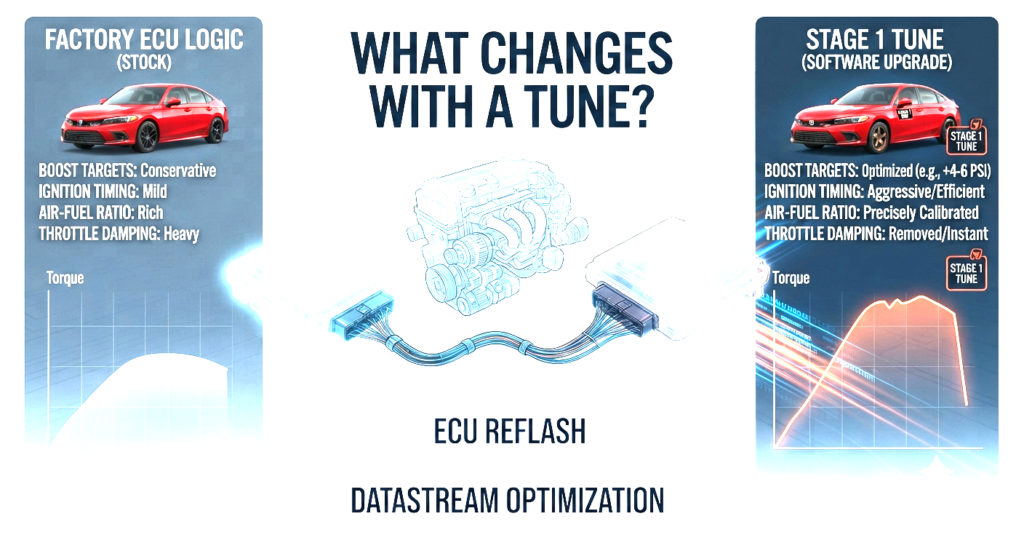
A Stage 1 tune is a software upgrade that alters how your engine control unit (ECU) manages boost targets, ignition timing, and air-fuel ratios. You don’t need to install heavy physical bolt-ons like upgraded intercoolers or downpipes to run a Stage 1 map safely.
In the US market, popular tuning solutions include the KTuner device and the COBB Accessport. Many drivers pair these hardware flashers with off-the-shelf (OTS) performance maps created by reputable tuners like Two Step Performance or Phearable.
Once flashed, a Stage 1 tune on 93 octane pump gas bumps output to roughly 225 to 237 wheel horsepower. Torque numbers jump even higher, reaching between 250 and 280 lb-ft. This creates a massive mid-range power surge that completely transforms how the car pulls through the gears.
Stock vs. Stage 1 Tune: Head-to-Head Comparison
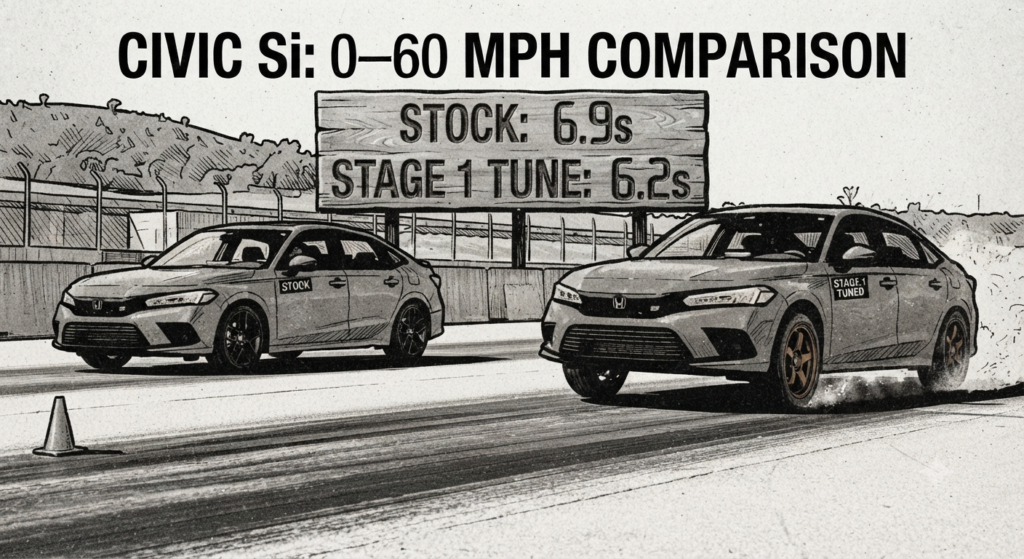
| Performance Metric | Stock Civic Si | Stage 1 Tune |
| Horsepower | 200 – 205 hp | 225 – 237 whp |
| Torque | 192 – 196 lb-ft | 250 – 280 lb-ft |
| 0–60 MPH Time | 6.7 – 7.1 seconds | 6.0 – 6.3 seconds |
| Power Delivery | Linear and mild | Aggressive mid-range punch |
Looking at the raw numbers, a Stage 1 tune drops your 0–60 MPH time down into the low-six-second range. Breaking into the sub-six-second bracket is tough on stock street tires due to front-wheel-drive traction limits and initial wheel spin.
You also have to deal with a physical gear ratio limitation in the Civic Si transmission. The car runs out of revs in second gear just a few miles per hour short of 60, forcing a quick shift into third. That extra shift adds precious tenths of a second to your timer.
The Role of Fuel Quality and Octane Ratings
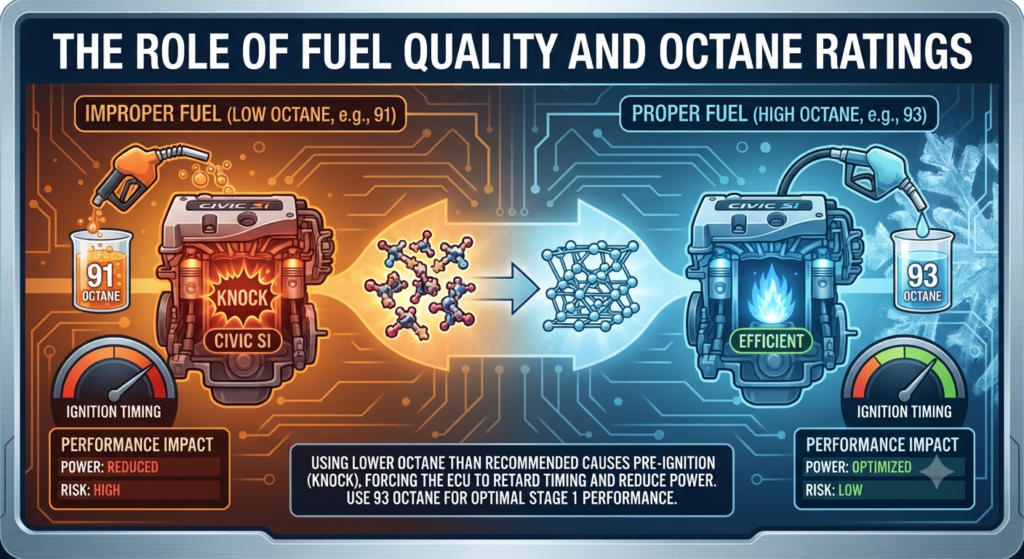
Fuel quality plays a massive role in how well your Stage 1 tune performs on American roads. Gas stations across different states offer varying maximum octane levels—usually ranging from 91 in states like California to 93 on the East Coast.
Running a Stage 1 tune designed for 93 octane on lower-quality 91 gas can cause negative side effects. Your engine computer will detect minor detonations and automatically pull ignition timing to protect the motor, robbing you of those hard-earned horsepower gains.
Note: If you live in an area that only offers 91 octane fuel, make sure to select an appropriate map tailored specifically for that fuel grade. Always monitor your live parameters via your tuning device to ensure the engine runs smoothly.
Hidden Costs and Risks: What Others Might Not Tell You
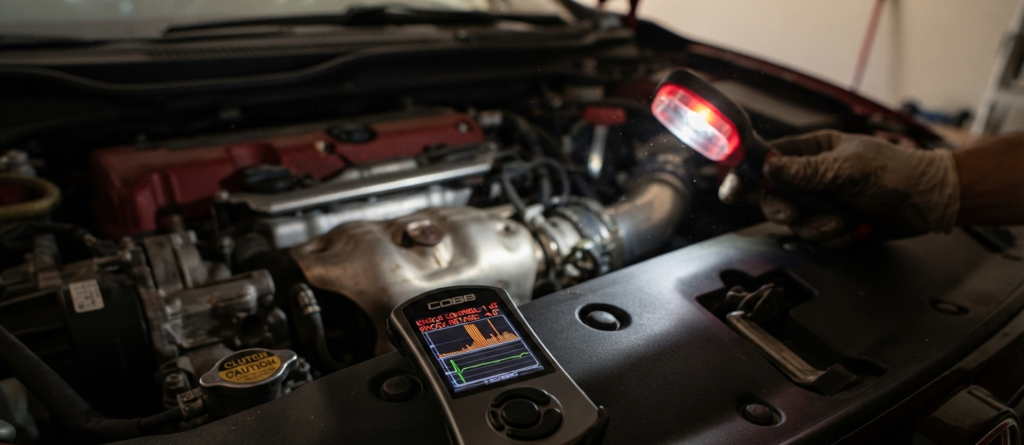
Every modification comes with mechanical trade-offs that you need to understand before flashing your ECU.
- Factory Clutch Life: The biggest mechanical hurdle with a Stage 1 tune is clutch longevity. The stock clutch disc in modern Civic Si models is notoriously weak and struggles to hold a sudden spike in mid-range torque. If your car has high mileage, expect to plan for an upgraded heavy-duty aftermarket clutch sooner rather than later.
- Knock Control: Pay close attention to knock control monitoring on your tuning device. Seeing minor fluctuations is normal, but constant spikes during hot summer weather mean your engine is fighting poor fuel quality or excessive heat.
- Heat Soak: Heat soak is a real-world enemy for turbocharged daily drivers. Consecutive hard pulls on a hot summer day will cause intake air temperatures to rise, leading the computer to pull timing and slow down acceleration times.
Drivability: How Does It Feel on the Street?
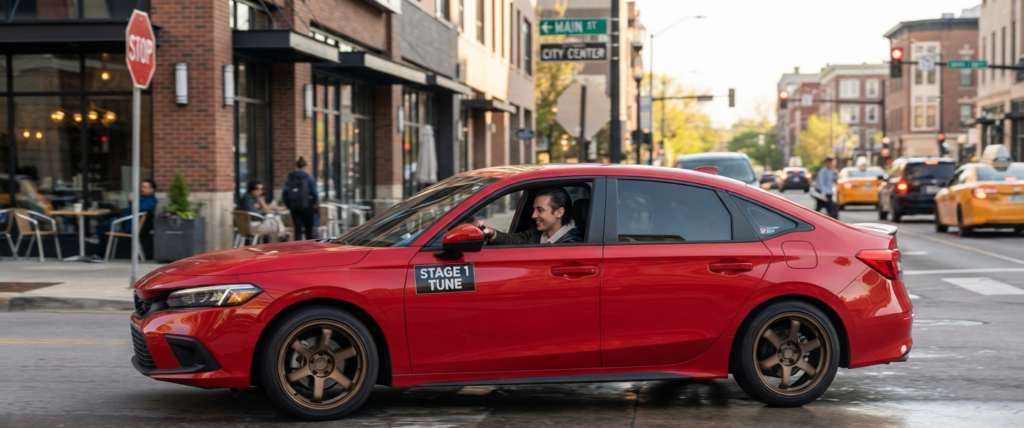
Raw dyno numbers only tell half the story. The true test of a Stage 1 tune is how it alters your daily commute and overall driving enjoyment.
Low-speed throttle response feels much crisper and more immediate once the conservative factory dampening is removed. Merging onto busy highways becomes effortless because the car pulls strongly in fourth and fifth gears without requiring a downshift.
The removal of factory throttle lag makes stop-and-go city driving feel more engaging. However, you have to stay mindful of your right foot—that sudden rush of torque can easily break traction if the roads are wet.
Final Verdict: Is It Worth It for Your Daily Driver?
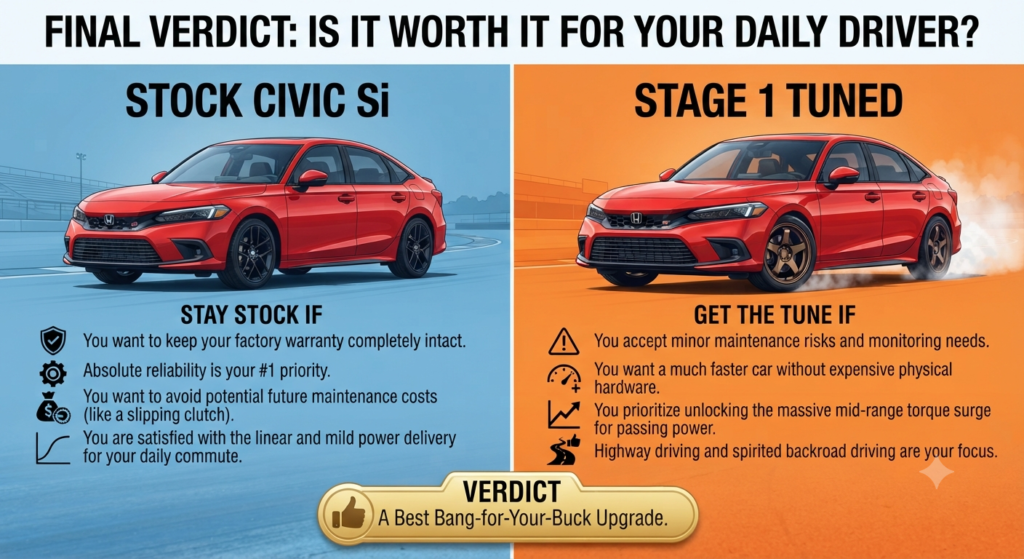
A Stage 1 tune delivers the absolute best bang for your buck if you want to unlock hidden performance from your Civic Si. The massive jump in mid-range torque makes highway passing and spirited backroad driving infinitely more enjoyable.
- Stay stock if: You want to keep your factory warranty completely intact and avoid the potential cost of replacing a slipping clutch.
- Get the tune if: You accept minor maintenance risks and want a much faster car without buying expensive physical hardware. It’s an absolute game-changer that redefines what your Civic Si can achieve.