
Introduction
The automotive world has fully embraced electrification, and Honda is leading the charge with an incredible hybrid lineup. Car buyers across the United States are looking closely at the latest Honda Civic Hybrid models, but choosing between them often leads to a common dilemma.
When shopping for a new car, you might wonder if paying extra for a higher trim level makes financial sense. Two specific trims capture the attention of daily drivers: the Sport Hybrid and the Sport Touring Hybrid.
Let’s break down the differences to see which one deserves your hard-earned money.
What Both Trims Share

Underneath the hood, both models share the exact same mechanical foundation and deliver stellar fuel economy ratings.
- Shared Powertrain: Honda pairs a 2.0-liter four-cylinder engine with an advanced dual-motor hybrid system.
- Performance: This smart setup pumps out a robust 200 horsepower and 232 lb-ft of torque for quick, responsive acceleration.
- Driving Dynamics: Power delivery remains instant and satisfying whether you are merging onto a fast highway or navigating stop-and-go city traffic.
- Fuel Economy: Figures match identically between the two cars. Drivers can expect an exceptional EPA-estimated rating of roughly 50 mpg in the city and 47 mpg on the highway.
Choosing the base trim certainly does not mean burning more fuel.
Pricing and Value Breakdown
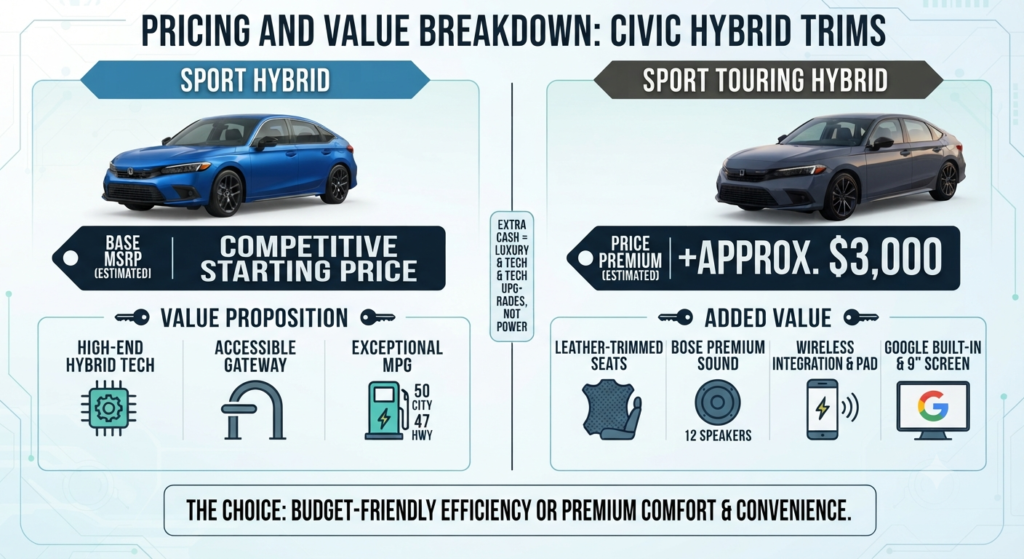
The primary factor driving buyers toward a tough decision is the price tag.
- Sport Hybrid: Serves as an accessible gateway into the electrified lineup, delivering high-end hybrid tech at a competitive starting MSRP.
- Sport Touring Hybrid: Requires an extra financial commitment, usually carrying a price premium of around $3,000.
That extra cash does not buy extra engine power. Instead, that money goes directly into luxury interior upgrades and advanced technology.
Interior Comfort and Seating Differences
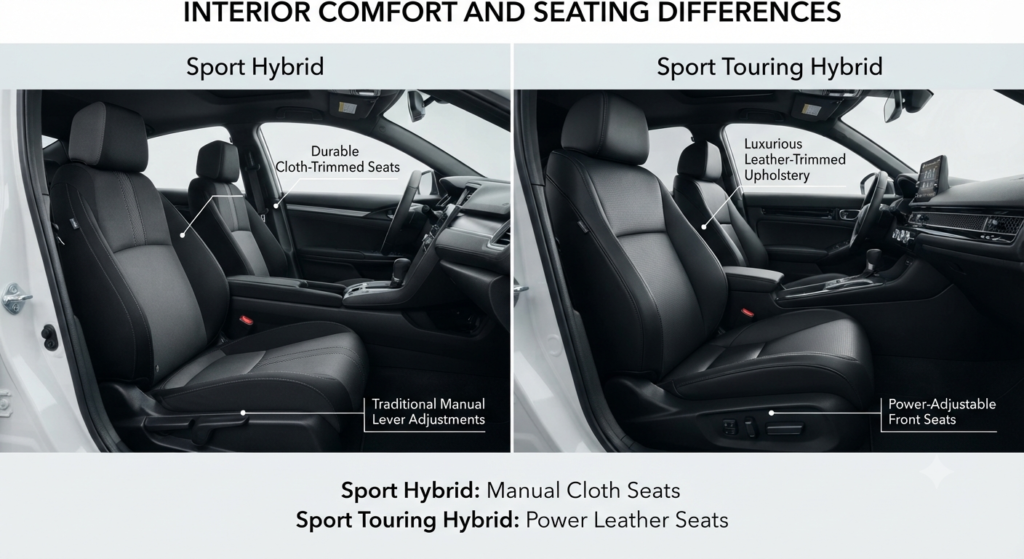
Cabin materials and seating adjustments create the most noticeable tactile difference between the two cars.
- Sport Hybrid: Comes equipped with durable, high-quality cloth-trimmed seats designed to withstand heavy daily wear. Front seat adjustments rely on traditional manual levers.
- Sport Touring Hybrid: Elevates the interior atmosphere by swapping cloth for luxurious leather-trimmed upholstery. It replaces manual adjustments with power-adjustable front seats, allowing drivers and front passengers to fine-tune their seating angle with absolute precision. If you share your vehicle with a family member, you’ll appreciate the ease of saving your preferred settings.
Infotainment and Technology Integration
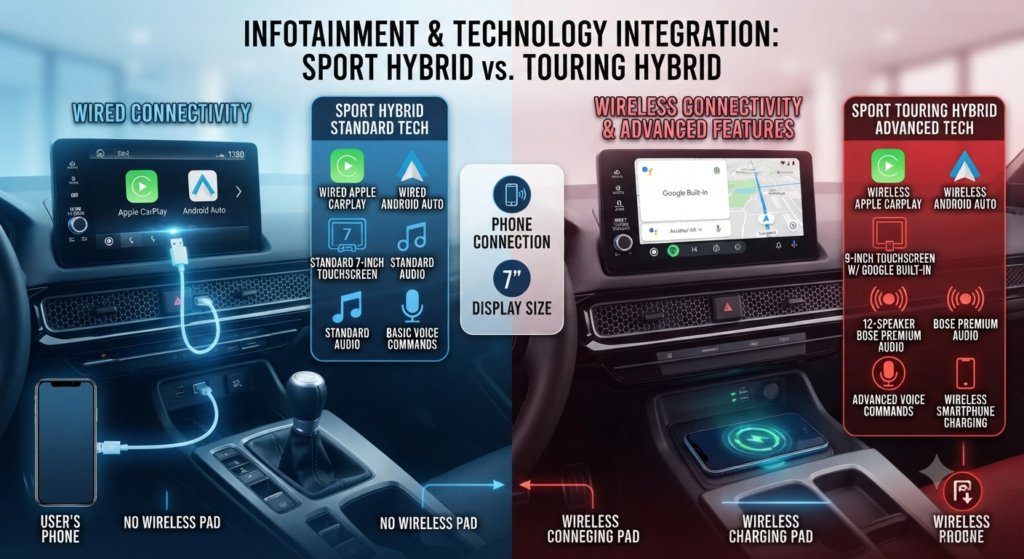
Modern drivers rely heavily on in-car technology, and this category highlights a major split between the two trims.
- Connectivity: The Sport Hybrid requires a physical USB cable plugged into the dash for smartphone navigation (wired Apple CarPlay/Android Auto). The Sport Touring Hybrid eliminates cable clutter completely by offering wireless capability along with a convenient wireless smartphone charging pad.
- Screen & Software: The top trim features a larger 9-inch touchscreen display and integrates Google Built-In, giving you direct access to Google Maps and Google Assistant right on the screen.
Audio Quality and Cabin Quietness
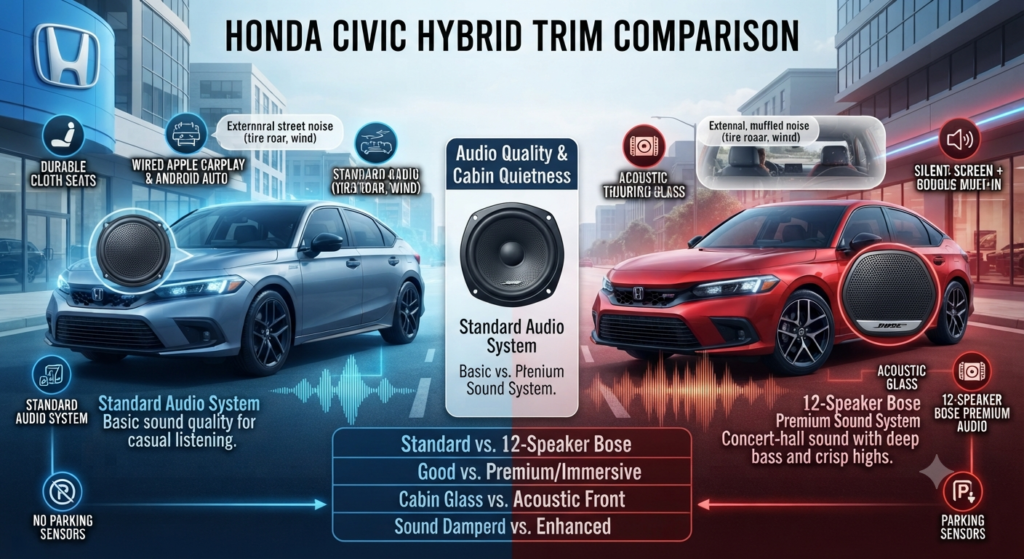
Music lovers and audiophiles will notice a stark contrast in how audio sounds between these two models.
- Sport Hybrid:
Utilizes a standard multi-speaker audio system that delivers clear sound for casual radio listeners and podcast fans. - Sport Touring Hybrid:
- Transforms the cabin into a concert hall by upgrading to a 12-speaker Bose Premium Sound System, delivering deep bass and crisp highs across all seating positions.
- Insulation:
Honda installs acoustic front door glass exclusively on the Sport Touring trim, alongside extra sound-dampening materials throughout the cabin to block out wind noise and tire roar during long road trips.
Safety and Driver Assistance Features
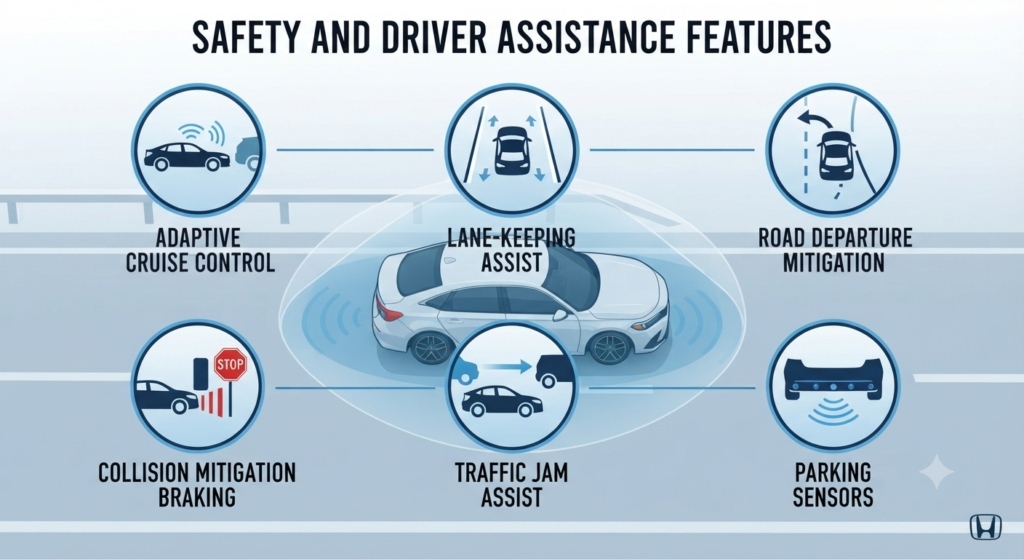
Safety remains a top priority for families and daily commuters. Both models come standard with the comprehensive Honda Sensing suite, which includes:
- Adaptive Cruise Control
- Lane-Keeping Assist
- Road Departure Mitigation
- Collision Mitigation Braking
The Difference:
The Sport Touring Hybrid adds parking sensors to the package, making it much easier to squeeze into tight urban parking garages by alerting you to unseen obstacles.
Quick Comparison Table
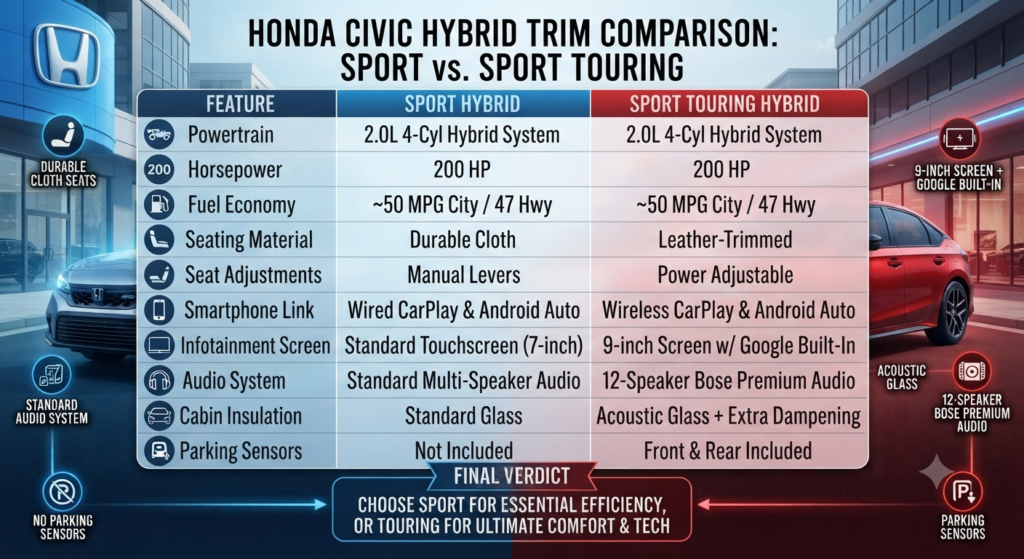
| Feature | Sport Hybrid | Sport Touring Hybrid |
| Engine & Power | 2.0L Hybrid (200 hp) | 2.0L Hybrid (200 hp) |
| Fuel Economy | ~50 City / 47 Hwy | ~50 City / 47 Hwy |
| Seating Material | Durable Cloth | Leather-Trimmed |
| Seat Adjustments | Manual Levers | Power Adjustable |
| Smartphone Link | Wired Connection | Wireless Connection |
| Infotainment Screen | Standard Touchscreen | 9-inch with Google Built-In |
| Audio System | Standard Audio | 12-Speaker Bose System |
| Cabin Insulation | Standard Glass | Acoustic Glass & Extra Dampening |
| Parking Sensors | Not Included | Included |
Final Verdict: Which Trim Should You Buy?
Choosing the right Honda Civic Hybrid comes down to your personal priorities, daily driving habits, and budget.
- Choose the Sport Hybrid if: Your primary goal is maximizing fuel efficiency while staying on a strict budget. It delivers the exact same 200-horsepower hybrid engine without forcing you to pay for luxury extras you might not need.
- Choose the Sport Touring Hybrid if: You spend hours behind the wheel every single day. The wireless phone integration, leather seating, upgraded Bose audio, and quieter cabin easily justify the higher price tag for commuters who value everyday convenience and comfort.