
Powertrain reliability, 2026 market data, and high-mileage FAQs
Powertrain Reliability
The 2015 Honda Civic earns its reputation as one of the most dependable compact cars of its generation, and the powertrain is the biggest reason why.
Most trims came with a 1.8 liter four cylinder engine, known internally as the R18. This engine is simple by design. It uses a timing chain instead of a belt, which means owners avoid a costly replacement interval that trips up many competitors. Regular oil changes are really the only thing this engine asks for.
Drivers who chose the Civic Si got a livelier 2.4 liter K24 engine paired with a six speed manual transmission. This setup has a strong track record in the used market. Its main quirk is a cold start rattle from the VTC actuator, which sounds alarming but rarely signals a serious problem when addressed early.
Transmission choice matters more than most buyers expect. The CVT found in LX, EX, and Hybrid trims is smooth around town and helps with fuel economy, but it can develop a shudder or hesitation under light acceleration. Honda issued a software update to address this, so any CVT equipped Civic should have that update confirmed in its service history.
The five speed manual and six speed manual transmissions age even better than the CVT. They require nothing beyond periodic fluid changes and tend to outlast the rest of the car when properly maintained.
What really defines the Civic’s powertrain story is consistency. Consumer surveys and independent shops both rank this generation near the top of the compact class for mechanical dependability. That reputation holds up even as these cars cross the 150,000 mile mark, provided the basics like oil, coolant, and transmission fluid were never neglected.
For a shopper comparing used compacts, the takeaway is simple. A Civic with clean maintenance records and no unresolved recalls is a powertrain you can trust for years of further service.
2026 Used Market Snapshot: Pricing, Reliability, and Maintenance Costs
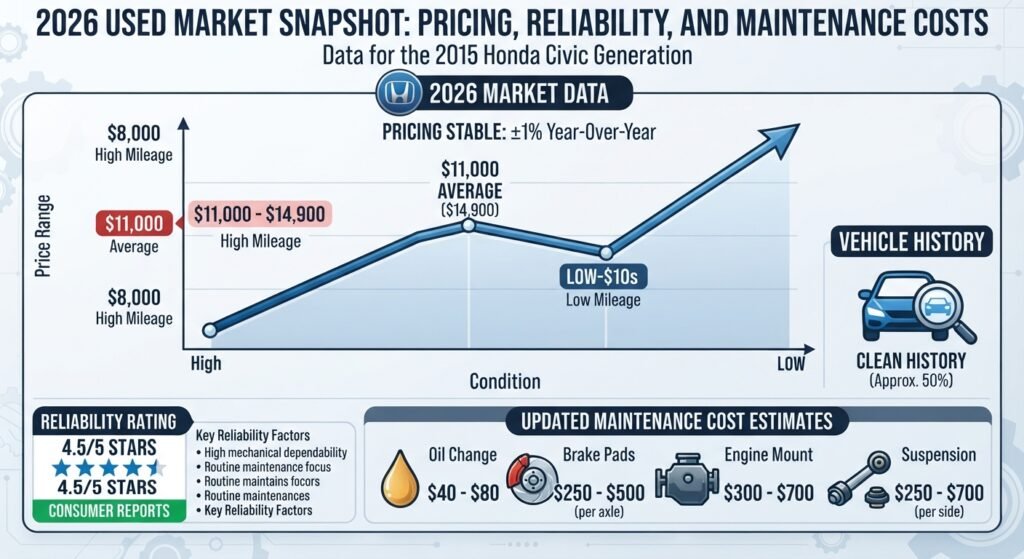
Heading into late 2026, the 2015 Civic remains one of the steadiest values in the used compact segment. Nationwide listings put the average asking price in the range of $11,000 to $14,900, with well documented, lower mileage examples reaching into the mid teens and higher mileage cars dipping under $8,000.
Pricing has held remarkably flat year over year. Multiple used car marketplaces report changes of roughly plus or minus one percent compared to the prior year, which signals a stable market rather than one still depreciating quickly. That stability is unusual for an 11 year old vehicle and reflects sustained demand from budget minded buyers.
Reliability scores remain strong as well. Consumer ratings from major marketplaces cluster around 4.5 to 4.8 out of 5, and independent reliability trackers place the 2015 Civic near the top of the compact car class. Roughly half of listed examples show a clean accident history, which is a healthy figure for a car this age.
Updated Maintenance Cost Estimates
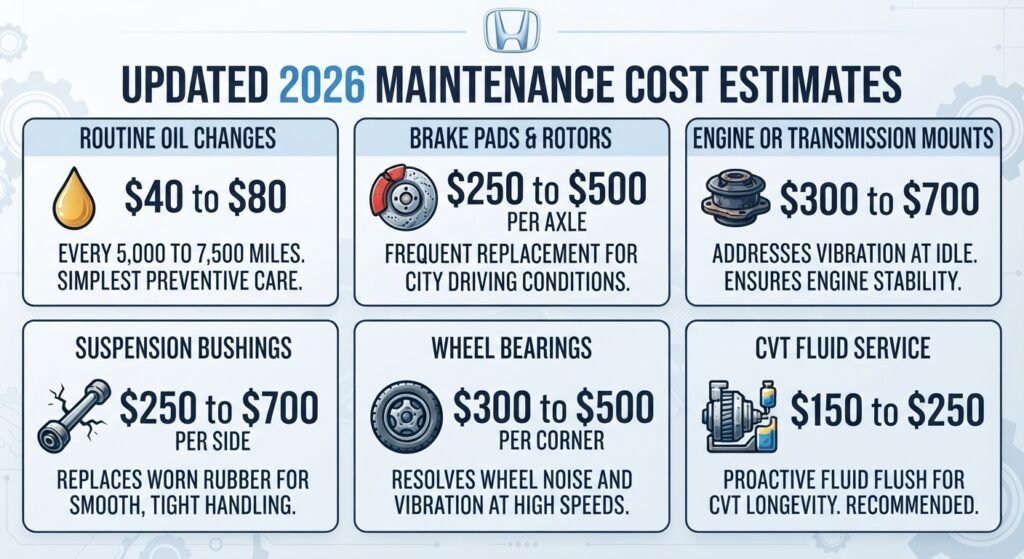
Owners budgeting for a high mileage 2015 Civic in 2026 should plan for the following typical ranges:
Routine oil changes: $40 to $80 every 5,000 to 7,500 miles.
Brake pads and rotors: $250 to $500 per axle, more frequent on cars used mainly for city driving.
Engine or transmission mounts: $300 to $700 depending on which mount is replaced.
Suspension bushings, particularly the front lower control arm compliance bushing: $250 to $700 per side once cracking begins.
Wheel bearings: $300 to $500 per corner when humming develops at speed.
CVT fluid service, for CVT equipped cars: $150 to $250, recommended proactively even though Honda’s official interval is long.
Common Long-Term Wear Patterns
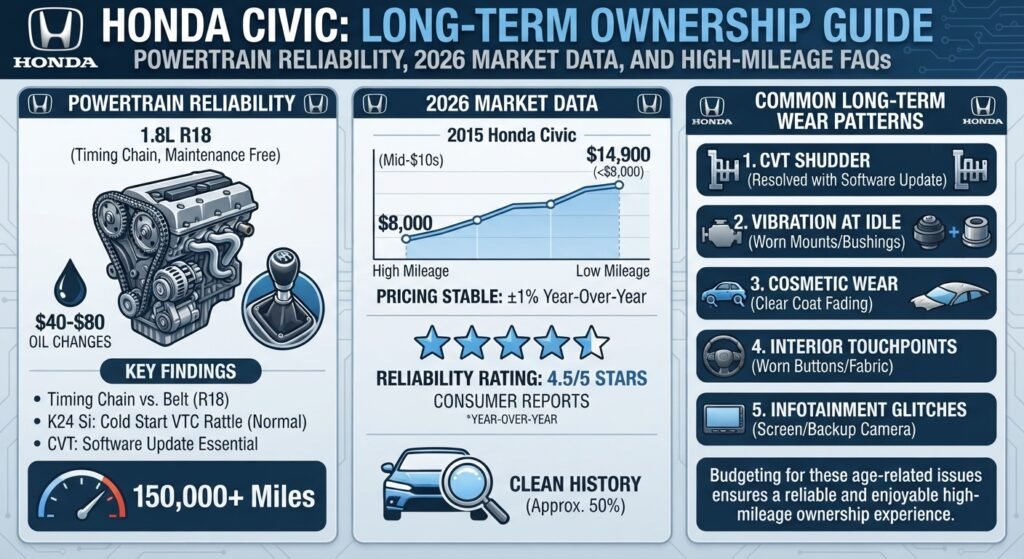
Two owner reported issues show up more than any others as these cars age. The first is CVT shudder, which is well documented and usually resolved with the software update mentioned earlier, or in persistent cases, a CVT fluid change.
The second is vibration at idle traced back to worn engine or transmission mounts and aging suspension bushings. Neither issue reflects a flaw in the core engine, and both are inexpensive compared to the drivetrain problems that plague many other cars at this mileage.
Buyers should also budget for normal wear items tied to age rather than mechanics: clear coat fading in sunny climates, worn interior touchpoints, and occasional touchscreen or backup camera glitches on infotainment equipped trims. None of these affect drivability, but they are worth factoring into a purchase decision.
High-Mileage FAQ: What Owners Are Really Searching For
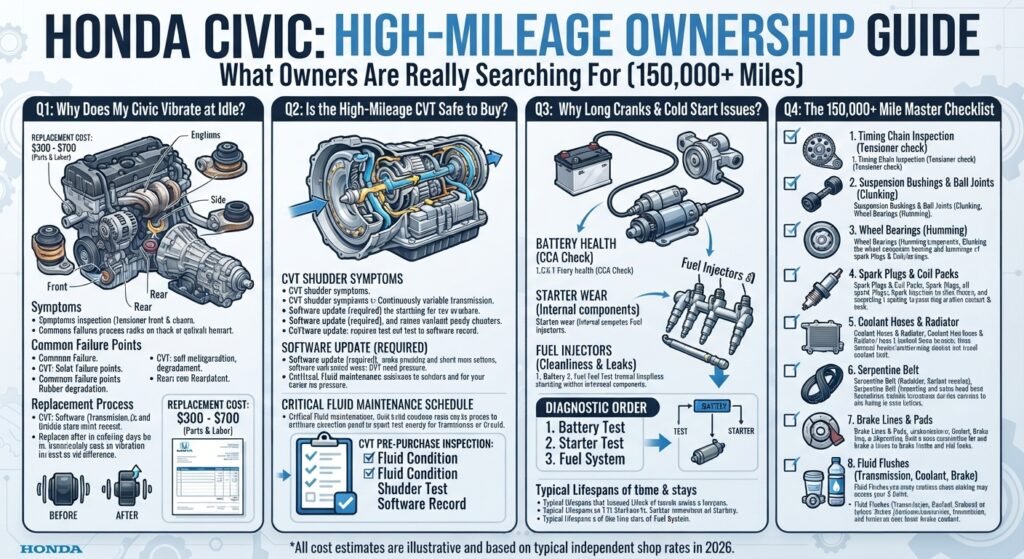
Why does my 2015 Civic vibrate or shake when idling?
Idle vibration is one of the most searched complaints for this generation, and it almost always traces back to engine or transmission mounts rather than the engine itself. The R18 and K24 engines are not prone to internal wear that causes shaking, but the rubber and hydraulic mounts holding them in place lose their cushioning over time, especially past 100,000 miles. A worn front or rear mount lets normal engine movement transmit straight into the cabin, the steering wheel, and the shifter. Mount replacement runs roughly $300 to $700 depending on location, and most owners describe the fix as transformative, making the car feel new again at idle.
How do I know if my starter is failing, and what does replacement cost?
Starter problems tend to sneak up gradually rather than happening all at once. Early warning signs include a slow or grinding crank, an intermittent clicking sound with no start, or the need to try the key two or three times before the engine catches. Heat is often the trigger, since a starter that struggles right after a hot drive but works fine once it cools down is a classic symptom of internal wear. On the 2015 Civic, starter replacement typically costs between $350 and $600 including labor, and most independent shops can complete the job in under two hours since access is straightforward on both the 1.8 liter and 2.4 liter engines.
Is the CVT in a high-mileage 2015 Civic safe to buy?
Yes, with a caveat. The CVT earned a reputation for shudder and hesitation during light throttle application, particularly in stop and go traffic. Honda addressed the core of this with a transmission control module software update, so any used example should have that update confirmed in its service history before purchase. Beyond that, CVTs generally reward proactive fluid changes even when the factory interval suggests otherwise. A Civic with documented CVT fluid services and no reported shudder after a thorough test drive is a safe bet even well past 100,000 miles.
Why does my Civic take longer to start on cold mornings at high mileage?
A longer crank time on cold mornings is usually one of three things: a weakening battery that has lost cold cranking amps with age, a starter beginning to wear, or slightly worn fuel injectors delivering a leaner initial spray. Because these three causes overlap in symptoms, the efficient diagnostic order is battery load test first, since it is the cheapest and most common culprit, followed by a visual and audio check on the starter, and only then a look at fuel delivery. Most cold start complaints on this generation resolve with nothing more than a new battery.
What should I check before buying a 2015 Civic with over 150,000 miles?
At this mileage, focus less on the engine and more on wear items that owners often defer. Ask for records confirming timing chain related service was never neglected, though the R18 rarely needs chain work itself. Inspect suspension bushings and mounts for the vibration and clunking issues covered above. Confirm any outstanding recalls, especially the Takata airbag inflator recall, have been completed. Finally, take a longer test drive than usual, ideally including a stretch of stop and go traffic, so any CVT shudder or idle vibration has a chance to reveal itself before you commit to a purchase.