
If you drive a Honda Civic, Accord, or CR-V made within the last decade, there’s a strong chance your car runs on Honda’s 1.5-liter turbocharged four-cylinder engine. It quickly became a favorite for Honda: it gives you great fuel economy without sacrificing punchy power, quietly replacing older, larger engines across their lineup.
But with that massive popularity came a wave of online chatter and owner complaints. If you’ve been searching terms like “Honda 1.5 turbo recall,” you’re likely trying to figure out if your car is hiding a ticking time bomb and what Honda is actually going to do about it.
The reality is a bit more complicated than a single, sweeping recall notice.
Some drivers are catching a distinct smell of raw gas inside the cabin. Others are pulling their dipsticks only to find the oil level mysteriously climbing. A smaller group is dealing with rough idles, sudden stalling, or random dashboard warning lights. These aren’t just internet runors they’re real issues that have caught the eye of mechanics, regulators, and Honda itself.
Let’s break down what’s really going on with the 1.5 turbo engine, what these different service notices actually mean, and what you should do if your car is acting up.
Recall vs. TSB vs. Extended Warranty: What’s the Difference?
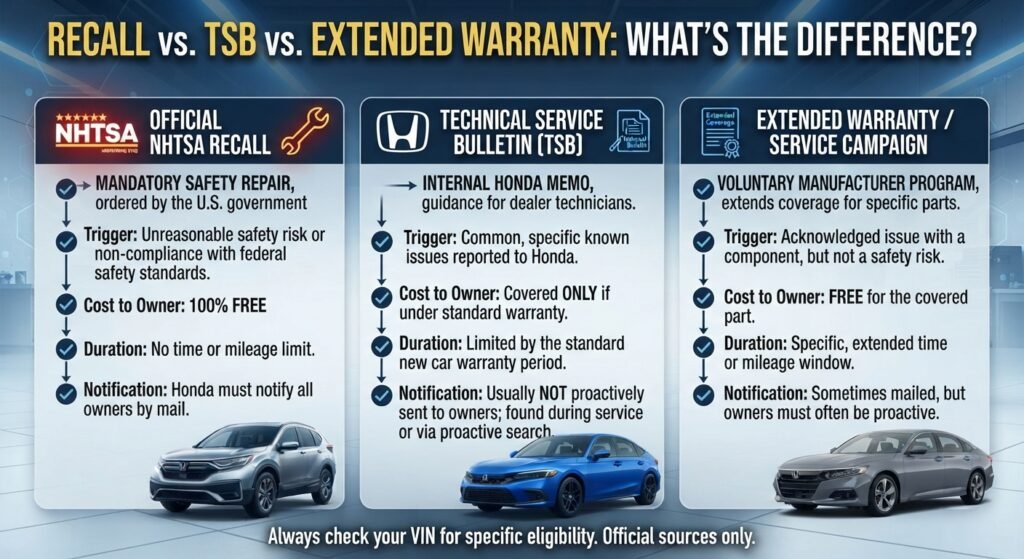
When car troubles hit, the legal terminology can feel like a foreign language. People throw around terms like “recall,” “TSB,” and “extended warranty” as if they mean the same thing, but they are entirely different beasts.
- What is an Official NHTSA Recall?
A formal recall only happens when the National Highway Traffic Safety Administration (NHTSA) decides a vehicle poses an unreasonable safety risk or fails federal safety standards. When this happens, Honda is legally required to notify every owner by mail and fix it for free, with no time or mileage limits. If it’s not in the public NHTSA database as a recall, legally speaking, it isn’t one no matter how widespread the forum complaints are. - What is a Technical Service Bulletin (TSB)?
A TSB is basically an internal memo from Honda to its dealerships. It says, “Hey, a lot of people are seeing this specific problem, and here is the exact way we want you to fix it.” It helps mechanics diagnose issues quickly, but it is not a recall. Unless your car is still covered under a standard warranty, a TSB doesn’t automatically mean you get a free repair. - What is an Extended Warranty / Service Campaign?
Sometimes, instead of a recall, a manufacturer quietly extends the warranty on a specific troubled part for a longer window. Honda has used this route for certain 1.5 turbo headaches. The catch? You usually have to be proactive, check your eligibility, and ask for the fix yourself.
Why hasn’t Honda issued a blanket recall?
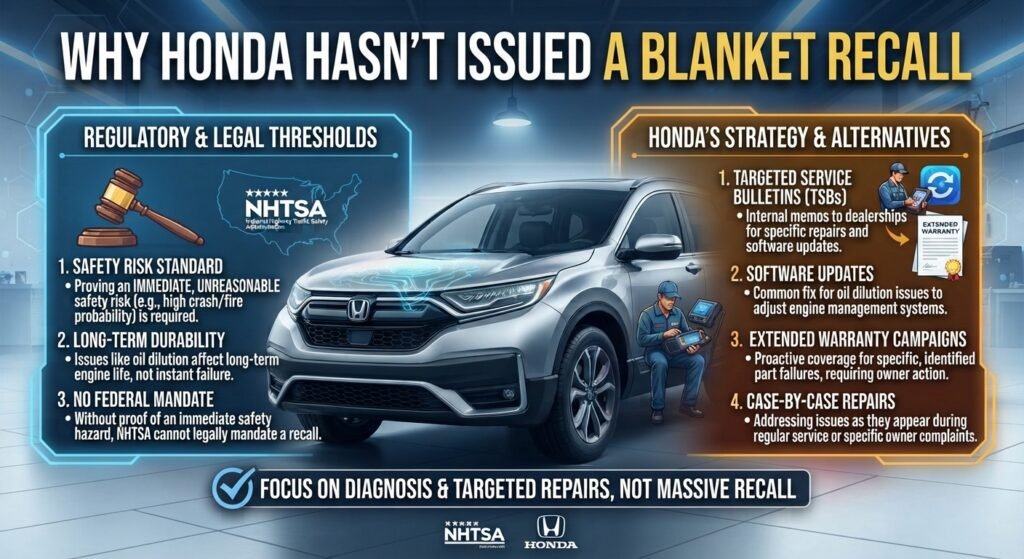
It feels frustrating when thousands of people complain about a problem and no massive recall is announced. However, regulators require proof of an immediate safety hazard (like a high crash or fire risk) before forcing a recall. Issues like oil dilution can hurt long-term engine life, but they don’t always create an instant safety crisis. That’s why Honda has mostly tackled these via software updates, TSBs, and extended coverage rather than a massive recall.
The Core Symptoms: What to Look Out for
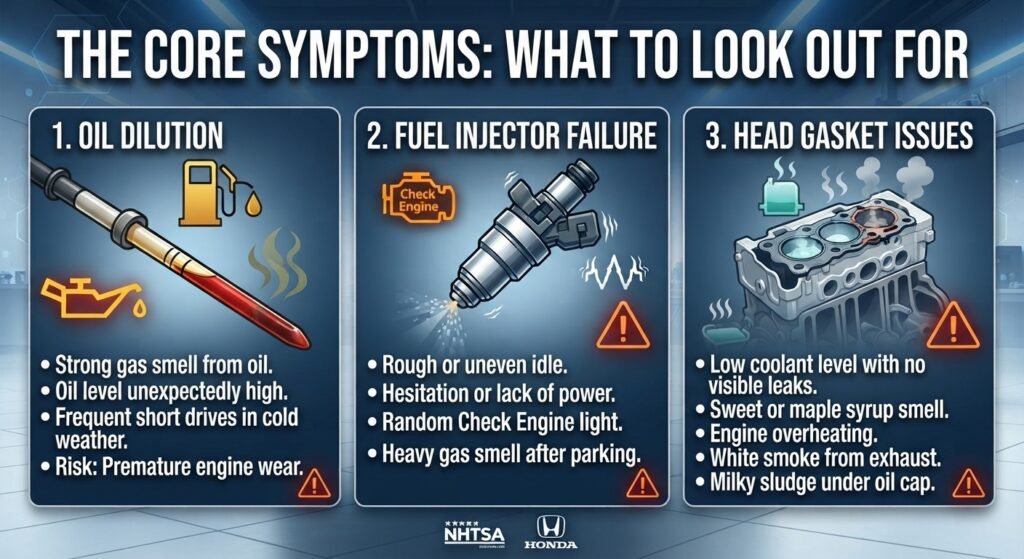
Drivers across Civic, Accord, and CR-V communities usually report a few very specific warning signs. Catching these early can save you a mountain of cash.
1. Oil Dilution
This is the most infamous issue tied to the 1.5 turbo. If you mostly drive short distances in freezing weather, unburned fuel can slip past the piston rings and mix straight into your engine oil.
- The signs: Your oil smells strongly of gas, or when you check the dipstick, the oil level is actually higher than normal.
- The danger: Thinned-out oil loses its ability to protect moving parts, which can lead to premature engine wear.
2. Fuel Injector Failure
Some owners run into failing fuel injectors, which mess up the air-fuel mix.
- The signs: A rough idle, hesitation when you step on the gas, a random check engine light, or a subtle vibration/shudder at stoplights. You might also catch a heavy gasoline smell in your garage after parking.
3. Head Gasket Issues
Though less common, a failing head gasket is the heavyweight champ of engine headaches.
- The signs:
Losing coolant with no obvious leaks on the driveway, a sweet smell under the hood, the engine running hotter than normal, white smoke from the exhaust, or a milky sludge under your oil cap. Left unchecked, this can easily destroy an engine.
What does it feel like day-to-day?
Usually, these problems don’t happen overnight with a dramatic explosion. It’s a slow creep: your car takes a second longer to start smoothly, the fuel economy dips for no obvious reason, or a faint fuel smell lingers. Pay attention to how your car sounds, smells, and drives—your gut feeling is usually right.
Which Models Are Affected?
Because Honda used this 1.5-liter turbo engine across a massive span of years and multiple vehicle types, sweeping assumptions won’t help. However, keep a close eye on these generations:
- Honda Civic: Turbo models starting from the 10th-generation redesign in the mid-2010s up through recent years (especially trims like the Sport, EX, and Touring).
- Honda Accord: 1.5L turbo variants found in trims like the LX, Sport, and EX (higher trims like the Sport 2.0T got a different, larger engine).
- Honda CR-V: This engine served as the core gasoline powerhouse for a massive run of CR-Vs across multiple trim levels.
The Fool proof Way to Check: Look Up Your VIN
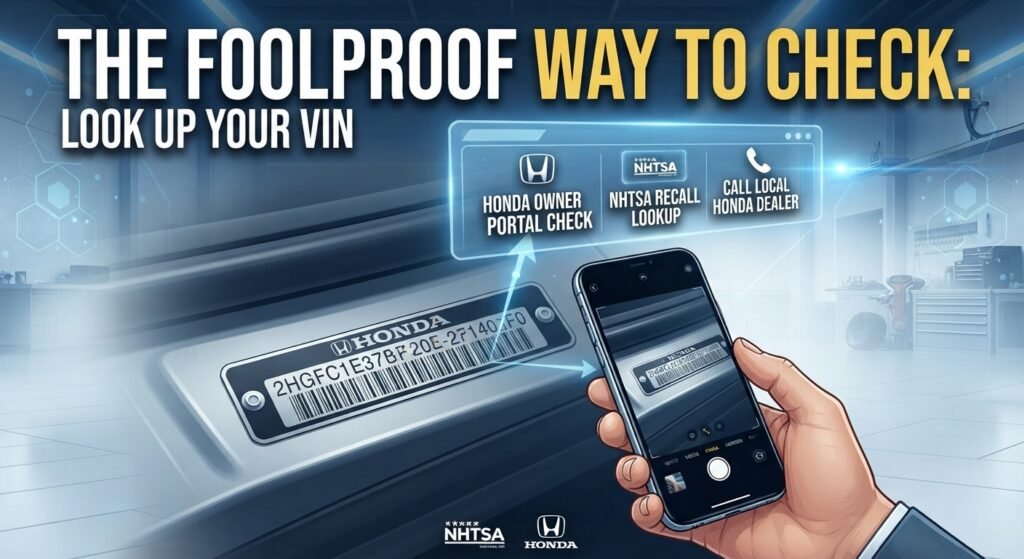
Don’t guess based on a blog post or forum thread. Grab your 17-digit Vehicle Identification Number (VIN) on your dashboard or insurance card and do this:
- Plug it into Honda’s official owner portal to check for open campaigns.
- Run it through the NHTSA recall lookup tool for independent federal records.
- Call your local Honda service department and ask them to check your VIN for any active extended coverages or secret service bulletins.
Your Game Plan: What to Do If You Suspect Trouble
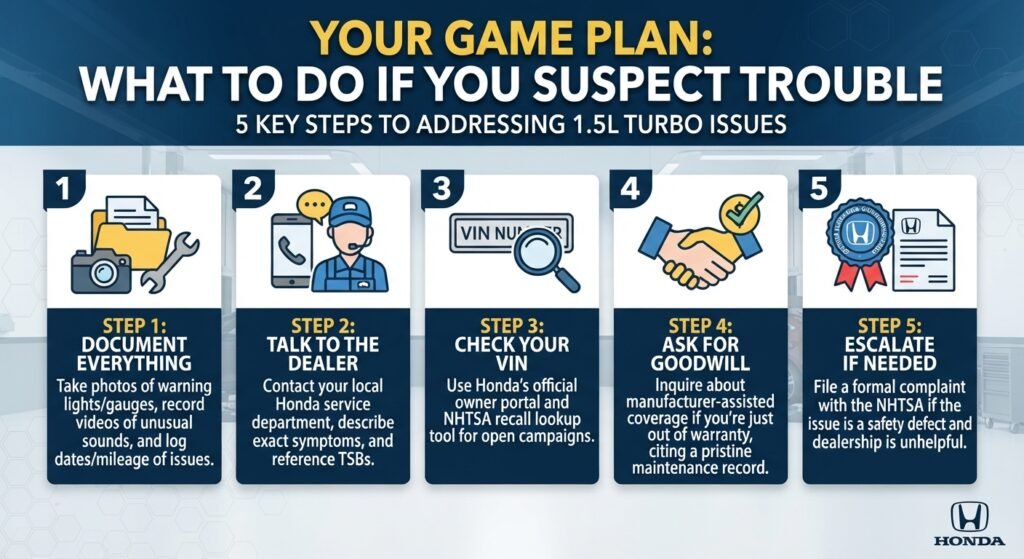
If your car is showing warning signs, don’t just sit on it. Follow these steps:
- Document everything:
Snap photos of warning lights, record a quick video if there’s a weird noise, and log dates and mileage when you notice fuel smells or rough idles. Keep every single oil change and maintenance receipt. - Talk to the dealer the right way:
When you call for service, don’t just ask for a “general inspection.” Describe the exact symptoms. Mention any TSB numbers you’ve found online so the advisor knows you’ve done your homework. Ask point-blank if your VIN is tied to any extended warranties or secret campaigns. - Ask for “Goodwill” help if you’re out of warranty:
If your factory warranty has expired but you’re dealing with a textbook manufacturing flaw, ask for a goodwill repair. It’s not guaranteed, but if you have a pristine maintenance history and politely ask to speak with the service manager, Honda sometimes covers part or all of the bill. - Escalate if needed:
If you truly believe your car has a dangerous safety defect and the dealership brushes you off, file a formal complaint with the NHTSA. It helps build a paper trail for future federal investigations.