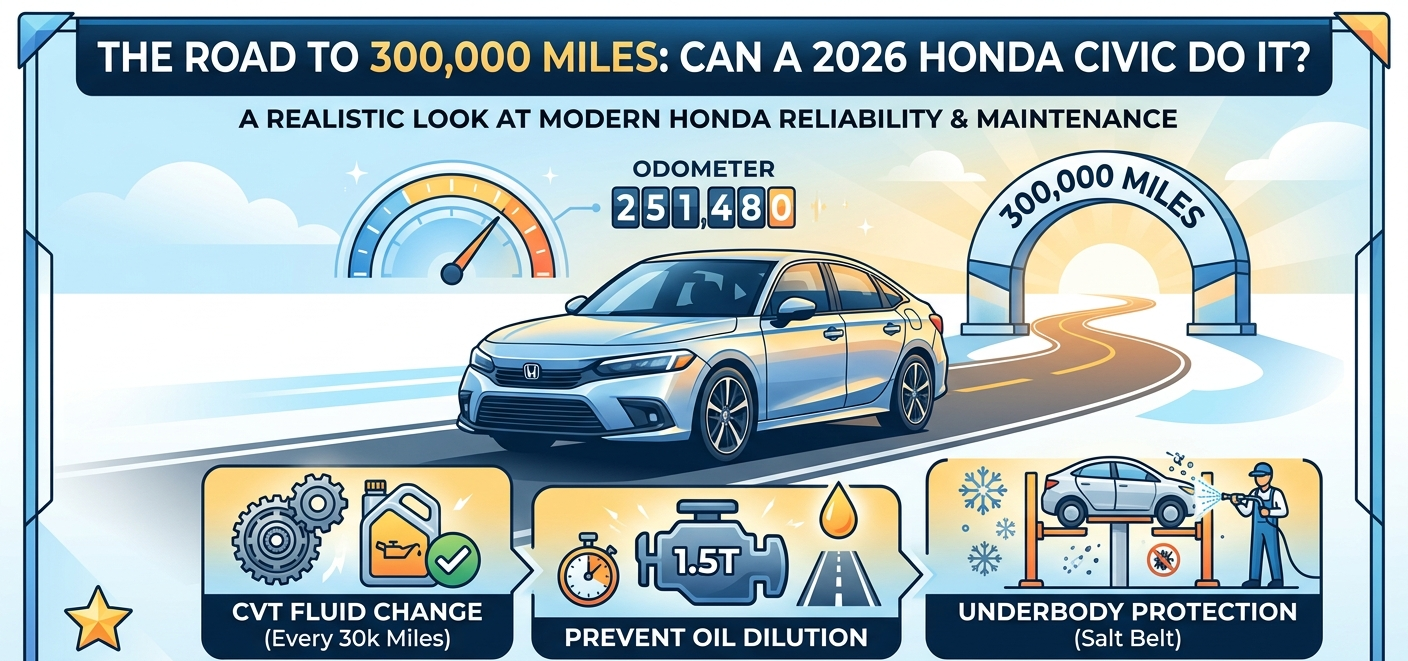
Everyone knows a guy with a 90s Civic still running on original parts. But does the 2026 Honda Civic still have that same bulletproof DNA? I recently spotted a 2017 Civic Sport listed at 280,000 miles asking $7,500, four pages of service records. It sold in 48 hours. That tells you something important.
The short answer: a modern Honda Civic will realistically last between 200,000 and 300,000 miles if you follow the maintenance minder. For the average US driver doing around 15,000 miles a year, that’s 13 to 20 years of ownership. The engine isn’t the problem. What kills these cars early is neglect, specific model-year gremlins, and a handful of mistakes that are completely avoidable once you know about them.
Reliability by the Numbers
Let’s start with the data because it actually backs up the reputation. J.D. Power’s 2026 Vehicle Dependability Study gave the Civic an 82 out of 100 landing it comfortably above the compact segment average of 74. That’s not marketing copy. That’s owner-reported problems per 100 vehicles after three years of real-world use.
82/100
J.D. Power 2026 dependability score (segment avg: 74)
2.3%
of Civics on US roads have passed 200k miles above segment average
200–300k
realistic lifespan with proper maintenance
iSeeCars’ longevity data confirms that 2.3% of Civics currently on US roads have already crossed 200,000 miles a figure that puts it in the top tier of the compact class. The segment average hovers around 1.4%. A well-kept Civic is roughly 60% more likely to hit that milestone than a comparable competitor.
As Civic owners, we want our cars to hit that 300k milestone without a $5k repair bill showing up at year 12. The numbers say it’s achievable. The devil, as always, is in the specific failure modes.
The ‘Missing’ Gaps — What No One Tells You
Here’s where we need to be honest. The Civic’s reputation was built on the 7th and 8th gen (2001–2011) platforms. Those cars had a naturally aspirated 1.8L R18 that was genuinely unkillable. The modern Civic is different — more refined, more capable, and slightly more fragile in specific ways.
Sticky Steering: 2022–2024 Models
The 11th gen (2022–2024) saw a pattern of sticky, notchy steering complaints tied to the electric power steering rack. NHTSA opened a preliminary investigation in 2023 covering these model years after receiving complaints about binding at low speeds — particularly during parking maneuvers. Honda issued a software calibration update in late 2023, but mechanical wear in affected racks is an unresolved concern for high-mileage examples.
Salt Belt Frame Decay
If you live in Ohio, Michigan, New York, Pennsylvania, or Minnesota — road salt is actively attacking your Civic’s subframe and rear trailing arm brackets right now. We’ve seen 10th gen Civics (2016–2021) with under 100,000 miles requiring $2,000+ in rust remediation. The engine runs fine. The frame rots. Annual undercoating isn’t optional in these states — it’s maintenance.
Hybrid Battery Reality: 2025–2026 Models
The e:HEV powertrain is impressive and the fuel economy is real. But that battery pack carries a replacement cost of $3,000 to $5,000 when accessed outside the 8-year/100,000-mile federal warranty. At year 11 or 12, you could be facing a repair bill that nearly matches the car’s market value. Honda’s battery longevity has been solid so far — but it’s a cost non-hybrid owners never face.
One more issue the 10th gen (2016–2021) 1.5L turbo had documented oil dilution. In cold climates, short trips don’t allow the engine to fully warm up, meaning raw fuel washes past the piston rings and into the crankcase. You end up with oil that smells like gasoline and loses its viscosity. It won’t show a check engine light. Your engine is just running on compromised lubrication for weeks at a time.
The 300k Maintenance Formula
There’s no magic to it. The Civics that hit 300,000 miles aren’t running on luck — they’re running on a consistent maintenance schedule that most owners skip.
CVT Fluid Change Every 30,000 Miles. Honda’s maintenance minder often pushes this out past 50k or doesn’t flag it at all under “normal” use. Don’t trust it. The CVT in the 10th and 11th gen Civic is reliable but heat-sensitive. Old, degraded fluid accelerates belt wear. A fluid change costs $100–$150 at a shop. A CVT rebuild runs $3,000–$4,500. This is the single highest-ROI maintenance item on the modern Civic.
Fix Oil Dilution With Driving Habits. If you own a 1.5L turbo model and commute less than 10 miles each way, take one longer highway drive per week 20+ minutes at full operating temperature. This burns off fuel contamination in the oil. Also, shorten your oil change interval to every 5,000 miles in cold weather rather than waiting for the minder. This one habit alone separates the 250k engines from the ones that knock at 140k.
Beyond those two: keep up with spark plugs at 60k (don’t run them to 100k on a turbo), change brake fluid every 3 years regardless of miles, and inspect CVT cooler lines on 10th gen cars hey’re known to weep at high mileage.
Verdict: Is It Still the Best Long-Term Investment in 2026?
Yes but with conditions. The 2026 Honda Civic remains one of the strongest long-term value propositions in the compact segment, and the data supports that. A well-maintained example will outlast most of its competition. But “well-maintained” means something more specific with the modern Civic than it did with the 8th gen.
To hit 250,000+ miles, don’t make these three mistakes:
1
Skipping CVT fluid changes past 30k miles
The minder won’t always catch this. Set your own reminder. This is the most expensive preventable failure on the platform and the most ignored.
2
Running a 1.5T on short winter trips without longer drives
Fuel dilutes the oil silently. By the time there’s a symptom, the damage is done. A 20-minute highway run once a week fixes this entirely.
3
Ignoring the underbody in Salt Belt states
The engine will outlast the frame without protection. Annual undercoating and a pressure wash of the undercarriage before winter ends is non-negotiable.
The 2026 Civic isn’t the indestructible box that the 90s Civic was. It’s more sophisticated, more refined, and — in the right owner’s hands — just as capable of a 300,000-mile lifespan. The car will do its part. The question is whether we do ours.
RevCivic publishes independent research on Honda Civic ownership, maintenance, and long-term value. No affiliate relationships with dealers or repair shops.