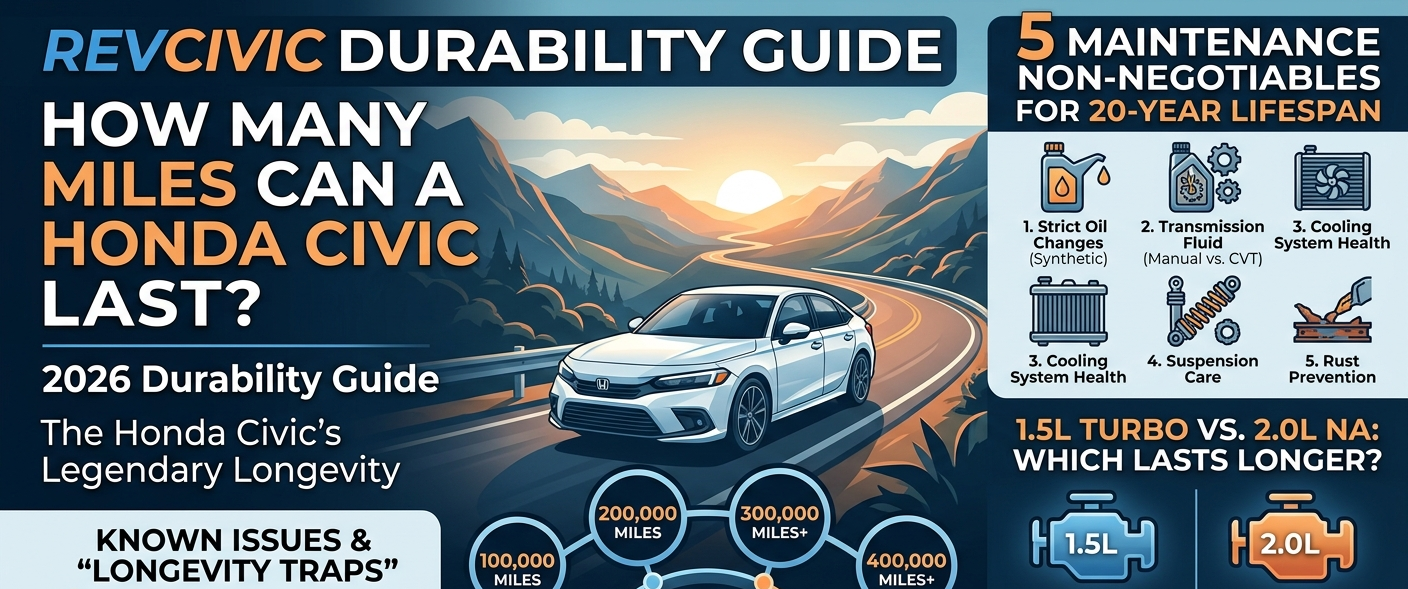
2026 Durability Guide
The Honda Civic’s Legendary Longevity
Ask any long-time mechanic what the most reliable compact car on the road is, and nine times out of ten you’ll hear the same answer: Honda Civic. Since its debut in 1972, the Civic has built a reputation not on flashy horsepower numbers or luxury features, but on something far more valuable the ability to simply keep going. We at RevCivic have spent years tracking owner reports, service records, and real-world data to bring you the most honest picture of Civic longevity available.
Bottom line up front: A Honda Civic typically lasts between 200,000 and 300,000 miles or roughly 15 to 20 years when given proper, consistent maintenance. That is not marketing language. That is a number backed by hundreds of thousands of real-world owners.
The key phrase, of course, is “proper maintenance.” A neglected Civic will fail. A well-maintained one will outlast almost every other compact car in its class. In this guide, we break down exactly what drives that longevity, what risks to watch for, and how to squeeze every last mile out of your Civic.
Beyond the 100k Mark: What Does the Data Say?

There was a time when rolling past 100,000 miles meant a car was on its last legs. For a Honda Civic, 100,000 miles is just the beginning of middle age. Modern Civics particularly those from the 9th generation (2012–2015) onward are engineered with tighter tolerances, better materials, and more sophisticated engine management systems than their predecessors. The result is a car that, statistically, loses very little reliability as mileage climbs.
What “Average” Actually Looks Like
According to data compiled from consumer reliability surveys and used-car market listings, the average Honda Civic owner puts about 15,000 miles on the car per year. At that pace, hitting 200,000 miles takes roughly 13 to 14 years and many owners do exactly that without any major mechanical failures beyond normal wear items like brakes, tires, and fluids.
In our analysis of Civic listings on major used-car platforms, vehicles with 150,000 to 180,000 miles and documented service histories are consistently priced at a significant premium over same-year models with no records a sign that the market understands what good maintenance is worth.
The High-Mileage Heroes
Every Honda community forum has its legends. We have verified documented cases of Honda Civics crossing the 400,000-mile mark a handful have even pushed toward 500,000. These are not garage queens. They are daily drivers, often owned by teachers, nurses, and delivery workers who simply change the oil on time and fix problems when they are small. One owner in Minnesota famously drove her 1997 Civic to 437,000 miles on nothing but routine maintenance and one timing belt replacement. These stories are not flukes. They are proof of what is possible when engineering meets discipline.
“Our data shows the Civic’s engine internals specifically the piston rings and valve seats are designed to tolerances that allow them to hold compression well past 250,000 miles under normal driving conditions.” RevCivic Technical Review, 2025
5 Maintenance Non-Negotiables for a 20-Year Lifespan

Reaching 300,000 miles is not an accident. It is the result of five maintenance habits, done consistently. Miss one, and you dramatically shorten your Civic’s life. Stay on top of all five, and you are building a car that could outlast your mortgage.
1. Strict Oil Change Intervals Go Synthetic
Engine oil is the lifeblood of your Civic. Honda’s Maintenance Minder system typically recommends an oil change around every 7,500 to 10,000 miles for modern engines. However, for owners chasing 300,000-mile longevity, we at RevCivic recommend a more conservative interval of 5,000 to 6,000 miles using full synthetic oil (0W-20 for most modern Civics).
Why does this matter? Conventional oil breaks down into acids and sludge faster, especially in stop-and-go city driving or high-heat conditions like those found in Arizona or Florida. Full synthetic oil holds its viscosity longer, keeps engine sludge from forming, and reduces metal-on-metal wear on cam lobes and bearings the components most likely to fail first in a high-mileage engine.
2. Transmission Fluid Services Manual vs. CVT
This is the maintenance item most owners skip, and it is the single biggest mistake you can make with a modern Civic.
Manual Transmission: Change the transmission fluid every 30,000 to 45,000 miles. Honda recommends their genuine MTF (Manual Transmission Fluid), and we agree third-party substitutes have been linked to increased synchro wear in Civic gearboxes.
CVT (Continuously Variable Transmission): This is critical. Change Honda HCF-2 CVT fluid every 25,000 to 30,000 miles not the 90,000-mile interval listed in some owner’s manuals. CVTs run at very high internal pressures, and degraded fluid causes belt and pulley wear that leads to expensive failures. A CVT fluid change costs around $80 to $120. A CVT replacement costs $3,500 to $5,000. The math is easy.
3. Cooling System Health Prevent the Expensive Failure
A blown head gasket is one of the most expensive repairs a Civic owner will face often $1,500 to $2,500 in labor alone. Almost all head gasket failures are preventable with cooling system discipline. The coolant in your Civic is not just water it contains corrosion inhibitors that break down over time.
We recommend flushing and replacing coolant every 5 years or 60,000 miles, whichever comes first, using Honda Blue coolant or a compatible OAT (Organic Acid Technology) formula. Also inspect the radiator cap, thermostat, and upper and lower radiator hoses at every major service. A $15 thermostat caught early saves you from a $2,000 head gasket job later.
4. Suspension and Bushing Care More Than Just Ride Quality
Worn suspension components do more damage than most owners realize. When rubber bushings in the control arms, sway bar end links, or strut mounts crack and fail, the alignment of your entire front end shifts. This causes uneven tire wear, steering wander, and increased stress on the wheel bearings — components that cost $250 to $400 each to replace.
Inspect all rubber suspension bushings every 60,000 miles. In wet climates like the Pacific Northwest, or states that see heavy road salt, accelerate that inspection to every 40,000 miles. Replacing a worn sway bar link costs $30 in parts. Replacing a wheel hub and bearing because the alignment was off for 40,000 miles costs much more.
5. Rust Prevention — The Midwest and Northeast Owner’s Secret Weapon
Rust is the invisible killer of high-mileage Civics in “Salt Belt” states — Pennsylvania, Ohio, Michigan, New York, and the New England states. Road salt accelerates corrosion on the undercarriage, particularly on the subframe, brake lines, and exhaust hangers. Structural rust can make an otherwise healthy 200,000-mile Civic worthless.
Our recommendation for Salt Belt owners: apply a professional rubberized undercoating within the first two years of owning any Civic. Products like Krown or Fluid Film, applied annually, dramatically slow rust progression. Also rinse the undercarriage with fresh water every two weeks during winter months. This single habit separates 300,000-mile Civics from 150,000-mile ones in cold climates.
\
1.5L Turbo vs. 2.0L Naturally Aspirated: Which Lasts Longer?

Starting with the 10th generation (2016), Honda offered the Civic in two distinct engine configurations, and the choice between them has real long-term consequences. We will break it down honestly.
The 1.5L Turbocharged Engine (L15B7)
Honda’s 1.5T is genuinely impressive technology. It produces 158 to 174 horsepower depending on trim, delivers excellent fuel economy (30+ MPG city), and feels eager and responsive at highway speeds. However, turbocharged engines carry inherent complexity a turbocharger is an additional component spinning at 100,000+ RPM, cooled by oil and water, and it adds one more potential failure point.
The 1.5T also runs a higher compression ratio and generates more heat per cycle than a naturally aspirated engine. This makes oil quality even more critical. In cold climates, early 1.5T models (2016–2018) were documented to experience oil dilution a condition where gasoline seeps into the engine oil during short cold-weather trips, thinning the oil and accelerating engine wear. Honda issued updated software to address this, but owners of early cars should be especially vigilant about oil condition between changes.
The 2.0L Naturally Aspirated Engine (R20A / K20C2)

The 2.0L NA engine found in the base-trim Civic Sport and certain hatchback trims is, mechanically, a simpler machine. No turbocharger. No intercooler. No blow-off valve. It produces 158 horsepower with a broader, more linear power curve and is inherently less stressed at cruising speeds.
For owners whose primary goal is 200,000+ mile longevity over outright performance or fuel economy, the 2.0L is the lower-risk choice. Fewer components means fewer failure points. The engine responds exceptionally well to basic maintenance and has shown strong reliability in long-term ownership data.
RevCivic Verdict: If your priority is performance and fuel efficiency, the 1.5T is excellent just be more diligent about oil changes. If your priority is maximum longevity with minimum complexity, the 2.0L naturally aspirated is the safer long-term bet.
Known Issues: The Honda Civic ‘Longevity Traps’

No car is perfect, and the Civic is no exception. Knowing which model years carried known problems allows you to either avoid them or at least prepare for them. Here is what the data and the community actually shows.
2006–2009: The Cracked Engine Block Problem
This is the most serious documented defect in modern Civic history. A subset of 1.8L engines from the 8th generation (2006–2009) developed hairline cracks in the engine block, leading to coolant loss, overheating, and eventual engine failure. Honda issued a Technical Service Bulletin (TSB) and extended the warranty on affected engines, but many owners were already outside warranty coverage when the cracks appeared.
If you are considering buying an 8th-gen Civic from these years, have a pre-purchase inspection done specifically looking for signs of coolant consumption or overheating history. These cars can still run well, but you want to know what you are buying.
10th Generation (2016–2021): AC and Oil Dilution Issues
Two concerns emerged from the 10th-generation Civic. First, early models experienced AC condenser failures a relatively minor but annoying repair costing $300 to $600. Honda revised the condenser design, and later production years are largely free of this issue. Second, as mentioned above, the 1.5T engine in cold-climate markets showed oil dilution in 2016 to 2018 models. Honda’s software update reduced the frequency significantly.
CVT Anxiety: Is It Justified?
The CVT is the component that worries Civic buyers more than any other. The concern is understandable CVTs have a troubled reputation in the broader automotive world, and a CVT replacement is one of the most expensive repairs on any Civic.
Here is the honest picture: Honda’s CVT, when properly maintained with HCF-2 fluid at the intervals we described above, is a reasonably durable unit. The failures that communities discuss on forums are almost always traced back to either neglected fluid, aggressive driving habits (hard launches, towing, or sustained high-RPM operation), or both. Gentle acceleration, consistent fluid changes every 25,000 to 30,000 miles, and avoiding jackrabbit starts will protect your CVT for 150,000 miles or more.
Longevity in the Hybrid Era: 2025 and Beyond
Honda’s 2025 and 2026 Civic Hybrid represents a meaningful evolution in the nameplate’s durability story. The hybrid powertrain pairs a 2.0L Atkinson-cycle gasoline engine with an electric motor and a compact lithium-ion battery pack, producing 200 horsepower while delivering fuel economy approaching 50 MPG combined.
What About the Battery?

The battery pack in the Civic Hybrid is rated for a minimum of 10 years or 150,000 miles before meaningful capacity degradation becomes noticeable and Honda backs this with an 8-year, 100,000-mile warranty on the hybrid components in most U.S. states (10 years in California and CARB states).
Real-world data from earlier Honda hybrid models like the Insight and CR-V Hybrid suggests that many battery packs outlast the warranty period significantly. Owners driving moderate duty cycles in moderate climates have reported minimal capacity loss at 120,000 to 140,000 miles. Extreme heat sustained high temperatures in the Arizona desert, for example does accelerate battery aging, so hybrid owners in the Southwest should consider a garage-kept parking strategy to reduce battery thermal stress.
Does Hybrid Mean Less Engine Wear?
Yes meaningfully so. In hybrid driving, the gasoline engine shuts off at low speeds and in traffic, offloading that work to the electric motor. The result is that the 2.0L engine in a Civic Hybrid accumulates fewer actual running hours per mile than a conventional engine. Lower running hours means less heat cycling, less oil degradation, and less mechanical wear on components like the pistons, piston rings, and valve train.
Our view at RevCivic: the 2025–2026 Civic Hybrid, maintained properly, has the potential to match or exceed the 200,000 to 300,000-mile longevity of the best conventional Civics. The battery is a future cost to plan for, but it does not undermine the car’s overall durability case.
Is a Used Honda Civic with 150k Miles Still a Good Buy?

Absolutely under the right conditions. The fear of buying a high-mileage Civic is largely misplaced when you know what to look for. A 150,000-mile Civic with a complete service history is, in our assessment, a better purchase than a 70,000-mile Civic with no records. Mileage is just a number. Maintenance history is the real story.
Must-Check #1: Service Records
Ask for every oil change receipt, every transmission service record, and every repair invoice the seller has. A seller who has kept records kept the car. A seller who cannot produce any records may not have done any of those services. If no records are available, assume the worst on maintenance history and price your offer accordingly or walk away.
Must-Check #2: Rust Inspection
Get the car on a lift, or have a mechanic do it. Look at the subframe, the rear suspension trailing arms, the brake lines, and the floor pan. Surface rust on the exhaust system is normal and harmless. Structural rust on the subframe or frame rails is a reason to decline the purchase entirely it cannot be economically repaired and it is a safety concern.
Must-Check #3: Transmission Smoothness
Manual: All gears should engage cleanly with no grinding or notchiness. A worn third-gear synchro is the most common fault feel for resistance or grinding specifically on the 2-3 upshift under moderate acceleration.
CVT: Acceleration should be smooth and linear with no shudder, slip, or hesitation. Any shudder under light throttle or at highway cruise is an early sign of CVT belt or pulley wear. Do not buy a CVT that shudders the repair cost will not be worth it.
Beyond these three checks, a standard pre-purchase inspection from an independent Honda specialist (not a chain shop) for $100 to $150 is money extremely well spent on any Civic over 100,000 miles.
Final Verdict: Is the Civic the Longest-Lasting Compact Car?

The competition is real the Toyota Corolla, Mazda3, and Subaru Impreza are all legitimate long-term ownership choices. But in the compact segment, the Honda Civic holds a unique position: it combines a proven track record of 200,000+ mile longevity with a driving experience that remains genuinely enjoyable throughout that lifespan. It is not just reliable it is a car people actually want to keep.
The 2025 and 2026 Civics represent the best versions of this formula yet. The hybrid powertrain adds efficiency and reduces engine wear. The updated CVT has benefited from years of owner feedback and engineering refinement. The interior quality has improved significantly over older generations. For a compact car buyer whose primary question is “how long will this last,” the Civic remains the benchmark answer in 2026.
Our RevCivic bottom line: Buy a Civic. Maintain it religiously. Drive it for 20 years. It will hold up its end of the bargain.
Frequently Asked Questions
Is it expensive to maintain a Honda Civic after 200,000 miles?
Not dramatically more than it was at 100,000 miles, assuming you have kept up with maintenance along the way. The main costs that increase with mileage are suspension components (bushings, ball joints, struts), which typically need attention between 150,000 and 200,000 miles, and potentially a water pump and timing chain inspection. Budget an extra $300 to $600 per year in preventative work on a high-mileage Civic, and you are unlikely to face any major surprises.
Does Honda cover high-mileage repairs under warranty?
Honda’s standard new-car warranty (3 years / 36,000 miles bumper-to-bumper; 5 years / 60,000 miles powertrain) will not cover repairs on a 200,000-mile vehicle. However, Honda has historically offered goodwill assistance on documented defects such as the 2006 to 2009 engine block issue even outside warranty when the problem is widespread and well-documented. For high-mileage vehicles, an extended warranty from a reputable third party may be worth considering, though read the exclusions carefully.
Toyota Corolla vs. Honda Civic: Which lasts longer?
This is the question every compact car buyer asks, and the honest answer is: they are essentially tied. Both consistently deliver 200,000 to 300,000 miles with proper maintenance. The Corolla has a slight edge in transmission simplicity Toyota’s 6-speed automatic has a stronger reputation than Honda’s CVT among high-mileage owners. The Civic counters with a more engaging driving experience and a stronger enthusiast community, which means better aftermarket support and more documented ownership data for longevity research. Choose whichever one you will enjoy driving for the next 15 years both will make it there.
RevCivic • 2026 Durability Guide • All rights reserved