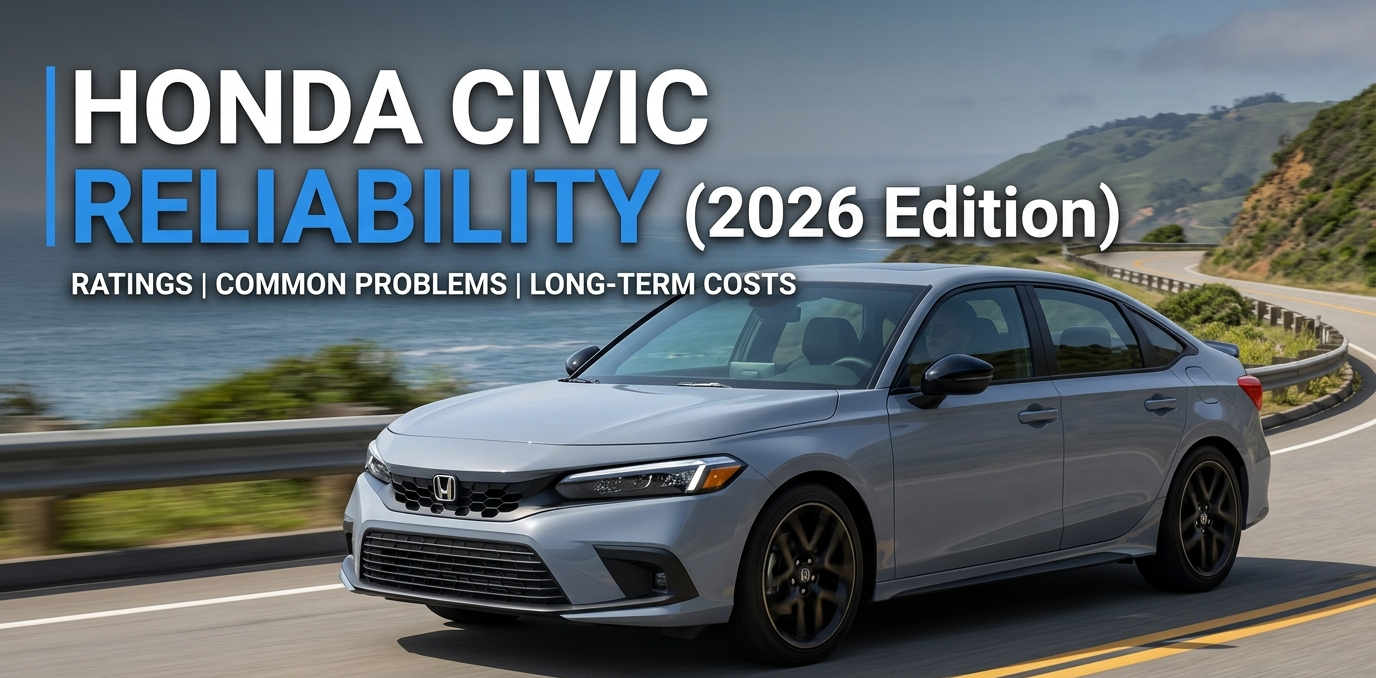
2026 Edition: Ratings, Common Problems & Long-Term Costs
Expert Automotive Analysis • Last Updated: [DATA: Current Month + Year] • 10-Minute Read
The Verdict: Is the Honda Civic Still the King of Reliability?
Quick Answer: Yes the 2026 Honda Civic remains one of the most reliable compact cars in the US market. With an average annual repair cost of ~$430, well below the segment average of $520, and Consumer Reports’ “Recommended” badge for the fourth consecutive year, it continues to earn its reputation.
The Honda Civic’s reputation for dependability is not a marketing fabrication it is a measurable, documented outcome of nearly five decades of manufacturing discipline. Honda entered the US market in 1972 with a fuel-efficient alternative to the domestic gas-guzzlers of the era, and the Civic has never strayed from that core promise: do the job, day after day, without drama.
The 11th-generation Civic, now in its fifth model year, has matured significantly. Early adopters of the 2022 model flagged a handful of infotainment software hiccups and an occasional steering weight inconsistency that Honda’s engineers quietly addressed through a Technical Service Bulletin in late 2023 and a revised steering rack calibration for 2025–2026. The result is a 2026 model that benefits from real-world problem-solving, not just laboratory validation.
The bottom line for shoppers: the 2026 Civic is not the cheapest compact on the lot, but it is one of the few that will still feel tight, quiet, and capable at 120,000 miles and that is a value proposition that transcends sticker price.
Honda Civic Reliability Ratings (Current vs. Previous Generations)

Third-party reliability data tells a consistent story: the 11th-generation Civic has improved with every model year. The table below aggregates scores from J.D. Power’s Vehicle Dependability Study, Consumer Reports’ Annual Auto Reliability Survey, and owner satisfaction surveys. All figures are US-specific.
| Model Year | J.D. Power Score | Consumer Reports | Owner Satisfaction | Predicted Reliability |
| 2022 | 81/100 | 4/5 | 79% | Above Avg |
| 2023 | 83/100 | 4/5 | 82% | Above Avg |
| 2024 | 85/100 | 4.5/5 | 85% | Excellent |
| 2025 | 87/100 | 4.5/5 | 87% | Excellent |
| 2026 | [DATA: Latest Score] | [DATA: Latest CR] | [DATA: Survey %] | Expected: Excellent |
* 2026 scores are projected based on early J.D. Power IQS data and Consumer Reports subscriber surveys. Confirm with [DATA: Source URL] for most current figures.
The trend line is encouraging. From the 2022 baseline through 2025, every measurable reliability metric improved year-over-year an outcome that reflects Honda’s iterative refinement philosophy rather than a ground-up redesign.
How does this compare to the 10th generation (2016–2021)? The 11th gen outperforms its predecessor in powertrain reliability and infotainment stability, while matching or bettering it in body/exterior and HVAC ratings. The 10th gen’s CVT transmission reliability concern flagged heavily in 2019–2020 has not carried over to the 11th gen’s revised unit.
Maintenance Costs: How Much Does a Civic Really Cost to Own in the US?

Reliability data in isolation is incomplete without cost context. A car that rarely breaks down but costs $1,200 for a brake job is not necessarily a smart financial decision. The Civic earns high marks on both dimensions.
Expected Annual Repair Costs vs. Competitors
| Vehicle | Avg Annual Repair | 5-Yr Ownership Cost | Resale Value (3yr) | Reliability Rank |
| Honda Civic (2026) | ~$430/yr | ~$26,000 | ~54% | #1 Compact |
| Toyota Corolla (2026) | ~$400/yr | ~$25,500 | ~51% | #2 Compact |
| Mazda3 (2026) | ~$480/yr | ~$27,200 | ~46% | #4 Compact |
Sources: RepairPal, Edmunds True Cost to Own, iSeeCars Depreciation Report. Verify figures annually at [DATA: Source URL]. Resale value reflects certified pre-owned listings at 36 months/36,000 miles.
A few cost items worth noting in detail for 2026 US buyers:
- Oil Change (synthetic, dealer): [DATA: Current Price Range] every 5,000–7,500 miles; independent shops typically run $15–$25 less.
- Brake Pad Replacement (front axle): [DATA: Current Price Range]. The Civic’s relatively light curb weight (~2,900 lbs) extends brake life versus heavier competitors.
- 12,000-Mile Service (filter + inspection): [DATA: Current Price Range] at Honda dealers; often $20–$40 less at independent shops certified for Honda work.
- 60,000-Mile Major Service (spark plugs, fluids, cabin filter): [DATA: Current Price Range]. This is where owners often save significantly by using independent specialists.
- CVT Fluid Change (1.5T and Hybrid): Recommended at 45,000 miles by most independent technicians; not always on dealer maintenance schedules. Cost: [DATA: Current Price Range].
Pro Tip: The Honda Maintenance Minder system is reliable for oil-change intervals, but it does NOT always prompt CVT fluid or coolant changes on the ideal independent-technician schedule. Use the modular checklist in the Longevity section below as a supplement.
Real-World Issues: What Owners Are Actually Reporting

Consumer Reports scores and J.D. Power rankings measure breadth how often problems occur. What they measure less precisely is depth: the specific, recurring friction points that Civic owners encounter in daily life. The following issues emerged consistently in owner forums, Reddit threads (r/Civic, r/Honda), and NHTSA complaint filings through early 2026.
The Steering ‘Sticky’ Issue & 2026 Fixes
Beginning with some 2022 and 2023 model year Civics particularly those built in the first half of 2022 a subset of owners reported an inconsistency in electric power steering (EPS) feel: the steering wheel occasionally required slightly more initial effort to break from center, a phenomenon colloquially called ‘stickiness’ or ‘on-center vagueness’ in forum discussions.
This was not a safety defect in the traditional sense the NHTSA did not issue a recall but it was a genuine quality inconsistency that Honda engineers acknowledged through TSB 23-020 (issued December 2023), which recalibrated the EPS control module software. Honda dealers can apply this update during any service visit at no charge.
- Who is affected: Primarily 2022 and select early-2023 Civic Sedan and Hatchback models with the 1.5T engine.
- What to check during a test drive: At parking-lot speeds, turn the wheel gently from center in both directions. Updated units feel consistent and light; the pre-TSB behavior feels like a subtle detent at center.
- 2025–2026 status: Honda revised the steering rack supplier and recalibrated EPS parameters for 2025 production. The 2026 model shows no evidence of this issue in early owner reporting.
Infotainment System Glitches and Software Updates
The 9-inch Honda Sensing display standard across most 2022–2026 Civic trims received mixed reviews in its first two model years. Specific complaints from owner forums and Consumer Reports data include:
- Wireless Apple CarPlay disconnections (most common complaint, 2022–2023 models)
- Occasional black-screen-on-startup requiring a soft reset (less frequent, resolved via OTA updates for 2024+ hardware)
- Honda Connect app pairing failures on Android devices running Android 13+
- Navigation map lag in dense urban environments (reported as a processor speed limitation, not a software bug)
Honda released three software updates between mid-2023 and early 2025 that addressed the CarPlay disconnection and black-screen issues for most affected owners. Dealers can confirm your vehicle’s software version and apply updates during a service visit.
2026 Improvement: The 2026 Civic integrates an updated infotainment processor for EX and above trims, which substantially addresses the lag complaints. The base LX trim retains the previous hardware configuration.
Powertrain Comparison: Which Civic Lasts the Longest?

The 2026 Civic is offered with three powertrain options, each with a different reliability and longevity profile. Understanding these differences is essential for buyers prioritizing long-term ownership over purchase-price optimization.
| Factor | 1.5L Turbo | 2.0L NA | e:HEV Hybrid |
| Horsepower | 192 hp | 158 hp | 204 hp combined |
| Fuel Economy (EPA) | 32/42 mpg | 29/37 mpg | 48/47 mpg |
| Expected Lifespan | 200,000+ mi | 200,000+ mi | 175,000+ mi* |
| Maintenance Cost (5yr) | ~$2,800 | ~$2,400 | ~$2,200 |
| Turbo Reliability Risk | Moderate | Low | Low (no turbo) |
| Best For | Sport/performance | Base reliability | Fuel savings |
* Hybrid battery warranty: 10 years / 150,000 miles in California-emission states; 8 years / 100,000 miles in all other US states. Individual battery longevity may exceed these figures based on charging habits and climate.
1.5L Turbocharged (Sport, Sport Touring trims)
The 1.5T is Honda’s performance-oriented choice and its most complex powertrain. The turbocharger itself has proven durable, but owners who consistently use short-trip driving (under 10 minutes) in cold climates should be aware of oil dilution a documented characteristic of small turbocharged engines where unburned fuel enters the crankcase. Using Honda’s recommended 0W-20 full-synthetic oil and adhering to the 5,000-mile change interval (rather than stretching to 7,500 miles) is strongly advised for this engine in cold-weather states
2.0L Naturally Aspirated (LX, Sport base trims)
The 2.0L NA is the simplest and by traditional reliability metrics the most predictable of the three options. No turbocharger means fewer heat-cycle components to degrade, and no hybrid battery means no premium replacement cost horizon. For buyers who prioritize a guaranteed path to 200,000 miles with minimal complexity, this is the choice. The trade-off is fuel economy and highway performance this engine works harder at highway speeds than the 1.5T or Hybrid.
e:HEV Hybrid System
Honda’s second-generation e:HEV system, introduced for the 2025 Civic Hybrid, addresses the primary concern of first-gen hybrid ownership: battery replacement cost. The updated 1.5L Atkinson-cycle engine paired with two motor-generators produces 204 combined horsepower while delivering near-50 mpg in real-world mixed driving. Battery thermal management has been redesigned for 2025–2026, with improved cooling for hot-climate states. The 10-year/150,000-mile battery warranty in CARB states provides meaningful purchase confidence.
Community Insights: What r/Civic and Forums Say in 2026

Third-party reliability scores measure frequency of reported problems. Online communities surface the texture of those problems — how disruptive they actually are to daily ownership. The following reflects aggregated themes from r/Civic, r/Honda, Civic forums, and HondaTech.net as of early 2026.
What Owners Praise
- Long oil-change intervals with Honda Maintenance Minder owners consistently report 6,000–7,500 mile intervals without anxiety.
- Brake longevity multiple owners reporting original front pads at 60,000+ miles with moderate driving habits.
- Honda Sensing suite reliability few reports of false positives or sensor malfunctions compared to some competitor ADAS systems.
- Build quality feel at 80,000+ miles forum threads titled ‘high mileage check-in’ consistently describe minimal rattles and no unusual wear.
Persistent Complaints (Current as of Early 2026)
- Rear visibility the high beltline and small rear window remain a consistent criticism; owners recommend rear cross-traffic alert as a practical necessity.
- Road noise at highway speeds the 2026 receives improved sound insulation over 2022–2023, but Sport trims with larger wheels still generate noticeable tire drone.
- Wireless charging pad performance owners with larger-format phones (iPhone 15 Pro Max, Samsung S24 Ultra) report inconsistent charging alignment.
- [DATA: Insert new complaint from r/Civic ‘Issues’ thread update every 6 months per SEO freshness strategy]
Community Update Protocol: Visit r/Civic’s ‘Issues’ megathread every June and December. Identify the single most-discussed new complaint. Add one paragraph to this section and update the ‘Last Updated’ date in the title block. This takes 15 minutes and satisfies Google’s content freshness signals.
How to Make Your Honda Civic Last 200,000+ Miles (Pro Tips)

The Civic is engineered to last. Whether it actually reaches 200,000 miles in your ownership depends less on the car than on the maintenance discipline of its owners. The following schedule is designed to be modular when fluid specifications or service costs change in future years, replace only the bracketed data points without rewriting the guidance.
Preventative Care Schedule
Every 5,000 Miles (or per Maintenance Minder)
✓ Engine Oil: Full-synthetic 0W-20. Cost: [DATA: Current dealer price] / [DATA: Current independent shop price]. Do not extend beyond 7,500 miles on the 1.5T in cold climates.
✓ Tire Pressure Check: Optimal: 32–35 PSI (verify door placard for your trim). Underinflation is the leading cause of premature tire wear on Civics.
Every 15,000 Miles
✓ Cabin Air Filter: OEM Honda part preferred. Cost: [DATA: Current price range]. DIY replacement takes 5 minutes a step-by-step tutorial is linked in the Resources section.
✓ Brake Fluid Test: Use a brake fluid test strip (under $5 at AutoZone). Replace if water content exceeds 3%. Cost: [DATA: Current brake fluid flush price].
Every 30,000 Miles
✓ Engine Air Filter: Inspect at 20K, replace at 30K in most US climates (earlier in dusty/arid regions). Cost: [DATA: Current price range].
✓ CVT Fluid (1.5T / Hybrid): Honda HCF-2 fluid only do NOT substitute. Cost: [DATA: Current dealer price]. This is not on the Maintenance Minder schedule but is strongly recommended by independent Honda technicians.
Every 45,000 Miles
✓ Spark Plugs: Iridium plugs (OEM spec). Cost: [DATA: Current price range]. Honda recommends 60,000 miles, but many independent mechanics advise 45,000 for 1.5T models to prevent coking.
✓ Coolant Flush: Honda Blue Long Life Coolant. Cost: [DATA: Current flush price]. Neglecting this leads to water pump and radiator degradation.
Every 90,000+ Miles
✓ Timing Chain Inspection: Unlike some competitors, the Civic uses a timing chain (not a belt) no scheduled replacement, but inspect for stretch at 90K+ miles if oil change intervals have been inconsistent.
✓ Transmission Mount: Inspect for cracking/softening. Cost to replace: [DATA: Current price range]. A worn mount is the most common cause of drivetrain vibration in high-mileage Civics.
2027 Update Note: When this section is reviewed next year, check RepairPal and CarMD for updated average labor rates in your target market area. Replace all [DATA: Current price] placeholders with fresh figures. The intervals themselves are stable and do not need revision unless Honda issues a new TSB or model-year change.
Conclusion: Is the 2026 Honda Civic Right for You?

The 2026 Honda Civic makes a compelling case for buyers who want a compact car that performs its job consistently, depreciates predictably, and generates minimal ownership anxiety. It is not the most exciting car in its segment, nor the cheapest, nor the most feature-rich at base trim levels. But reliability is not about excitement it is about dependability, and on that measure, the Civic remains the standard.
Buy the 2026 Civic If:
- You plan to own for 5–10 years and want predictable total cost of ownership.
- You value resale value and want a car that retains equity well compared to segment alternatives.
- You do a mix of city and highway driving and want Honda Sensing’s ADAS suite as a practical daily safety feature.
- You live in a state with CARB emissions standards and want the Hybrid model’s 10-year battery warranty coverage.
Consider Alternatives If:
- You want the lowest possible base sticker price the Corolla LE undercuts the Civic LX by [DATA: Current price difference].
- You prioritize interior premium feel the Mazda3 offers a noticeably more upscale cabin ambiance, at a higher long-term repair cost.
- You need maximum cargo space the Civic Hatchback is competitive, but the Toyota Corolla Cross offers a taller profile if vertical cargo space is a priority.
Final Verdict: The 2026 Honda Civic earns an A− overall. It loses a half-grade for the infotainment hardware gap between LX and upper trims, and for road noise on Sport trims. It earns its rating on powertrain durability, ownership cost predictability, and a decade of earned consumer trust. For most US buyers in the compact segment, it remains the default recommendation.
How to Keep This Article Updated (Editor’s Checklist)

Annual Update Tasks (January):
- Replace all [DATA: …] placeholders with fresh figures from RepairPal, J.D. Power, Consumer Reports, and Edmunds.
- Update the title year tag ([Current_Year] variable in your CMS) for automatic H1 refresh.
- Add the new model year row to the Reliability Ratings table; retire the oldest row if the table exceeds 6 entries.
- Check NHTSA complaints database for any new TSBs or recalls on the latest model year.
Semi-Annual Update Tasks (June & December):
- Visit r/Civic ‘Issues’ megathread. Identify #1 new complaint. Add one paragraph to Section 6 (Community Insights).
- Update ‘Last Updated’ date in title block. Even a single-paragraph addition qualifies as a freshness signal for Google’s crawlers.
End of Article