Updated April 2026 — For US Readers ~1,100 words
SECTION 1 INDEPENDENCE & OWNERSHIP
Who Owns Honda? The Current Ownership Structure in 2026
Let’s put a persistent myth to rest before we go any further: Honda is not owned by Toyota. It is not a subsidiary of General Motors. It is not a division of some larger Japanese conglomerate quietly pulling strings from a boardroom in Nagoya. Honda Motor Co., Ltd. is one of the few remaining fully independent automakers on the planet and that independence is not incidental to its identity. It is the identity.
Honda Motor Co., Ltd. trades publicly under ticker “7267” on the Tokyo Stock Exchange and “HMC” on the New York Stock Exchange. No single corporation controls it. No rival automaker holds a decisive stake. What you find when you look at the shareholder registry is a familiar roster of large institutional investors the same names you’d see at the top of any major global equity.
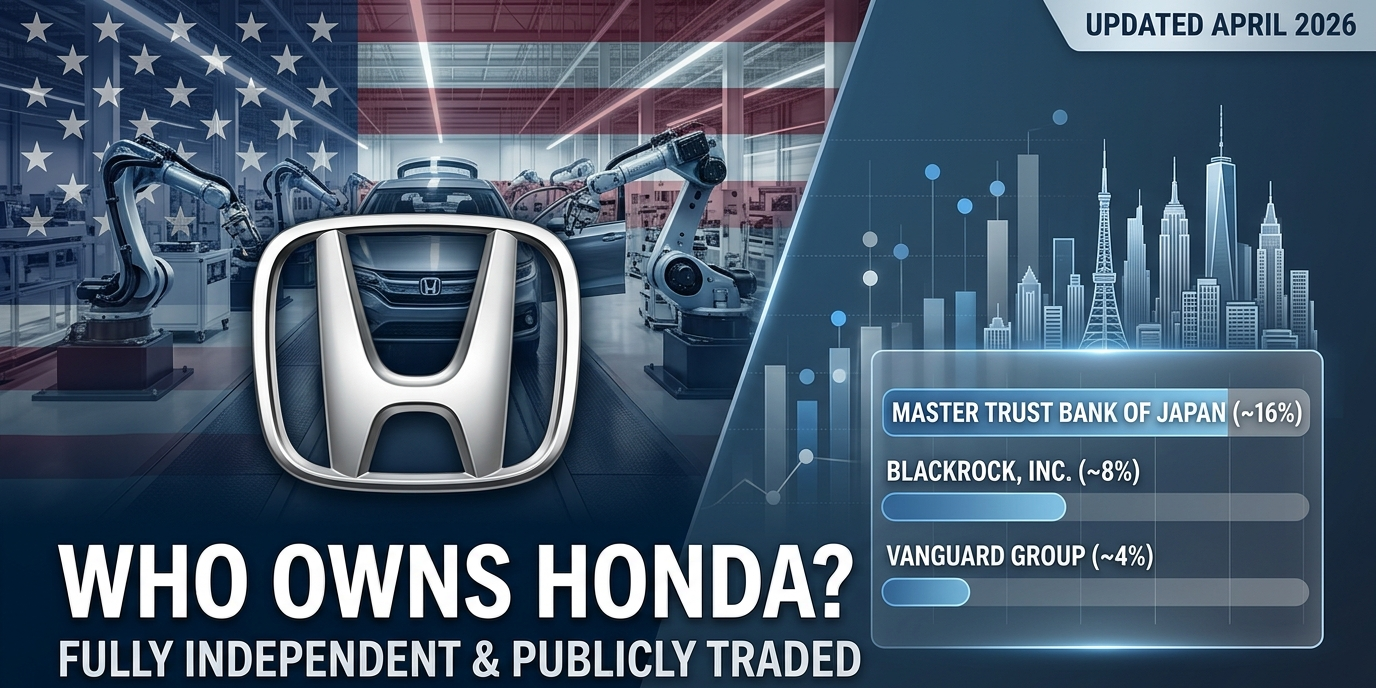
For 2026, the three largest institutional positions break down as follows:
| SHAREHOLDER | TYPE | STAKE | RELATIVE SHARE |
|---|---|---|---|
| Master Trust Bank of Japan | Custodian / Trust | ~16% | ████████████████████████████████████████████████████████████████████████████████████████████████████████████████████████████████████████████████████████████████████████████████████████████████████████████████████████████████████████████████████████████████████████████████████████████████████████████████████████████████████████████████████████████████████████████████████████████████████████████████████████████████████████████████████████████████████████████████████████████████████████████████████████████████████████████████████████████████████████████████████████████████████████████████████████████████████████████████████████████████ |
| BlackRock, Inc. | Asset Manager (US) | ~8% | ████████████████████████████████████████████████████████████████████████████████████████████████████████████████████████████████████████████████████████████████████████████████████████████████████████████████████████████████████████████████████████████████████████████████████████████████████████████████████████████████ |
| Vanguard Group | Asset Manager (US) | ~4% | ████████████████████████████████████████████████████████████████████████████████████████████████████████████████████████████████████████████████████████████████ |
The Master Trust Bank of Japan’s large position is typical for Japanese blue-chips much of it reflects pension fund and cross-shareholding custodial arrangements, not activist ownership. The presence of BlackRock and Vanguard reflects Honda’s deep integration into global index funds. Nobody controls Honda. That’s the point.
| This structural independence has direct engineering consequences. Unlike automakers absorbed into alliances where platform-sharing mandates and corporate politics constrain R&D decisions Honda engineers work within a company that answers to the market, not a parent. The result: motorcycle engines that win MotoGP titles, VTEC technology developed decades before competitors caught up, and a hydrogen fuel-cell program that refuses to abandon a thesis the rest of the industry periodically dismisses. |
SECTION 2 — SUBSIDIARIES & DIVISIONS
Is Acura a Separate Company? & The Sony-Honda Future
Acura is not a separate company. It is Honda’s luxury and performance division, created in 1986 specifically for the North American market the first Japanese premium automotive brand to launch in the US. Acura vehicles are designed, engineered, and manufactured within Honda’s global operations. There is no separate Acura Motor Co. filing with the SEC, no independent board, and no distinction at the corporate-structure level.
The Sony-Honda story is more complicated and significantly more turbulent as of early 2026.
Sony Honda Mobility Inc. (SHM) was established in 2022 as a 50/50 joint venture between Sony Group Corporation and Honda. The premise was compelling: Sony’s software, AI, sensor technology, and entertainment IP fused with Honda’s manufacturing precision and US dealer infrastructure. The resulting brand, Afeela, was set to deliver its first model the Afeela 1, a mid-size electric liftback starting at $89,900 to California customers in 2026.
Trial production runs had already been completed at Honda’s East Liberty Auto Plant in Ohio. Studios opened in Beverly Hills, Century City, San Diego, and San Jose. More than 100,000 visitors walked through demo events within the first year of reservations. Then, on March 25, 2026, SHM announced it was cancelling both the Afeela 1 and its planned SUV successor.
The reason cited: Honda’s reassessment of its EV electrification strategy, announced March 12, 2026, meant that certain technologies and assets originally committed to SHM by Honda would no longer be available. For American consumers tracking the EV space, this is a significant inflection point the most high-profile EV launch cancellation of 2026 so far, and a signal that even well-resourced partnerships cannot insulate themselves from strategic pivots in a volatile market.
SECTION 3 US MANUFACTURING FOOTPRINT
Is Honda an American Brand? Manufacturing and Economic Footprint
The question of whether Honda is an “American brand” is a good one, and the answer is more nuanced than the “Japanese automaker” label implies. Honda’s parent company is headquartered in Minato, Tokyo. Its CEO, Toshihiro Mibe, is Japanese. Its shares primarily trade in Tokyo. By any legal definition, Honda Motor Co., Ltd. is a Japanese corporation.
But the cars that American families drive are, in the majority, built by American workers on American soil.
Honda’s Marysville, Ohio plant opened in 1982, making it the first Japanese automaker’s production facility on US soil remains the cornerstone of this domestic footprint. It is joined by the East Liberty Auto Plant in Ohio, additional operations in Lincoln, Alabama (producing the Odyssey, Passport, and Ridgeline), and engine manufacturing in Anna, Ohio. Indiana contributes to Honda’s powertrain output.
Honda calls this philosophy “local-to-local” the idea that vehicles sold in a market should, wherever feasible, be made in that market. For American buyers concerned about the economic provenance of their purchase, that principle matters. The Accord you drive off the lot in Columbus likely rolled off a line in Marysville. The reliability reputation Honda has built with American families is not borrowed from Japan it was earned in Ohio.
SECTION 4 — FACT CHECK & FAQ
Common Myths: Who Honda Is NOT Owned By
The following questions represent the most common misconceptions searched by American consumers. Each answer is structured for clarity and optimized for direct, snippet-ready responses.
MYTH: Is Honda owned by Toyota?
FALSE Honda and Toyota are entirely separate, competing publicly-traded corporations. Honda trades as HMC on the NYSE and 7267 on the Tokyo Stock Exchange. Toyota holds zero ownership stake in Honda. The two companies compete directly across virtually every vehicle segment.
MYTH: Is Honda a Chinese-owned company?
FALSE Honda Motor Co., Ltd. is a Japanese corporation. Honda does operate joint ventures in China for the Chinese domestic market a standard practice for automakers but no Chinese entity owns or controls Honda. Joint venture operations in a foreign market do not constitute foreign ownership of the parent company.
MYTH: Does the Honda family still own the company?
FALSE Soichiro Honda, the founder, passed away in 1991. His family has not held a controlling stake in Honda Motor Co. for decades. Honda is a publicly-traded corporation with diffuse institutional ownership. No founding-family bloc controls the company’s direction.
FACT: Who is the current CEO of Honda?
ANSWER Toshihiro Mibe is the President and CEO of Honda Motor Co., Ltd., serving since April 2021. For American Honda Motor Co. specifically, Eiji Fujimura assumed the CEO role effective April 1, 2026, succeeding Kazuhiro Takizawa. Fujimura previously served as CFO and brings direct US market experience to the role.
Honda Motor Co., Ltd. (TSE: 7267 / NYSE: HMC) — All figures as of April 2026 — For informational purposes only