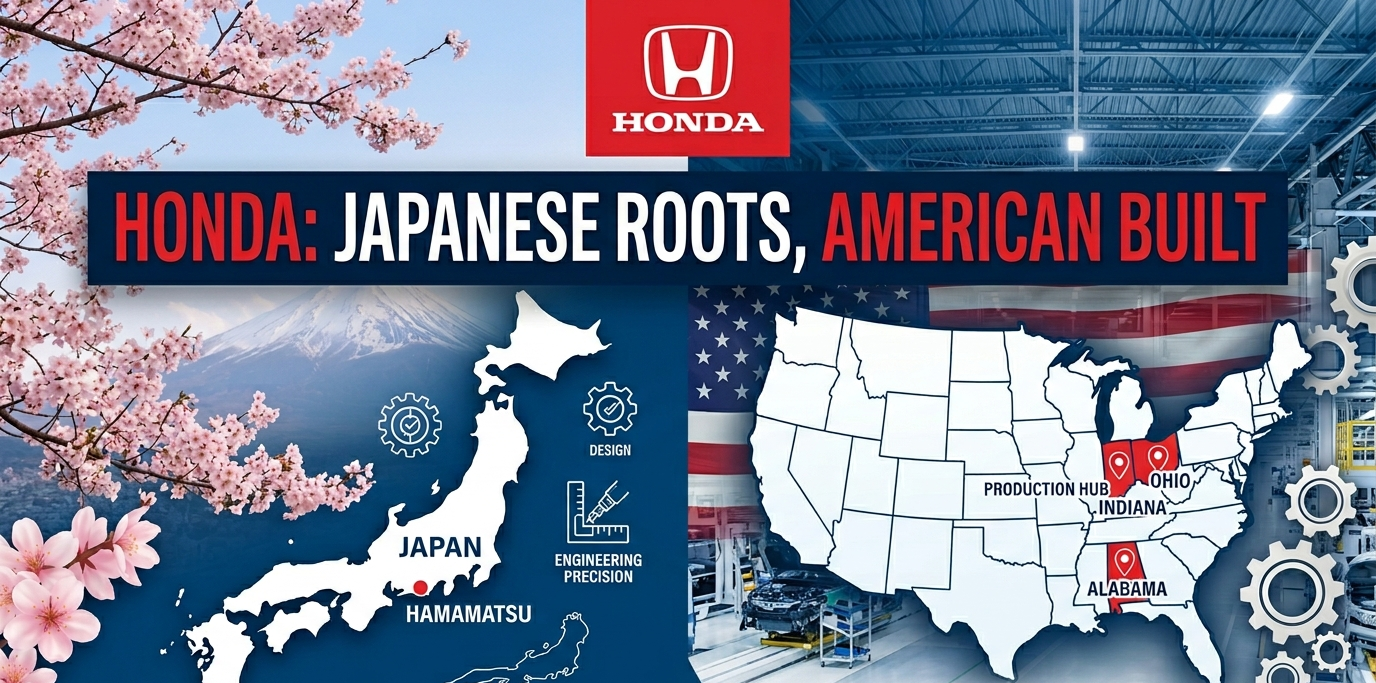
Origin, Manufacturing & VIN Guide | Updated 2026
| TL;DRHonda Motor Company was founded in 1948 in Hamamatsu, Japan, making it a Japanese-origin automaker at its core.However, the majority of Honda vehicles sold in the United States today are manufactured right here in America, primarily across plants in Ohio, Indiana, and Alabama. |
Ask a casual car buyer where Honda comes from, and you might get two different answers: Japan or America. Surprisingly, both answers carry a kernel of truth. Honda Motor Company was born on Japanese soil, shaped by one engineer’s stubborn refusal to give up, yet it has spent the last four decades planting roots so deep in American manufacturing that many of its best-selling models never see the inside of a Japanese factory. Understanding both sides of that story is the key to answering the question properly.
The Birth of a Legend: Honda’s Japanese Roots (1948)
To understand Honda, you have to picture post-war Japan in 1948 — a country rebuilding from rubble, where fuel was scarce and a reliable bicycle was considered a luxury. It was in this environment that Soichiro Honda, a machinist and self-taught engineer from the small coastal city of Hamamatsu, Shizuoka Prefecture, did something audacious: he strapped surplus army radio generator engines onto bicycle frames and sold them to neighbors who needed a way to get around without burning precious gasoline on foot.
That crude contraption was the spiritual ancestor of every Honda ever made. Honda formally incorporated Honda Motor Co., Ltd. on September 24, 1948. Within a few years, the company had outgrown bicycles entirely and began producing purpose-built motorcycles. By 1958, the Honda Super Cub had arrived — a machine so dependable and affordable that it would go on to become the best-selling motor vehicle in human history, with over 100 million units produced.
From Motorbikes to Automobiles: Honda did not rush into the car business. The company’s first four-wheeled vehicle, the T360 mini-truck, debuted in 1963, followed shortly by the S500 sports car. These early vehicles were built in Japan and sold domestically, carrying a manufacturing identity that would define the brand’s “Made in Japan” heritage for decades. That heritage still matters today: Honda’s engineering philosophy, quality control standards, and corporate DNA remain rooted in Hamamatsu and its Yorii assembly complex in Saitama Prefecture.
Where Are Honda Cars Made Today? (The 2026 Production Map)
Honda’s manufacturing footprint in 2026 looks nothing like it did in 1963. The company operates assembly facilities across multiple continents, and for American consumers, the most relevant geography is squarely in the Midwest and the South.
North American Dominance: Ohio, Indiana, and Alabama
Honda’s North American manufacturing story begins in Marysville, Ohio. When Honda opened the Marysville Auto Plant (MAP) in 1982, it became the first Japanese automaker to build cars in the United States. Today, Marysville remains the production home of the Honda Accord, one of America’s top-selling sedans for over four decades.
Ohio’s importance to Honda cannot be overstated. The state hosts multiple Honda facilities within a tight geographic cluster:
- Marysville Auto Plant (MAP): Accord production hub, operational since 1982
- East Liberty Auto Plant (ELP): Primary source of the Honda CR-V for the US market
- Honda Engineering North America and Honda R&D Americas: Both headquartered in Raymond, Ohio
Indiana entered the picture in 2008 when Honda opened the Greensburg facility. Today it assembles the Honda Civic, one of the most popular compact cars in American history. The Greensburg plant is notable for its environmental design, including a rooftop meadow and solar panels, reflecting Honda’s broader sustainability goals.
Alabama rounds out the North American core. The Lincoln plant, which opened in 2001, is Honda’s largest North American facility by output and handles the brand’s truck and SUV lineup: the Pilot, Passport, Odyssey minivan, and Ridgeline pickup truck all come from Lincoln.
The Global Network: Japan, Thailand, and Canada
Outside North America, Honda maintains major production in Japan (Yorii Plant, Saitama Prefecture), Thailand (for Southeast Asian markets), and Ontario, Canada (the Alliston plant produces the Honda CR-V for the Canadian market). For US buyers, Japanese-origin Hondas are increasingly limited to niche models and certain trims not manufactured domestically.
Honda Model vs. Primary Manufacturing Plant (US Market, 2026):
| Model Name | Primary Manufacturing Plant | VIN 1st Char |
| Honda Accord | Marysville, Ohio (MAP) | 1 |
| Honda CR-V | East Liberty, Ohio (ELP) | 4 |
| Honda Passport | Lincoln, Alabama | 1 |
| Honda Pilot | Lincoln, Alabama | 1 |
| Honda Ridgeline | Lincoln, Alabama | 1 |
| Honda Odyssey | Lincoln, Alabama | 1 |
| Honda HR-V | Celaya, Mexico | 3 |
| Honda Civic (Sedan/Hatch) | Greensburg, Indiana | 1/4 |
| Honda Fit / Jazz | Yorii, Japan | J |
| Honda e:Ny1 (EV) | Yorii, Japan (export) | J |
Note: Manufacturing assignments can shift between model years. Always verify using your vehicle’s VIN.
Is My Honda Japanese or American? How to Decode Your VIN
Every car sold in the United States carries a 17-character Vehicle Identification Number (VIN), and the very first character of that number tells you exactly where the vehicle was assembled. This is not marketing — it is a federally standardized code governed by ISO 3779.
Step-by-Step: Reading Your VIN’s First Character
- Locate your VIN. It appears on a metal plate on the driver-side dashboard (visible through the windshield), on the driver-side door jamb sticker, and on your title and registration documents.
- Look only at the first character (Position 1).
- Match it to the country of manufacture:
- J = Japan (assembled at a Japanese Honda plant, e.g., Yorii)
- 1, 4, or 5 = United States (any of Honda’s Ohio, Indiana, or Alabama facilities)
- 2 = Canada (Honda’s Alliston, Ontario plant)
- 3 = Mexico (used for models like the HR-V built in Celaya)
The J-VIN vs. US-VIN Perception Gap: Among enthusiast communities, a long-standing debate exists: does a “J-VIN” (Japan-built) Honda represent higher craftsmanship than its American-assembled counterpart? The short answer is that Honda operates under a single global quality standard regardless of assembly location. The longer answer involves nuance around panel fit tolerances, paint processes, and workforce training — topics we address in the section below.
Domestic Content Percentage: Beyond the first VIN character, US federal law (the American Automobile Labeling Act) requires automakers to disclose the percentage of US and Canadian parts content on new vehicles. A Honda Accord built in Marysville, Ohio, typically carries a 60-75% US/Canadian parts content rating, making it more “American” by parts origin than many vehicles badged by US-headquartered automakers.
Addressing the Community Debate: Japan-Built vs. US-Built Quality
Spend thirty minutes on Honda-Tech.com or the r/Honda subreddit and you will encounter threads with titles like “J-VIN Accord > US Accord — fight me” or “Does plant location actually affect quality?” These conversations have been running for twenty years, and the data behind them is more nuanced than the passion suggests.
The legitimate concerns historically raised about US-built Hondas center on two areas: paint depth and panel gap consistency. Some owners of Japan-built Hondas in the late 1990s and early 2000s documented tighter panel gaps and a deeper paint finish compared to Ohio-built equivalents of the same model year. Honda acknowledged these variations and invested heavily in standardizing processes across facilities.
The Modern Reality: By the mid-2010s, Honda had implemented its Global Honda Quality Standard across all assembly plants worldwide. Automated body welding lines, robot-applied paint systems, and centralized supplier quality audits have largely eliminated plant-to-plant variation. J.D. Power Initial Quality studies from 2022 to 2024 show no statistically significant difference in defect rates between Japanese-built and US-built Honda models.
The honest takeaway for a US buyer in 2026: the assembly plant on your VIN matters far less than the model year, trim level, and maintenance history of the individual vehicle. A well-maintained US-built Accord will consistently outperform a neglected J-VIN Accord in every meaningful metric.
The Future of Honda: The EV Transition in Ohio (2026-2030)
Honda is not standing still. The company has committed to one of the most ambitious electrification investments in the automotive industry, and the center of that investment is — fittingly — Ohio.
The $4.4 Billion EV Hub: In partnership with LG Energy Solution, Honda is constructing a joint-venture battery plant in Jeffersonville, Ohio (L-H Battery Company), scheduled to begin production in 2025-2026. Combined with retooling investments at Marysville and East Liberty, Honda’s total US EV-related commitment exceeds $4.4 billion — a figure that underscores just how deeply the company is embedding itself in American manufacturing for the electric era.
The Honda 0 Series: Honda’s next-generation EV lineup, branded as the Honda 0 Series, is designed around a new dedicated electric architecture. The 0 Series is built on Honda’s philosophy of “Thin, Light, and Wise” — prioritizing efficiency through structural simplicity rather than simply scaling up battery packs. The first 0 Series models targeting the US market are expected in the 2026-2027 window, with North American manufacturing ramping up through 2028-2030.
What this means for American buyers is straightforward: Honda’s commitment to US-based manufacturing is not weakening as EVs arrive — it is deepening. The next generation of Hondas is being built in Ohio, for America, by American workers.
Frequently Asked Questions (FAQ)
Q: Is Honda owned by Toyota?
No. Honda Motor Co., Ltd. and Toyota Motor Corporation are entirely separate, independent companies and direct competitors. Honda has never been a subsidiary of Toyota. Both are Japanese automakers, which may be the source of occasional confusion, but they maintain distinct corporate ownership, engineering teams, and manufacturing networks. Honda is publicly traded on the Tokyo Stock Exchange and the New York Stock Exchange.
Q: Who is the founder of Honda?
Honda Motor Company was founded by Soichiro Honda (1906-1991), an engineer from Hamamatsu, Japan. Honda co-founded the company alongside businessman Takeo Fujisawa, who managed the financial and business operations while Honda focused on engineering. Soichiro Honda is widely regarded as one of the most influential figures in automotive and motorcycle history.
Q: Are Acura cars made in Japan?
Not necessarily. Acura is Honda’s luxury division, launched in the United States in 1986. Like Honda-branded vehicles, Acura models are manufactured across multiple locations. The Acura MDX and RDX, the brand’s top-selling SUVs, are assembled in East Liberty, Ohio, and Lincoln, Alabama, respectively. The Acura TLX sedan is built in Marysville, Ohio. Some specialty Acura models, including certain NSX production runs, have been assembled in Honda’s Performance Manufacturing Center in Marysville. A Japan VIN on an Acura indicates assembly at a Japanese plant, but the majority of Acuras sold in the US carry American-origin VINs.
Q: Does the plant location affect my Honda’s resale value?
In practice, plant location has minimal impact on resale value for mainstream Honda models. Used car pricing is driven primarily by mileage, condition, accident history, trim level, and regional demand. The J-VIN premium that existed in certain enthusiast markets during the early 2000s has largely disappeared as Honda’s global quality standardization became widely recognized.
Q: What does ‘assembled in the USA’ mean on a Honda window sticker?
It means the vehicle was physically put together at one of Honda’s North American assembly facilities (Ohio, Indiana, or Alabama). It does not mean 100% of the parts were manufactured in the US. The separate ‘Domestic Parts Content’ figure on the Monroney sticker gives you the percentage of US and Canadian parts by value — a more complete picture of the vehicle’s American manufacturing footprint.
Content accurate as of 2026 | Sources: Honda Motor Co. Ltd., NHTSA VIN Database, American Automobile Labeling Act disclosures