The Truth About Its Origin and US Manufacturing
2026 Complete Guide
| Quick Verdict Yes Honda is a Japanese company, founded in Japan, headquartered in Tokyo, and engineered according to philosophies born on Japanese factory floors. But in 2026, calling Honda purely “Japanese” misses half the story. It builds more cars in America than most American brands do. The more accurate answer: Japanese by DNA, global by design. |
1. Corporate Identity: The Japanese Soul
Soichiro Honda didn’t build an empire by following rules. He built it by ignoring them.
Born in 1906 in rural Hamamatsu, he was the son of a blacksmith who taught him that anything mechanical could be understood and improved. By the time he founded Honda Motor Co. in 1948, Japan was still rebuilding from the war. His factory was a converted aircraft hangar. His first product was a bicycle fitted with a repurposed military engine.
What separated Honda from other postwar manufacturers was a specific engineering obsession: the idea that a product should work perfectly, not adequately. Soichiro said he wanted to create products that “bring joy to people throughout the world.” That became the cultural instruction manual every Honda engineer still carries.
This philosophy is what Americans mean when they say “Japanese reliability.” It predates global manufacturing. It’s the source code, not the assembly address.
2. Honda’s American Footprint
Honda was the first Japanese automaker to build passenger cars in the United States on November 1, 1982, at the Marysville Auto Plant in Ohio. Today, Honda’s US manufacturing network is one of the most significant foreign-owned industrial operations in the country.
In 2025, around 99% of all Honda vehicles sold in the US were made in North America, with about 62% made in America using domestic and globally made parts.
Five Major US Honda Plants
| Plant | Location | Models Built |
| Marysville Auto Plant | Marysville, Ohio | Honda Accord, Acura TLX |
| East Liberty Auto Plant | East Liberty, Ohio | Honda CR-V, CR-V Hybrid |
| Performance Mfg. Center | Marysville, Ohio | Acura NSX (boutique facility) |
| Lincoln Auto Plant | Lincoln, Alabama | Passport, Pilot, Odyssey, Ridgeline + V6 engines |
| Greensburg Auto Plant | Greensburg, Indiana | Honda Civic sedan & hatchback |
| Key StatHonda currently operates eight major auto manufacturing facilities in America — more than many legacy Detroit brands have running domestically today. |
3. VIN Decoder Guide: J vs. 1
Visit any Honda forum and you’ll find the debate: “Is a J-VIN Honda better quality than a 1-VIN?” Here’s the actual answer.
The first character of a VIN is the World Manufacturer Identifier it tells you where the vehicle was assembled, nothing more. It is not a quality grade.
| VIN 1st Digit | Country | Honda Examples |
| J | Japan | Civic Type R, HR-V |
| 1 | United States | Accord, CR-V, Ridgeline, Passport, Odyssey, Pilot, Civic |
| 2 | Canada | Select models |
| 3 | Mexico | Honda Prologue (GM partnership) |
| 4, 5 | United States | Also valid US-origin prefix |
The Mother Factory System
Honda’s quality architecture works on a “Mother Factory” model: plants in Japan establish the baseline standards and inspection criteria that every other Honda plant worldwide must match.
The Civic Type R is the perfect illustration:
- Engine: Built at Honda’s Anna Engine Plant in Ohio (USA)
- Transmission: Manufactured at Honda’s Suzuka factory in Japan
- Final Assembly: Yorii plant, Saitama, Japan joined first at the Ogawa Mother Factory
Ohio builds the heart. Japan builds the gearbox. Together they make Honda’s fastest car. Borders are irrelevant to the quality process.
4. The 2026 American-Made Index Rankings
The Honda Ridgeline is the only pickup truck to hold consecutive top-10 rankings on the Cars.com American-Made Index® for nine consecutive years. The F-150 doesn’t have that record. Neither does the Silverado.
The AMI measures five factors: US/Canadian parts percentage, engine origin, transmission origin, assembly location, and US workforce involvement.
Top Honda AMI Performers (2026)
- Honda Ridgeline: #1-ranked pickup; built & engineered entirely in Lincoln, Alabama
- Honda Passport: Top-ranked 2-row midsize SUV; Lincoln, Alabama
- Honda Odyssey: Top-ranked minivan; Lincoln, Alabama
- Honda Accord: Top domestic sedan; Marysville, Ohio since 1982
| The Plot TwistA Japanese brand’s truck out-Americans the American truck brands — by the standards the US government uses to measure domestic content. The F-150 and Silverado source significant percentages of their parts from outside the US and Canada. The Ridgeline doesn’t. |
5. Japan-Built vs. US-Built: Complete Breakdown
Imported from Japan (J-VIN)
- Honda Civic Type R (FL5): Assembled exclusively at the Yorii plant in Saitama, Japan
- Honda HR-V: Japanese production
- Honda Fit, Step Wgn, Freed, ZR-V, Civic, Prelude: All made in Japan
- Key irony: The Civic Type R’s engine is made in Ohio then shipped to Japan for assembly
Built in the USA (1-VIN)
- Honda Accord: Marysville, Ohio
- Honda CR-V / CR-V Hybrid: East Liberty, Ohio
- Honda Civic (US-spec sedan & hatch): Greensburg, Indiana
- Honda Odyssey: Lincoln, Alabama
- Honda Pilot: Lincoln, Alabama
- Honda Passport: Lincoln, Alabama
- Honda Ridgeline: Lincoln, Alabama
- Acura MDX, RDX, TLX, Integra: Ohio plants
Special case Honda Prologue: Built in partnership with GM in Mexico. Not Japan, not Ohio — a one-off arrangement for Honda’s first US-market EV.
6. The 2026 Shift: Reverse Exports & the AFEELA Story
The Reverse Export Trend
Two developments in early 2026 redefined what it means to be a Japanese automaker in America. One is unprecedented. The other is a cautionary tale.
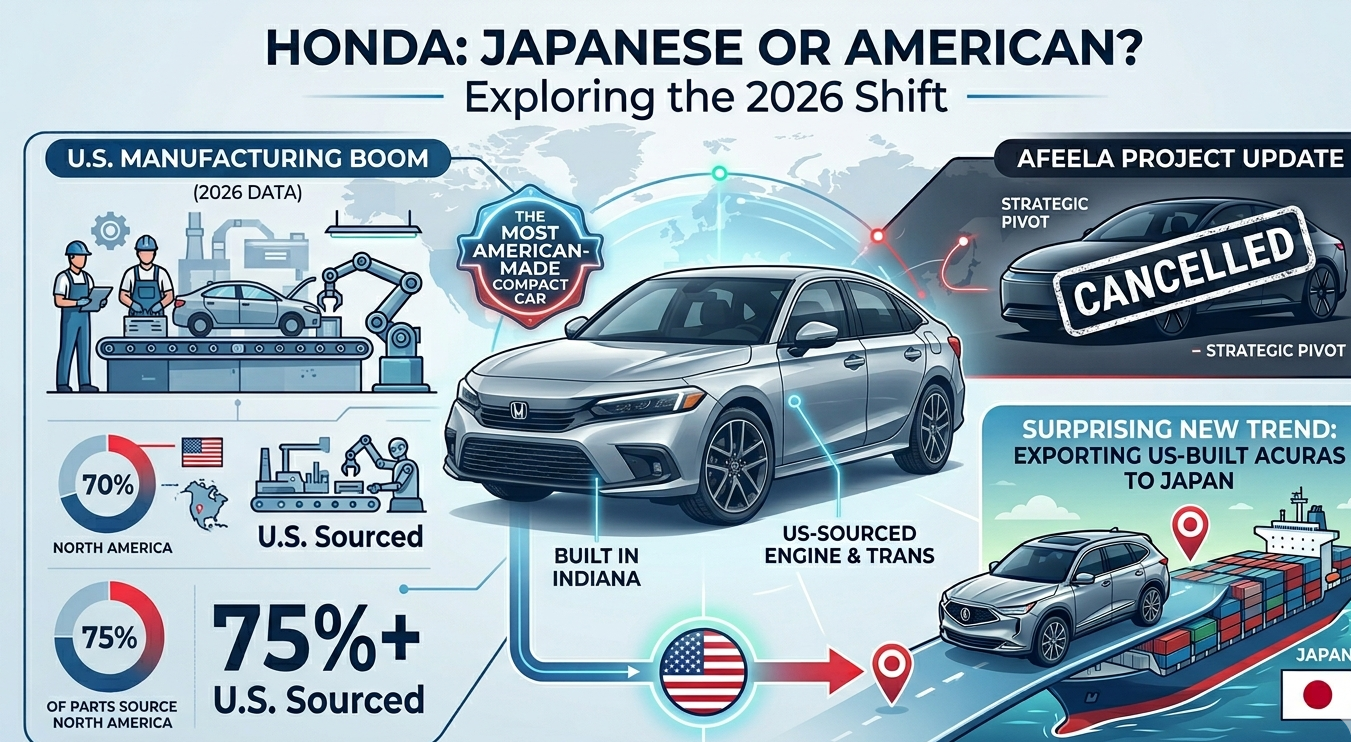
Starting in H2 2026, Honda will export the Acura Integra Type S (Ohio-built) and the Honda Passport TrailSport Elite (Alabama-built) to Japan reviving a reverse-import strategy not seen in nearly four decades.
- First time an Acura-badged vehicle will ever be sold in Japan
- Both exported in US specification, including left-hand drive, despite Japan being a right-hand-drive country
- Japan exported ~$34B in vehicles to the US in 2025; only ~$1B went the other direction
- The Ridgeline may also be exported to Japan at a later stage (unconfirmed)
- Toyota has announced parallel reverse exports: Camry, Highlander, and Tundra from US plants
The AFEELA Collapse: A Cautionary EV Tale
The Sony-Honda joint venture (Sony Honda Mobility) was supposed to be Honda’s boldest EV statement. The AFEELA 1 — a premium electric sedan from $89,900 was planned for California deliveries in mid-2026. It had reservations, a studio in Torrance, and a PlayStation 5 built into the dashboard.
On March 25, 2026, Sony Honda Mobility announced it was discontinuing both the AFEELA 1 and its planned SUV follow-up. Honda projected potential losses of up to 2.5 trillion yen (~$15.7 billion) on its electrification program. Reservation holders in California will receive full $200 refunds.
| What Killed AFEELA?Softening EV demand in the US • Elimination of federal EV tax credits • Intense Chinese competition • Honda’s inability to provide planned technologies and production assets to the joint venture. |
Honda’s EV pivot isn’t dead it’s recalibrating. The CR-V, Civic, Accord, and Prelude hybrid lines continue to grow. But the most high-profile chapter of Honda’s EV story in America ended before it started.
7. Conclusion: Made Where vs. Engineered How
The question “Is Honda Japanese?” is really two questions wearing the same coat.
Corporate answer: Honda is a Japanese company, founded by a Japanese engineer, guided by Japanese philosophy, headquartered in Tokyo. The J-VIN on a Civic Type R traces back to Soichiro Honda’s 1948 shed in Hamamatsu.
Manufacturing answer: Honda builds the majority of what Americans drive in America. The Ridgeline in your neighbor’s driveway was assembled in Alabama, powered by an Ohio engine. The Civic Type R shipped from Japan carries an engine born in Ohio.
What makes a Honda a Honda isn’t the prefecture in the VIN. It’s the same engineering obsession, the same tolerance thresholds, the same quality benchmarks running in Marysville, Yorii, and Lincoln, Alabama every shift, every year.
| Final VerdictThe “Made in USA” sticker on your Honda’s window isn’t a compromise. It’s the point. Honda didn’t come to America to cut costs. It came to prove that Japanese engineering principles could be transplanted anywhere and that’s exactly what happened. |
Phase 3: Future-Proof Update Prompt
Save this for October 2026 to refresh your article’s SEO freshness score:
| Refresh Prompt Template (October 2026):“I have a ranking article about Honda’s Japanese origins and US manufacturing. It is now [INSERT DATE]. Answer these specific questions:Has the AFEELA cancellation led to changes at Honda’s Ohio plants (new EVs, new partners, repurposed lines)?Have the Acura Integra Type S and Passport TrailSport Elite reverse exports to Japan actually launched?Has Honda shifted where the Civic, CR-V, or Accord is built, related to tariff policy changes?Provide 3 updated paragraphs (one per topic) in an analytical, conversational tone, ready to slot into my existing article.” |