
A generation-by-generation reliability review and current repair cost estimates for high-mileage owners.
Generation-by-Generation Reliability
11th Generation (2022 to Present)
The current Civic generation continues to earn strong marks. J.D. Power’s 100-point score puts the 2026 Civic at 85 overall, with a quality and reliability score of 84 out of 100, a rating J.D. Power classifies as “Great.”
U.S. News echoes that figure, giving the 2026 Civic the same predicted reliability score of 84 out of 100, placing it in the “Great” band on their scale.
Owner sentiment backs this up. In Kelley Blue Book’s latest owner survey, Civic drivers rated reliability at 4.2 out of 5, one of the model’s highest-scoring categories alongside styling.
Consumer Reports has also warmed to this generation. Industry analysis of CR data shows that the 11th generation, which began in 2022, is the point where Consumer Reports started rating the Civic better than average for reliability. That said, a carryover steering issue from the prior generation, where the wheel can feel heavy or inconsistent, remains the most notable complaint.
10th Generation (2016 to 2021)
This generation is a mixed bag depending on the model year. The early years struggled. According to Consumer Reports data shared among Civic owners, the 2016 to 2019 Civic earned a below-average reliability verdict, putting it roughly on par with or behind the Hyundai Elantra and Nissan Sentra of that era.
Common early issues included AC condenser failures and oil dilution in the turbocharged 1.5-liter engine. Things improved by the end of the run. The 2020 and 2021 model years stand out at the close of the 10th generation, earning Consumer Reports’ highest reliability rankings for that generation.
9th Generation (2012 to 2015)
This generation remains one of Honda’s most dependable, even if it is not the most exciting to drive. The seventh generation from 2001 to 2005 has one of the worst reliability records of any Civic, in sharp contrast to the ninth generation’s stellar reputation. Owners routinely report engines and transmissions that hold up well past 200,000 miles with basic maintenance.
7th Generation (2001 to 2005)
This is the generation to approach carefully on the used market. Transmission failures were common, and the early hybrid variant added its own set of problems. Buyers shopping this era should budget for drivetrain repairs or look for well-documented maintenance history.
High-Mileage Milestone: What Repairs Actually Cost
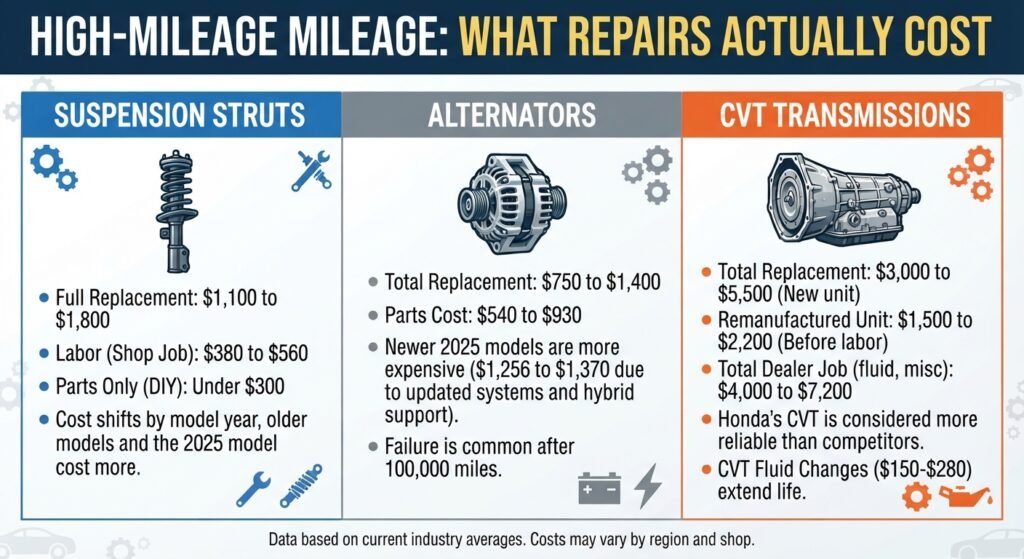
Once a Civic crosses 100,000 miles, a handful of components start showing wear. Here is what current data says you should expect to pay.
Suspension Struts
Struts typically wear out somewhere between 50,000 and 100,000 miles. A full strut replacement on a Civic runs between roughly $1,112 and $1,296 on average, with labor accounting for $383 to $562 of that total.
Costs shift by model year. Newer 2022 to 2024 Civics run closer to $988 to $1,256, while the 2025 model comes in higher, at $1,528 to $1,796. Older Civics from the 2006 to 2011 range often land near the top of the scale as well.
If you only need the strut assemblies themselves rather than a full shop job, parts alone can run much lower, sometimes under $300 for a pair when sourced independently.
Alternators
Alternator failure is another common high-mileage repair. The average cost for a Civic alternator replacement falls between $753 and $1,236, with parts making up the bulk of that expense at $544 to $930.
Newer Civics tend to cost more here too. A 2025 model runs $1,256 to $1,370, compared to $877 to $1,193 for 2022 through 2024 models. This reflects the higher cost of alternators built for updated electrical systems and hybrid support components.
CVT Transmissions
This is the big-ticket item on the list. A full CVT replacement is a major expense, and pricing varies widely depending on whether you choose new, remanufactured, or used.
A Honda CVT replacement typically costs between $3,000 and $5,500, which industry sources note is favorable compared to the wider CVT market, since Honda’s CVT units are generally considered more reliable than comparable Nissan units.
Other estimates land in a similar range. One transmission cost guide puts a complete CVT swap on a 2016 to 2024 Civic at $2,500 to $4,000 including parts and labor, while noting that remanufactured units typically cost $1,500 to $2,200 before installation.
A separate breakdown that factors in fluid and incidental parts estimates a total range of $4,000 to $7,200 for a full job. The gap between these figures usually comes down to whether you go with a dealer-installed new unit or a remanufactured one from an independent shop.
Bottom Line for High-Mileage Owners
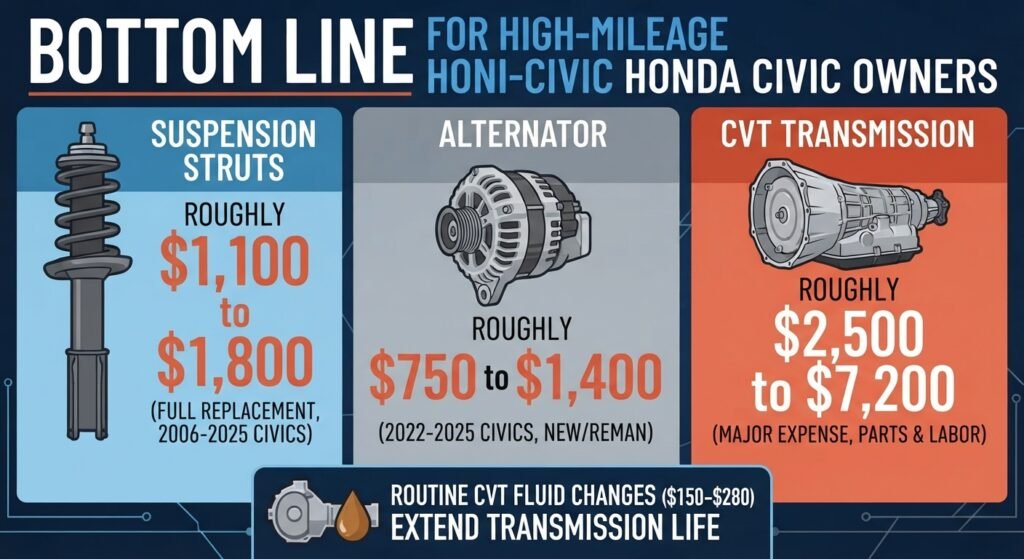
- Suspension struts: roughly $1,100 to $1,800
- Alternator: roughly $750 to $1,400
- CVT transmission: roughly $2,500 to $7,200, depending on parts choice and labor rates
Routine CVT fluid changes, which run $150 to $280 per service, remain one of the cheapest ways to push that transmission bill further down the road.