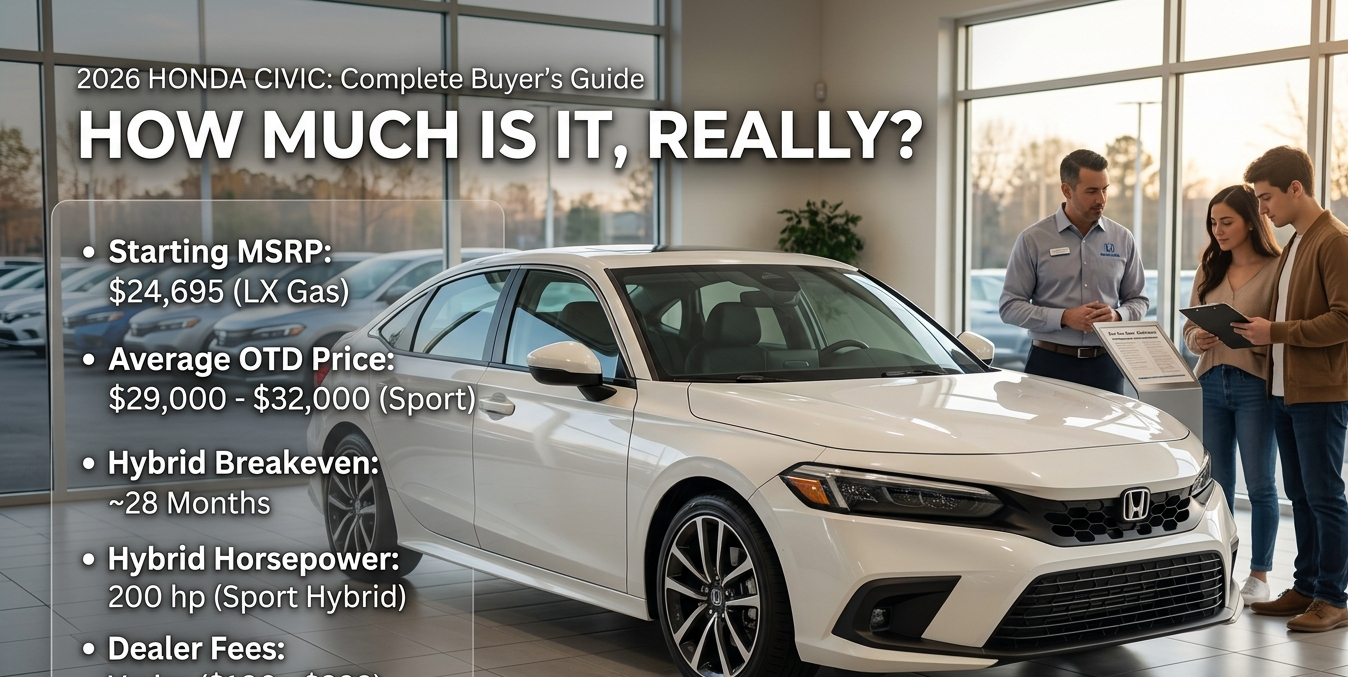
The Real Price, Not Just the Sticker Complete US Buyer’s Guide
Introduction
You have probably seen “$24,695” plastered everywhere online. But here is what nobody tells you: that number is just the starting line. By the time you drive off the lot, your actual cost could be $3,000 to $5,000 higher and that is before you have chosen a single option.
This guide breaks down every dollar, from the base LX trim all the way to the hot-hatch Type R, so you walk into any dealership ready. We cover the real “out-the-door” price, the gas-vs-hybrid breakeven math, honest owner feedback from forums, and what annual ownership actually costs.
Section 1: 2026 Honda Civic Trim-Level Pricing at a Glance
The Civic comes in five configurations for 2026. Here is how they stack up:
| Trim | Powertrain | Starting MSRP | Best For |
|---|---|---|---|
| LX | 1.5L Turbo Gas | $24,695 | Budget-smart |
| Sport | 1.5L Turbo Gas | $26,695 | Daily driver |
| Sport Hybrid | 2.0L Hybrid (200 hp) | $29,395 | Best value |
| Sport Touring Hybrid | 2.0L Hybrid (200 hp) | $33,590 | Top comfort |
| Type R | 2.0L VTEC Turbo | $46,000+ | Enthusiast |
Note: Prices are estimates based on current manufacturer data. Dealer markups especially on the Type R can add $2,000 to $10,000 above MSRP in high-demand markets. Always negotiate from invoice price, not sticker.
Section 2: The Real “Out-the-Door” Cost (What Dealers Don’t Advertise)
MSRP is marketing. Your “out-the-door” (OTD) price is what you actually pay. Here is what gets stacked on top before you sign:
| Cost Item | Estimate | Notes |
|---|---|---|
| Destination Fee | ~$1,095 | Fixed Honda charge — non-negotiable on every new Civic |
| Doc / Dealer Fee | $100 – $999 | Florida allows up to $999. California caps at ~$85 |
| Sales Tax | 0% – 10.25% | Oregon = $0. Los Angeles = 10.25% (adds ~$2,767 on $27K car) |
| Title & Registration | $150 – $500 | State-dependent. Florida uses weight-based; Texas uses flat rate |
Real-world example: A Sport trim at $26,695 MSRP can realistically land between $29,000 and $31,500 OTD depending on your state. Use this as your budget baseline, not the sticker price.
Pro tip at the dealership: Ask for the complete “OTD price sheet” before discussing monthly payments. Dealers may bundle fees into the payment calculation to obscure the true total. Get the full breakdown in writing.
Section 3: Gas vs. Hybrid When Does the Sport Hybrid Pay Off?
The Sport Hybrid costs roughly $2,700 to $4,000 more than the gas Sport upfront. But here is the thing most comparison articles miss: it also delivers 200 horsepower compared to the gas Sport’s 158 hp. You are not just buying efficiency you are getting a genuinely more capable car.
Let us run the numbers for a typical driver doing 15,000 miles per year:
- Fuel economy (Sport Gas): approximately 36 mpg combined
- Fuel economy (Sport Hybrid): approximately 50 mpg combined
- Annual fuel savings at $3.50/gallon: roughly $1,150 per year
- Break-even on the $2,700 price gap: approximately 2.3 years (28 months)
After that 28-month mark, the Hybrid is saving you money every single month — on top of already being the quicker, more powerful car. For most buyers doing average or above-average mileage, the Hybrid is simply the smarter buy.
At higher gas prices (like California’s $4.50+ average), the break-even drops to under 18 months. Even for low-mileage drivers doing 10,000 miles per year, break-even lands around 3.5 years — well within a typical ownership window.
Section 4: Real-World Cons What Owners Are Actually Saying
Official reviews are polished. Forum discussions are honest. Here is what 11th-generation Civic owners on CivicX, Reddit’s r/Honda, and Consumer Reports owner surveys consistently bring up framed not as deal-breakers, but as things to know before you buy:
- Highway road noise: Noticeable wind and tire noise above 65 mph, especially on rough pavement. It is a known characteristic of the platform. Solution: Aftermarket floor mats or acoustic underlay panels help significantly. Test-drive on a highway before you commit.
- No physical lumbar support on lower trims: The LX and Sport have no lumbar adjustment at all. On drives over 90 minutes, this becomes noticeable. The Sport Touring Hybrid resolves this. If you have back sensitivity, test the seat carefully.
- Infotainment lag: The 9-inch screen occasionally lags during cold boots or when switching apps quickly. This is a known firmware issue on early 11th-gen units. Most Honda dealers have a free software update that addresses it. Confirm your dealer has applied the latest update.
- Rear legroom for tall passengers: Adults over 6 feet will find the rear seat tight on longer trips. This is standard for a compact sedan the Accord is the move if you regularly carry tall passengers.
The bottom line: none of these are reasons to avoid the Civic. They are simply the honest picture that a brochure will never give you. A 10-minute highway test-drive and a seat check will confirm whether any of these matter for your specific situation.
Section 5: Maintenance & Insurance Annual Ownership Costs
The purchase price is just the beginning. Here is what ongoing ownership looks like including one Honda perk that most buyers overlook entirely:
| Item | Cost / Coverage | Details |
|---|---|---|
| Honda Service Pass | 2 yrs / 24,000 mi — FREE | Covers oil changes, tire rotations & inspections |
| Oil Changes (post-pass) | $60 – $90 each | Approx. every 5,000 – 7,500 miles |
| Annual Insurance (25–45) | $1,200 – $1,600/yr | Clean driving record, full coverage |
| Young Driver Surcharge (<25) | +$400 – $900/yr | Civic’s popularity = higher theft/claim rate |
| Hybrid Battery Warranty | 8 years / 100,000 mi | Honda hybrid system coverage — peace of mind included |
The Honda Service Pass is genuinely valuable. Two years of free oil changes, tire rotations, and multi-point inspections can save $400 to $600 over the coverage period. Factor it into your total cost comparison if you are cross-shopping against competitors that do not include complimentary maintenance.
Annual update guide: Replace insurance ranges with updated averages from Bankrate or NerdWallet’s annual car insurance report (published each January). MSRP and Service Pass terms typically update with Honda’s model-year announcement each fall. Fuel economy figures can be confirmed at fueleconomy.gov.
Bottom Line: What Should You Actually Pay?
Here is a quick decision framework for 2026 Civic buyers:
- Budget under $30,000 OTD: Start with the LX or Sport. Negotiate toward invoice and budget $2,500 for state taxes and fees.
- Best overall value: The Sport Hybrid at $29,395 MSRP. More power, better efficiency, and it pays for itself within 3 years for most drivers.
- Want luxury features: Step up to the Sport Touring Hybrid at $33,590. Physical lumbar, heated seats, and premium audio make a real difference on daily commutes.
- Performance priority: The Type R is in a different league — but budget $50,000+ OTD and expect dealer markup negotiations.
Walk into any Honda dealership knowing your OTD target, not just your MSRP ceiling. That single shift in framing will save you hundreds to thousands of dollars.
Prices are estimates as of 2026 and subject to change. Always verify with your local Honda dealer.