
The Honda Civic is a permanent fixture on American roads. For millions of drivers, it represents the gold standard of reliability and daily utility. When you decide to purchase one, the most significant decision you face is what lies under the hood.
The two primary contenders are the 1.5L Turbocharged (1.5T) engine and the 2.0L Naturally Aspirated (2.0 NA) engine. Each powerplant offers a distinct personality. One is engineered for modern efficiency and punchy acceleration. The other is built for mechanical simplicity and legendary longevity.
If you are struggling to decide between the two, you are certainly not alone. This guide breaks down everything from real-world performance specs to long-term ownership costs to help you make the best choice.
The Engineering Philosophy
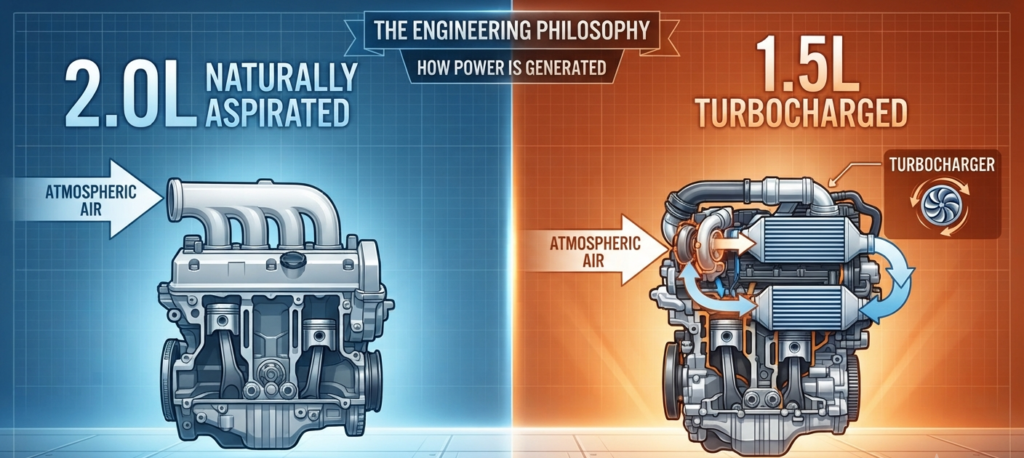
To truly understand the difference, we must look at how these engines generate power. The 2.0L Naturally Aspirated engine is a machine of tradition. It relies on atmospheric pressure to pull air into the cylinders for combustion.
Because there is no forced induction, there are significantly fewer complex parts under the hood. This design has been refined by Honda for several decades. It is smooth, predictable, and incredibly well-understood by mechanics across the United States. When you step on the gas, the power delivery is linear and steady, providing a sense of calm during your drive.
The 1.5L Turbocharged engine, conversely, is the result of modern automotive downsizing trends. Honda engineers wanted the power of a larger engine without sacrificing the fuel economy of a compact car. To achieve this, the turbocharger forces compressed air into the engine.
This creates much more power from a smaller displacement. The result is a car that feels energetic and quick, especially at low speeds. It is a masterpiece of modern engineering, but it inherently introduces more complexity to the vehicle’s powertrain.
Performance: City Traffic vs. Open Highway
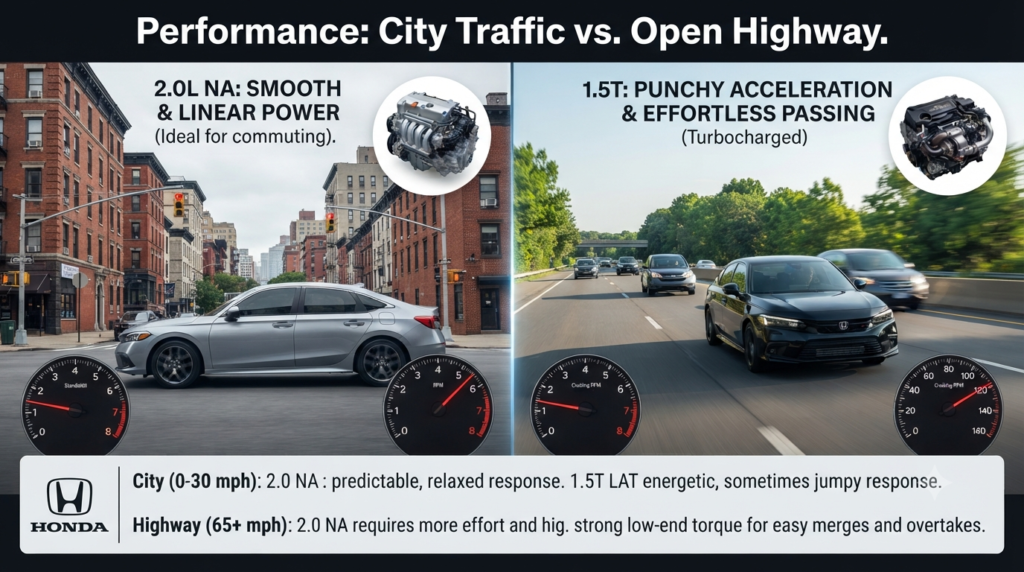
Your daily driving habits should be the primary factor in your engine selection. In heavy city traffic, the 2.0 NA is a gem. The power delivery is entirely consistent. You do not have to wait for a turbocharger to spool up to get moving.
For short trips to the grocery store or a typical commute through downtown, it feels effortless. The 1.5T is also capable in the city, but it can feel a bit twitchy to some drivers. Because the peak torque comes on so early, the car can feel jumpy when you are just trying to move through bumper-to-bumper traffic.
However, the highway is where the 1.5T completely changes the game. Because of the turbocharger, the engine provides high torque at low RPMs. This makes merging onto a busy 70 mph highway much easier and safer.
You can pass slower vehicles without having to floor the pedal and wait for the transmission to hunt for the right gear. The 2.0 NA is perfectly fine for the highway, but it has to work significantly harder. You will often notice the engine revving higher to find the power you need for a quick passing maneuver.
Reliability: The Truth Behind the Myths
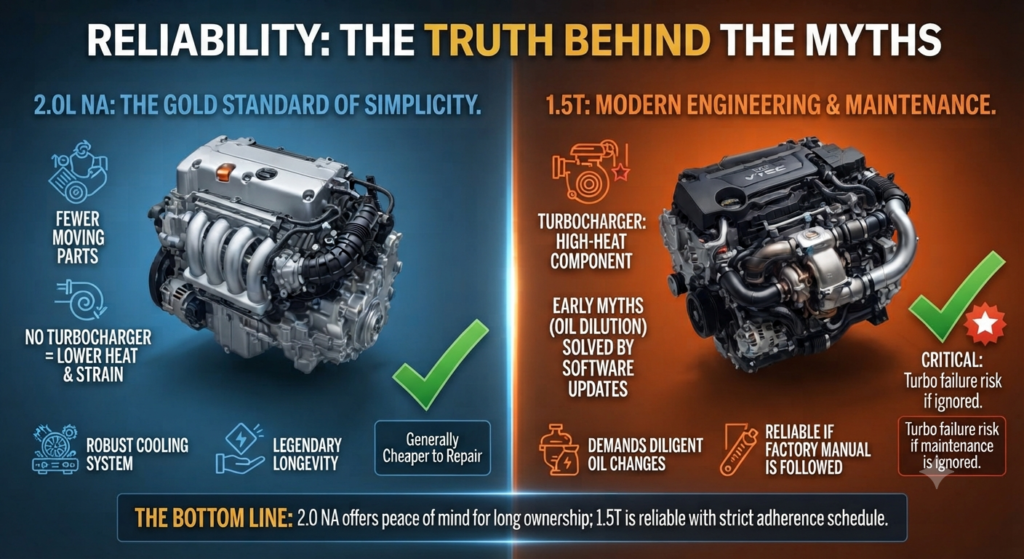
This is the biggest concern for most prospective Civic owners in the US. The 2.0 NA is arguably one of the most reliable engines Honda has ever produced. Because it lacks a turbocharger, the intake temperatures are significantly lower.
There is simply less strain on the internal engine components. The cooling system is under less stress, and there are fewer failure points. For someone planning to keep their car for 10 or 15 years, this is the gold standard of mechanical peace of mind. It is also generally cheaper to repair when things eventually wear out.
On the other hand, the 1.5T had a rough start with concerns regarding oil dilution in early models. It is vital to understand that these issues are largely a thing of the past. Honda released major software updates to help the engine reach operating temperatures faster, which effectively solved the problem.
However, a turbocharger remains a high-heat, high-pressure component. You must be diligent with your oil change intervals. If you ignore your maintenance, the turbocharger can eventually become a very expensive repair bill. If you stick to the factory manual, it is a perfectly reliable engine for the vast majority of owners.
Cost of Ownership: The Real-World Math
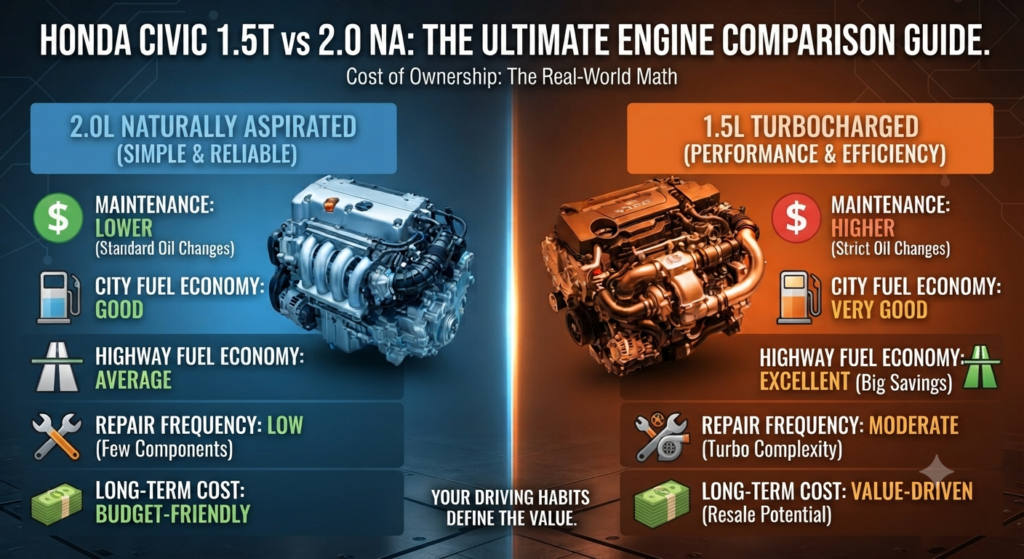
Efficiency is a major selling point for both engine options. The 1.5T is the clear winner if you prioritize highway fuel economy. Its design allows it to cruise at lower RPMs while maintaining high speeds.
If your daily commute involves long stretches of interstate driving, you will notice the savings at the gas pump every single week. The 2.0 NA is quite efficient for its size, but it simply cannot match the turbo’s highway capabilities. Interestingly, in stop-and-go city settings, the gap between the two engines narrows quite a bit.
Regarding service costs, the 2.0 NA requires standard high-quality synthetic oil changes. The 1.5T also requires synthetic, but because of the turbo, you should never skip an interval. You should think of the 1.5T as a high-performance athlete.
It needs clean, high-quality oil to keep the turbo bearings healthy. The 2.0 NA is like a dependable, tireless marathon runner. It is far less demanding of its owner, which is why many fleet buyers prefer the 2.0 NA for long-term operations.
Decision Matrix: Which One Wins?
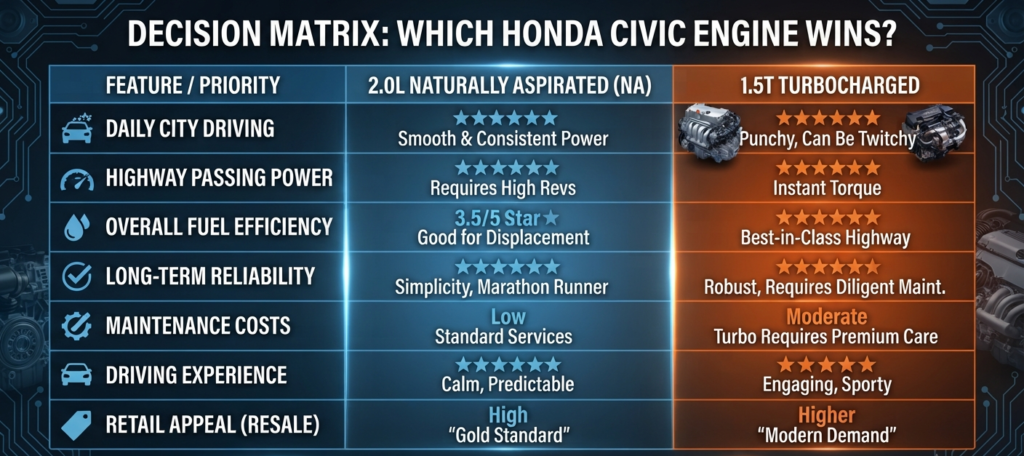
When you look at the specs side-by-side, the choice becomes a matter of priorities. The 2.0L Naturally Aspirated engine offers excellent city comfort, legendary reliability, and lower long-term maintenance costs. It is the king of simplicity.
The 1.5L Turbo offers excellent highway power, better overall fuel efficiency, and a more engaging, modern driving experience. It is the king of performance and versatility. Neither engine is objectively “bad,” but they serve different types of drivers.
If you are a “set it and forget it” owner who wants a car that will start every single morning for the next decade with zero fuss, choose the 2.0 NA. It is the best choice for a budget-conscious commuter who avoids highway passing and prefers linear power.
If you enjoy the feeling of a responsive, quick car and spend a significant amount of time on highways, the 1.5T is the better choice. It is also the better option if you plan to trade in your car within a few years, as it generally carries a higher resale appeal for modern buyers.
Addressing Common Community Concerns
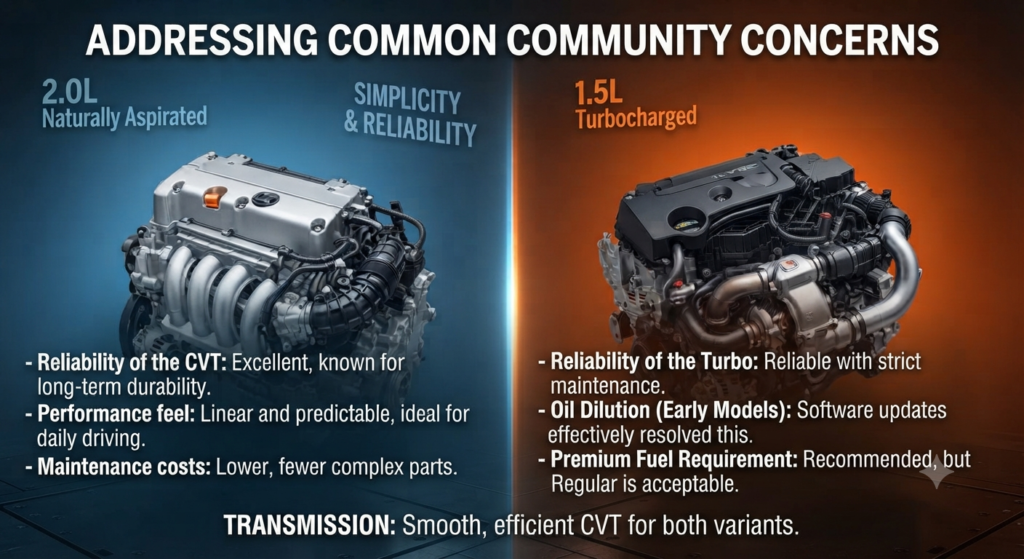
Many buyers worry about the CVT (Continuously Variable Transmission) that is often paired with these engines. Some enthusiasts dislike the “rubber band” feel of a CVT compared to a traditional geared transmission. However, modern Honda CVTs are exceptionally reliable.
They are specifically tuned for efficiency rather than track performance. If you want a manual transmission, you will have to hunt for specific trims, as they are becoming increasingly rare. Regardless of the engine, the transmission will be smooth and fuel-efficient.
Finally, there is the question of premium fuel. The 1.5T is designed to run perfectly fine on regular unleaded fuel. While some owners claim they feel better performance with premium, it is not required by the manufacturer.
Always check your owner’s manual for your specific model year, but generally, regular fuel is all you need. Using the fuel recommended by Honda is the best way to keep your engine running smoothly for years to come.