
Are you worried about scraping the front bumper of your Honda Civic on a steep driveway? You are certainly not alone.
Ground clearance is one of the most common questions for new and prospective Honda Civic owners. It is the critical distance between the lowest point of your car and the road surface.
For the modern Honda Civic, the ground clearance typically ranges between 4.8 inches and 6.7 inches. This figure varies significantly based on your specific trim level and the model year.
Why Is There No Single Official Number?
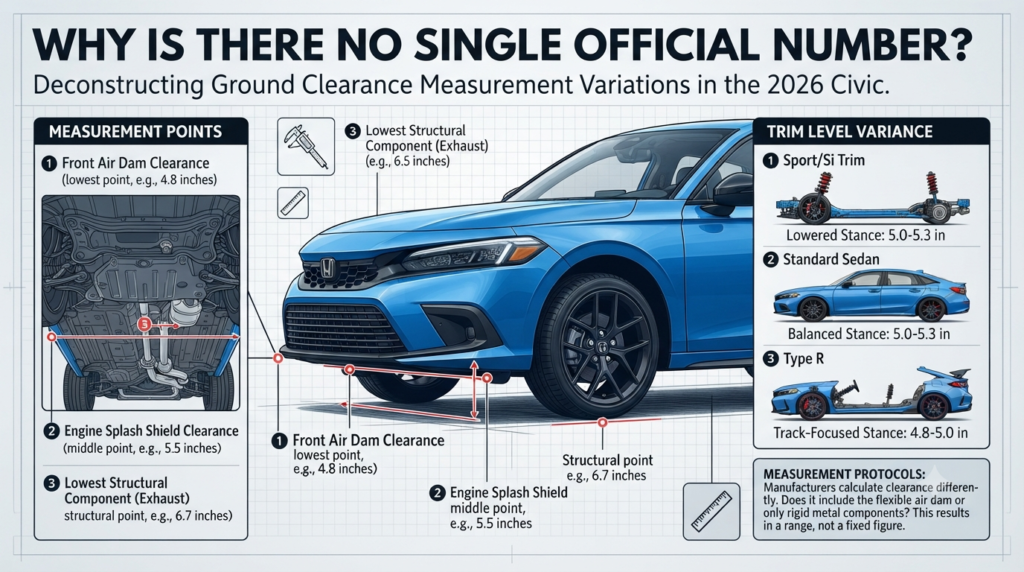
Many owners look for one exact number for their car. However, Honda does not list a single universal clearance for every Civic.
The measurement changes depending on how the manufacturer calculates it. Some measurements include the front air dam, while others look at the lowest point of the engine splash shield.
Additionally, different trims come with different suspension setups. A sportier trim may sit lower than a base model to improve handling.
Most manufacturers define ground clearance as the distance to the lowest structural component. This is often the exhaust pipe or a chassis brace rather than the front bumper.
The Impact of Trim Levels on Clearance
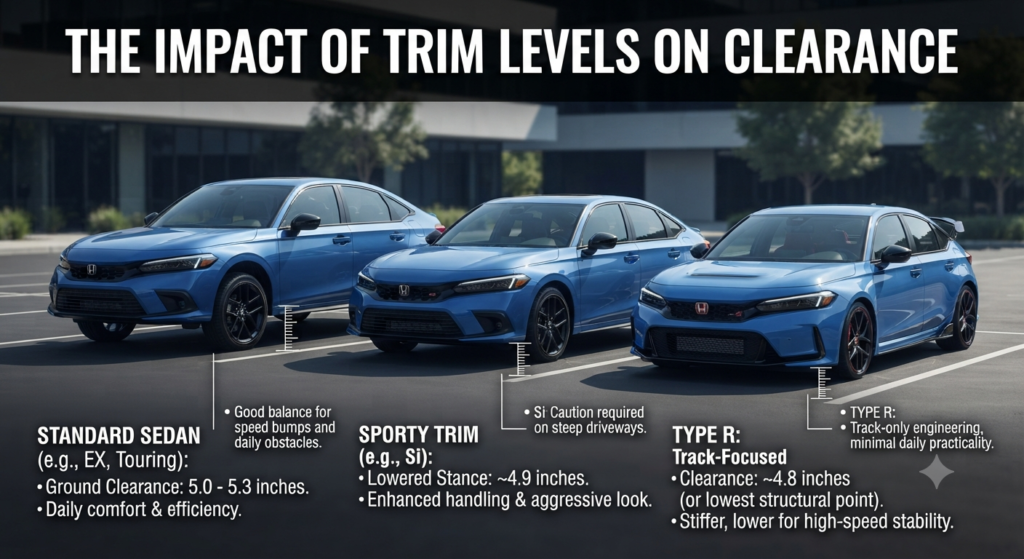
If you are trying to figure out where your car stands, look at your specific model category.
- Standard Sedans: These usually sit between 5.0 and 5.3 inches. This height offers a balance between daily comfort and sporty aesthetics.
- Hatchbacks: Often, these sit very close to the sedan models. They are designed for general road use and highway driving.
- Type R and Si Models: These performance models often feature a lower stance. This helps keep the car stable at higher speeds by reducing air flow underneath the vehicle.
The Type R is specifically engineered for track use. Its suspension is stiffer and lower, which means you must be much more careful with speed bumps and road debris.
Why Does Honda Keep the Civic Low?
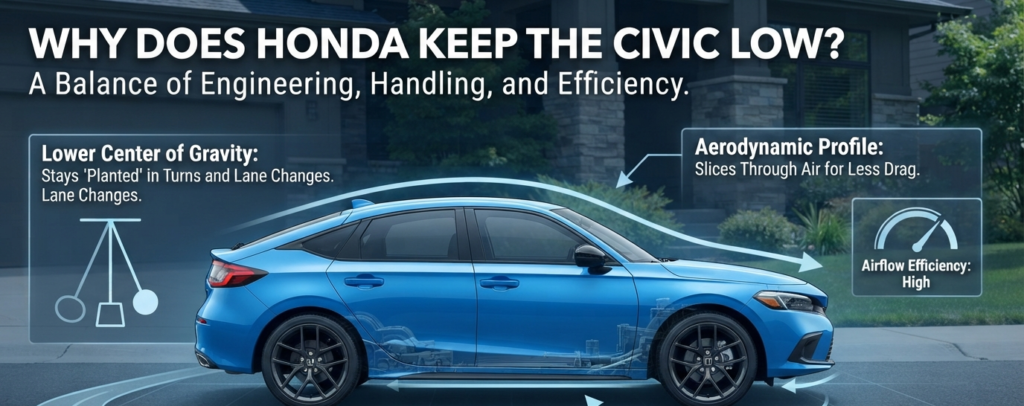
You might wonder why Honda does not design the car to be higher off the ground. The answer lies in engineering.
A lower center of gravity is vital for the signature handling the Civic is known for. It ensures the car stays planted during sharp turns and lane changes.
Furthermore, a lower ride height improves aerodynamics. This helps the car cut through the wind more efficiently, which leads to better fuel economy on the highway.
Engineers at Honda prioritize stability and efficiency. By keeping the car close to the ground, they reduce drag and improve the overall driving experience for the average user.
Real World Challenges and How to Handle Them
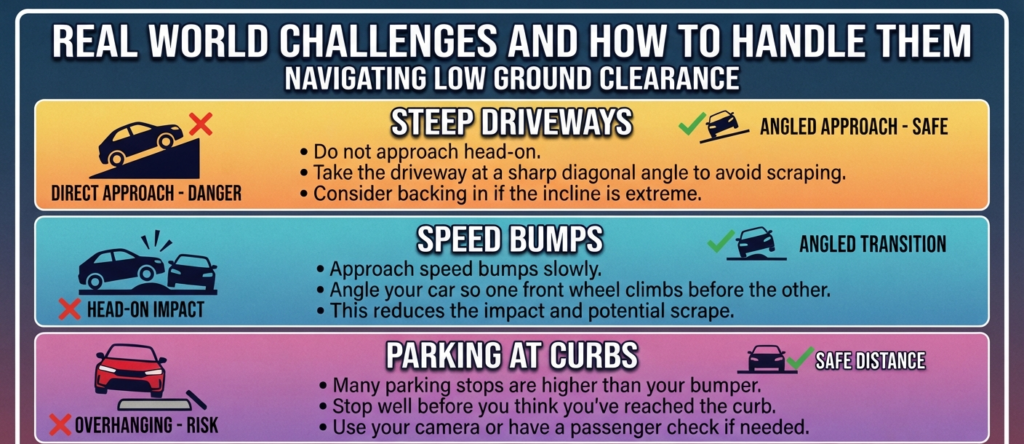
Driving a car with lower clearance requires a few minor adjustments to your daily driving habits. These tips will help you avoid that dreaded scraping sound.
Approaching Speed Bumps
If you see a sharp speed bump ahead, do not hit it head on. Approach the bump at a slight angle. This allows one front wheel to climb the bump before the other.
Parking at Curbs
Many parking lots have concrete wheel stops. These are the biggest enemy of your front bumper. When pulling into a space, stop well before you think you have reached the curb.
Driveway Inclines
If you face a steep driveway, try backing into the space instead of pulling in forward. The rear of the car often has a slightly different clearance angle that makes the transition smoother.
If you must pull in forward, take the driveway at a sharp diagonal angle. This prevents the front overhang from making contact with the pavement.
Does Loading Your Civic Change Clearance?
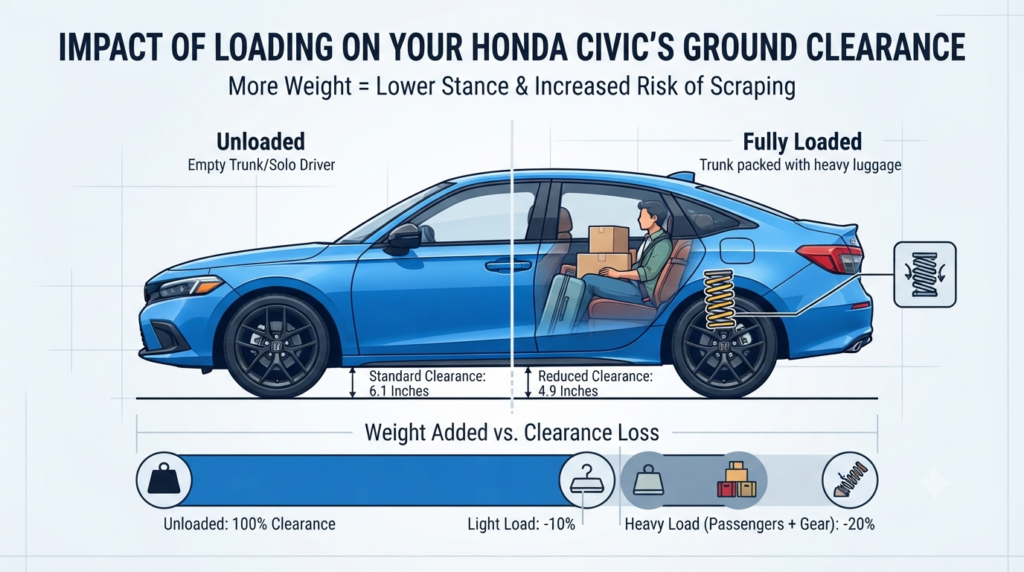
Yes, it does. Your ground clearance is not a static number.
When you pack your trunk with heavy gear or carry four passengers, the suspension compresses. This pushes the car closer to the road.
If you are planning a long road trip with a full load, be extra cautious on uneven roads. You have less room for error than you do when driving solo.
For every 100 pounds of weight added, you might notice a slight dip in ride height. Always account for this when traveling with a full cabin.
Suspension Modifications: Pros and Cons
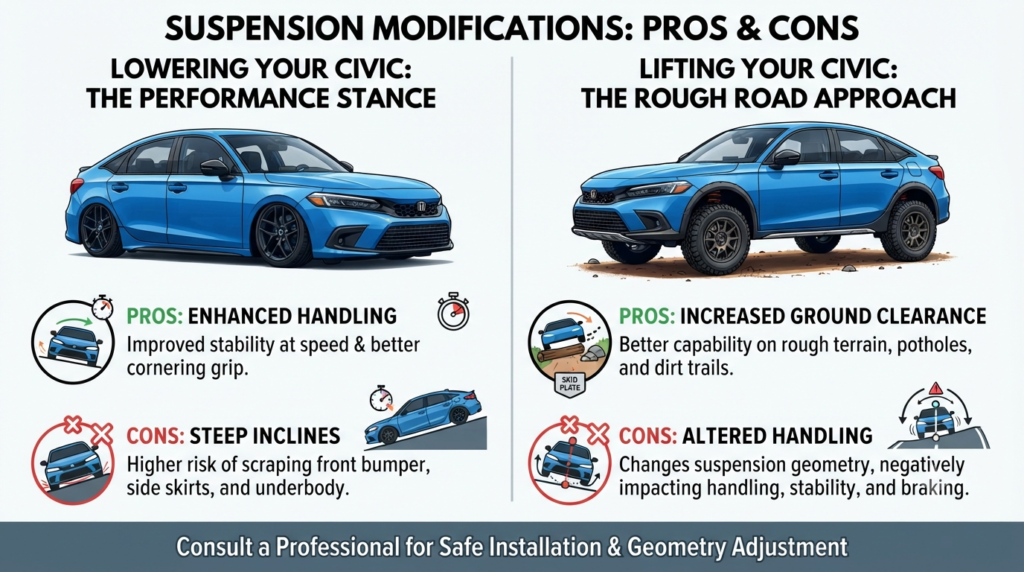
Some owners consider lowering their Civic further for a custom look. Others consider lifting it to handle rougher roads.
Lowering your car will make it look more aggressive. However, it will also make it much harder to navigate city speed bumps and steep driveways.
Lifting your car is generally not recommended for the Civic. It can change the geometry of the suspension and negatively impact the way your car handles in emergencies.
If you choose to modify your suspension, you must accept the trade-offs. Always consult a professional to ensure the modifications are safe for daily road use.
Protecting Your Investment
Your Honda Civic is a reliable vehicle that can last for years. However, constant scraping can lead to expensive damage.
The front air dam is often made of plastic. While it is designed to flex, repeated scraping can crack it or loosen the clips holding it in place.
Under-body damage is even more serious. The oil pan and transmission components are often located underneath. Hitting a large rock or a high curb could cause catastrophic leaks.
Consider installing a front bumper skid plate if you live in an area with many steep driveways. This small addition can save you hundreds of dollars in repair costs.
Comparison Table: Civic Clearance vs. Competitors
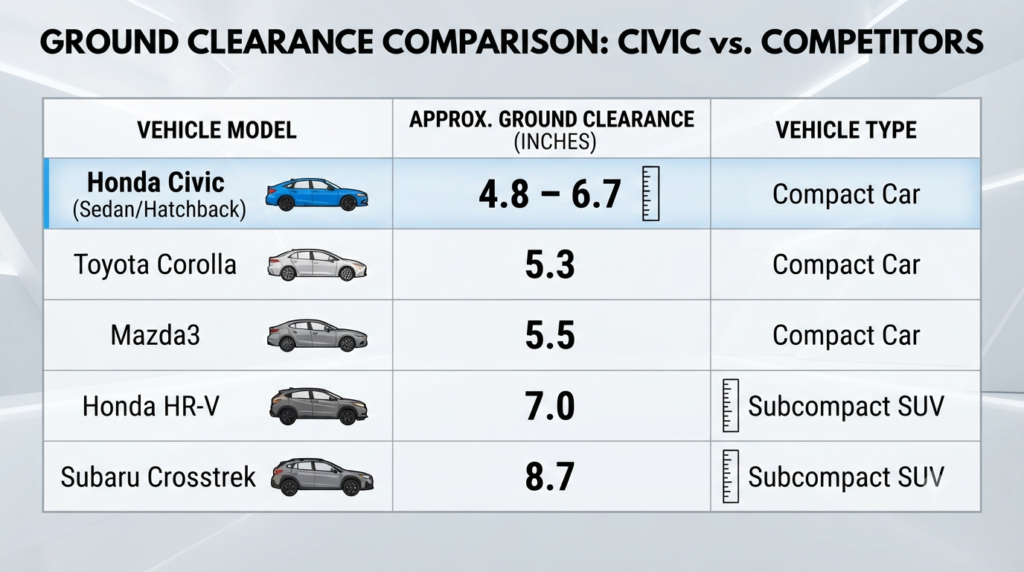
To give you perspective, let’s see how the Civic compares to other popular vehicles on the road.
| Vehicle Model | Approx. Clearance (Inches) |
| Honda Civic | 4.8 – 6.7 |
| Toyota Corolla | 5.3 |
| Mazda3 | 5.5 |
| Honda HR-V | 7.0 |
| Subaru Crosstrek | 8.7 |
As you can see, the Civic is built for the road. If you find yourself needing more than 7 inches of clearance, you might be looking for a Crossover or SUV rather than a sedan.
Maintenance Tips for Lowered Vehicles
If you have a lower-trim Civic, maintenance is slightly different. You should pay more attention to the underside during oil changes.
Ask your mechanic to inspect the front splash shield during every service. If it is hanging loose, it will catch on road debris and cause further damage.
Keep your tires properly inflated. Proper tire pressure helps maintain the intended ride height of the vehicle.
Worn-out shocks and struts can also cause the car to sit lower than factory specifications. If your Civic feels “bouncy” or hits the ground easily, it may be time for a suspension check.
Final Thoughts on Driving with Confidence

The Honda Civic remains one of the best-selling cars in the United States for a reason. Its low stance provides a driving experience that few competitors can match.
While the ground clearance might require you to be more careful in certain situations, it is a small price to pay for the handling and efficiency you get in return.
Master the techniques of angled approaches and cautious parking. With these habits, you will have no trouble navigating your daily commute.
Your Civic is capable of handling most road conditions with ease. Enjoy the drive, and keep an eye on those curbs.