
Changing your own oil is the single most effective way to extend the life of your Honda Civic engine. While it seems like a simple task, precision is everything. Putting in the wrong amount of oil even by a small margin can affect engine performance, fuel economy, and long-term reliability.
This guide provides everything you need to know about Honda Civic oil capacity with filter, updated for 2026. Whether you are driving a vintage model or the latest 2026 release, you will find the answers here.
Why Oil Capacity Matters
Your engine is a precision-engineered machine. It relies on a specific volume of oil to create a lubricating film between moving parts.
If you have too little oil, the engine components will grind against each other. This causes excessive heat and premature wear.
If you have too much oil, the crankshaft can whip the oil into a foam. Air bubbles in the oil prevent it from lubricating effectively, which can lead to catastrophic internal damage.
Understanding Service Fill vs. Dry Fill
When you search for oil capacity, you will often find two different numbers. It is important to know the difference.
Dry Fill
This refers to the amount of oil required to fill an engine that has just been built in a factory. Everything is bone dry.
Service Fill
This is the amount you actually need during a standard oil change. Some old oil always remains inside the oil galleries and the engine block.
Always follow the “Service Fill” specifications. Adding the full “Dry Fill” amount will almost certainly result in an overfilled engine.
Honda Civic Oil Capacity Chart (Updated 2026)
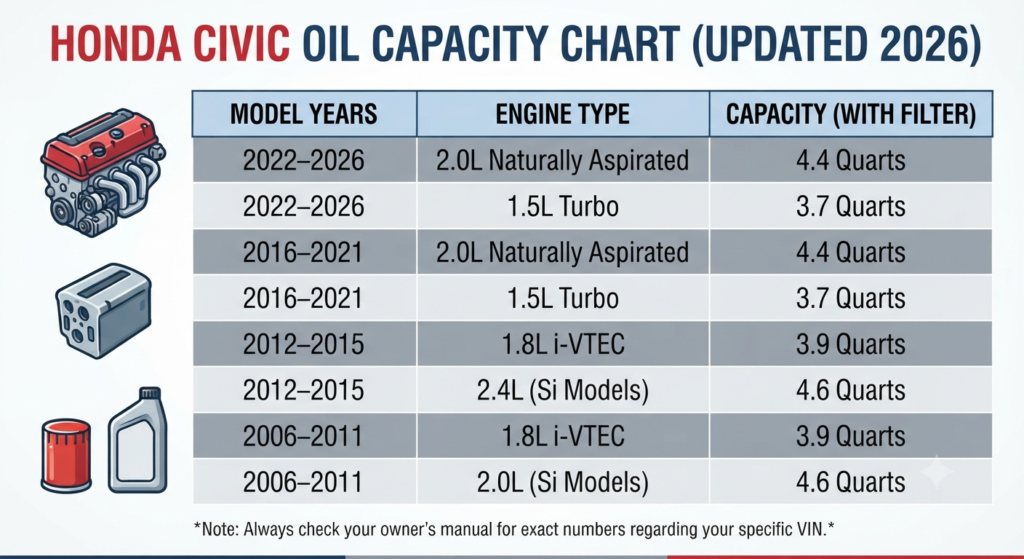
Always verify your specific trim level. Turbocharged engines and naturally aspirated engines often have different oil pans and requirements.
| Model Years | Engine Type | Capacity (With Filter) |
| 2022–2026 | 2.0L Naturally Aspirated | 4.4 Quarts |
| 2022–2026 | 1.5L Turbo | 3.7 Quarts |
| 2016–2021 | 2.0L Naturally Aspirated | 4.4 Quarts |
| 2016–2021 | 1.5L Turbo | 3.7 Quarts |
| 2012–2015 | 1.8L i-VTEC | 3.9 Quarts |
| 2012–2015 | 2.4L (Si Models) | 4.6 Quarts |
| 2006–2011 | 1.8L i-VTEC | 3.9 Quarts |
| 2006–2011 | 2.0L (Si Models) | 4.6 Quarts |
Note: Always check your owner’s manual for exact numbers regarding your specific VIN.
The Role of the Oil Filter
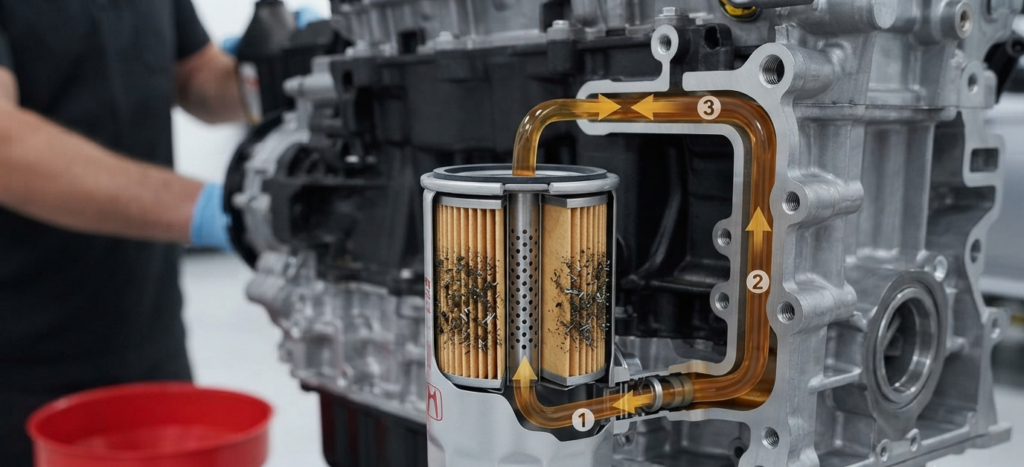
Many DIYers focus only on the oil and forget the filter. The filter is just as important as the oil itself.
During the oil change, you must always replace the filter. The old filter is filled with contaminants, metal shavings, and sludge from thousands of miles of driving.
If you use a new filter, it will absorb a small amount of oil when you first start the engine. This is why we always list the “Capacity with Filter” as the target number.
The Secret to a Leak-Free Change: The Crush Washer
One of the most overlooked components is the drain plug crush washer. This is a small, soft metal gasket that fits behind the bolt on your oil pan.
It is designed to compress once. When you tighten the bolt, the washer flattens out to create a perfect, airtight seal.
If you reuse an old, flattened washer, it cannot create a new seal. This is the #1 cause of minor oil leaks after a DIY oil change. Always spend the few cents to get a new OEM washer.
Step-by-Step: The Correct Way to Check Your Level
After you have poured in the recommended amount of oil, do not assume it is perfect. Follow this process:
- Park on level ground. If the car is on an incline, your reading will be inaccurate.
- Run the engine for one minute to circulate the oil into the new filter.
- Turn the engine off and wait three minutes. This allows the oil to drain back into the pan.
- Pull the dipstick, wipe it clean with a lint-free rag, and reinsert it fully.
- Pull it out again and observe the level. It should be between the two dots on the dipstick.
Managing Common Oil Change Mistakes
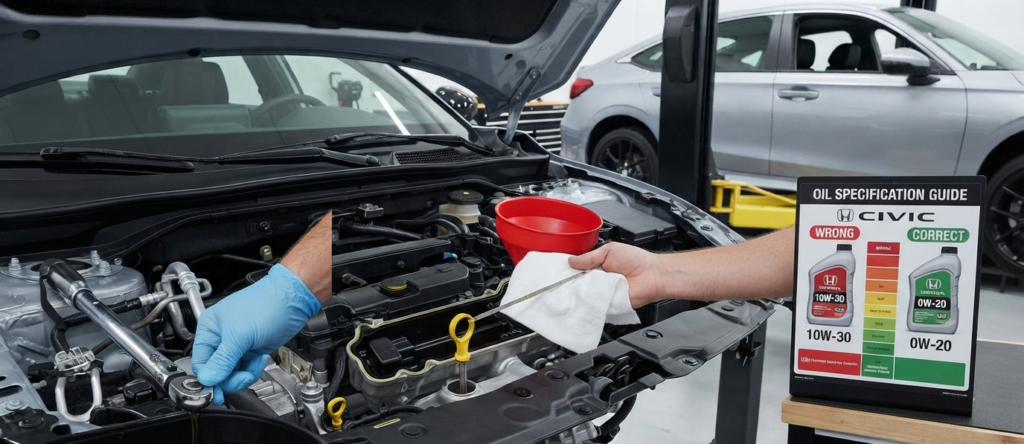
The “Overfill” Panic
If you check your dipstick and see the oil level is above the top mark, don’t panic. You can fix this easily.
Get under the car and place your drain pan under the plug. Slightly loosen the bolt just enough for a slow, thin stream of oil to escape. Tighten it back up once the level is correct.
Mixing Oil Brands
Can you mix different brands of the same viscosity (e.g., 0W-20)? Yes, it is safe in an emergency. However, it is always better to stick with the same brand and type for your full oil change.
The “Bigger Filter” Myth
Some people believe that using a larger oil filter will increase their oil capacity and improve engine health. While it technically adds a tiny amount of volume, it is generally unnecessary. Stick to the OEM size recommended by Honda.
Environmental Responsibility
Used motor oil is a significant environmental hazard. One quart of oil can contaminate thousands of gallons of water.
Never pour your old oil down the drain or onto the ground. Pour it into a sealed container and take it to a local auto parts store. Most major retailers in the US will accept used oil for recycling for free.
Tools You Will Need for the Job
- Socket Wrench Set: Specifically for the drain plug.
- Oil Filter Wrench: These can be tight; a dedicated wrench makes removal much easier.
- Drain Pan: Get one with a large surface area to prevent spills.
- Funnel: Keeps your engine bay clean while pouring.
- Latex Gloves: Used oil is toxic and harsh on the skin.
- Torque Wrench: Over-tightening the drain plug can strip the threads in your oil pan. Check the manual for the specific torque spec.
Frequently Asked Questions
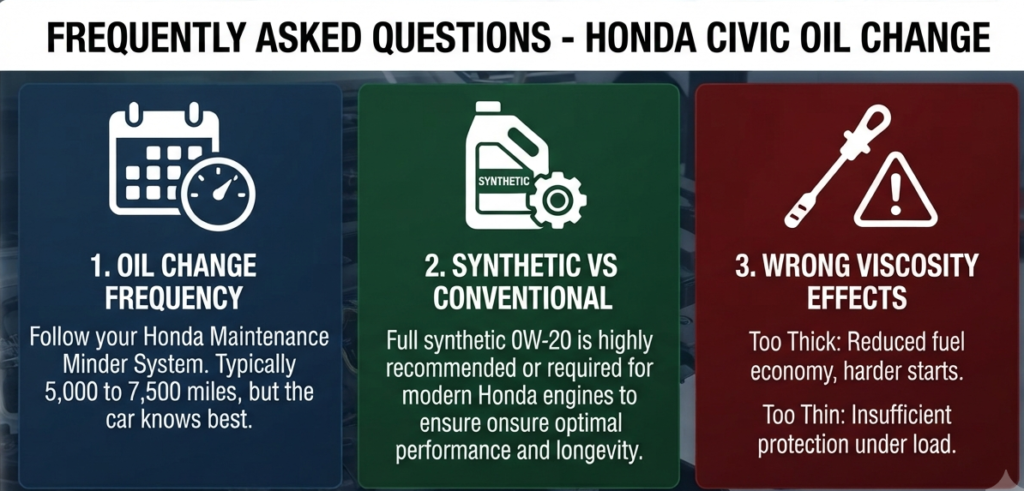
How often should I change my oil?
Modern Hondas have a Maintenance Minder system. It calculates your oil life based on how you drive. Generally, it is safe to change your oil every 5,000 to 7,500 miles, but follow the monitor in your dashboard.
Is synthetic oil really better?
Yes. Synthetic oil flows better in cold weather and is more resistant to heat breakdown. For modern Honda engines, full synthetic is highly recommended or required.
What happens if I use the wrong viscosity?
Using oil that is too thick will decrease your fuel economy and make starting the car harder in winter. Using oil that is too thin may not provide adequate protection under high loads. Stick to what is printed on your oil cap.