
2026 Honda Civic: Latest Model Year Changes
The Honda Civic enters the 2026 model year without a full redesign, since the last major refresh already landed for 2025. Even so, Honda made a handful of updates worth knowing about if you are cross shopping the compact sedan and hatchback segment.
Safety tech got a meaningful bump this year. Blind spot monitoring and rear cross traffic alert are now standard across every Civic trim, not just the higher end models. The Touring trim adds low speed braking support, front and rear parking sensors, and traffic sign recognition.
Infotainment also feels noticeably snappier for 2026. Honda improved software responsiveness across the touchscreen system, and the difference is most obvious on the larger 9 inch display found in upper trims. Exterior styling got a light touch as well, with refreshed front and rear fascias that give the car a sportier stance.
Pricing crept up slightly this year, as expected with inflation. Each of the five Civic trims saw a modest increase of a few hundred dollars over 2025 pricing. The lineup still spans from the value focused LX up through the Touring and Hybrid trims.
Speaking of the hybrid, it remains one of the biggest draws in the current Civic lineup. It pairs strong output with excellent fuel economy, making it a standout choice for buyers who want efficiency without giving up everyday performance. The hybrid continues largely unchanged mechanically for 2026.
Performance fans should take note of one important announcement. Honda confirmed that the manual only Civic Si will pause production after the 2026 model year, with dealer inventory expected to last into early 2027. An all new Si is expected to return in future years.
The Civic Type R also carries into 2026 with its formula intact. The turbocharged 2.0 liter engine still produces 315 horsepower and 310 pound feet of torque, paired exclusively with a 6 speed manual transmission. Honda updated the EPA fuel economy figures for 2026, but the driving experience enthusiasts love carries over unchanged.
Overall, 2026 is a steady, evolutionary year for the Civic rather than a dramatic one. Honda focused its energy on safety equipment, software polish, and keeping the lineup competitive on value. For most shoppers, that makes the 2026 Civic one of the most well rounded small cars on the market.
Honda Civic Reliability Through the Generations: Problems, Transmissions, and Maintenance Tips
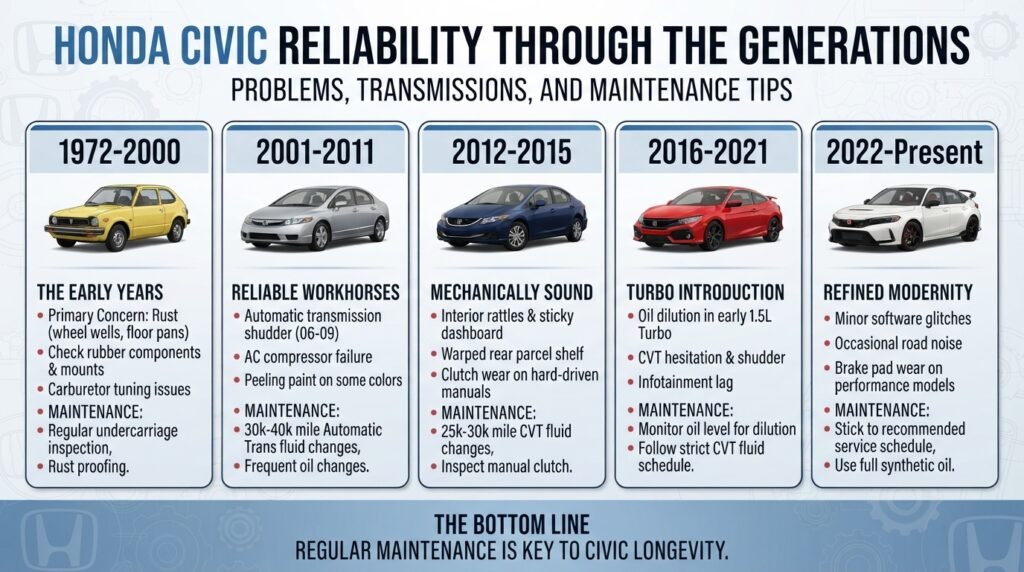
The Honda Civic has built a reputation as one of the most dependable compact cars in America, but that reputation was not built overnight. Every generation has its own quirks, and knowing them can save you real money down the road. Here is a generation by generation breakdown for US buyers and owners.
First Through Sixth Generation Civics (1972 to 2000)
These early Civics are prized today mostly by enthusiasts and collectors rather than daily commuters. Rust was the biggest long term enemy of these cars, especially in states that use road salt.
What to watch for:
- Rust around wheel wells, floor pans, and rocker panels
- Aging rubber components like hoses and engine mounts
- Carburetor issues on pre fuel injection models
Maintenance tips:
Regular undercarriage inspections and rust proofing go a long way on these older cars. Original manual transmissions from this era are famously tough and often outlast the rest of the vehicle.
Seventh and Eighth Generation Civics (2001 to 2011)
This stretch includes some of the most popular Civics ever sold in the US. Reliability was strong overall, though the 2006 to 2009 automatic models occasionally developed shifting harshness.
Common issues:
- Automatic transmission shudder or delayed engagement on some early eighth gen models
- AC compressor failures reported by owners in warmer climates
- Paint that could peel or chip more easily than expected on certain color codes
Transmission notes:
The 5 speed manual from this era is widely considered bulletproof with proper fluid changes. The automatic is solid as well once any early production issues were addressed by Honda through updated software and components.
Maintenance tips:
Stick to Honda approved automatic transmission fluid and change it every 30,000 to 40,000 miles even though some owners consider these units sealed for life. Regular oil changes every 5,000 to 7,500 miles keep the reliable four cylinder engines running for well over 200,000 miles.
Ninth Generation Civic (2012 to 2015)
The ninth generation gets criticized for cheaper interior materials, but mechanically it remains a strong performer. This is generally an easy Civic to live with as a used purchase.
Common issues:
- Interior rattles and a dashboard that can develop a sticky texture over time
- Rear parcel shelf material that can warp in high heat
- Occasional reports of clutch wear on manual models driven hard in city traffic
Transmission notes:
Both the 5 speed manual and the CVT introduced later in this generation have proven reliable when maintained properly. The CVT is smooth, though it should never be treated as maintenance free.
Maintenance tips:
Replace CVT fluid roughly every 25,000 to 30,000 miles using genuine Honda CVT fluid. This single habit is the most important thing you can do to protect a CVT equipped Civic from premature failure.
Tenth Generation Civic (2016 to 2021)
This generation brought a turbocharged 1.5 liter engine to the Civic lineup for the first time, and it came with a notable early issue. Some 1.5 liter turbo engines experienced oil dilution, where fuel seeped into the engine oil, particularly in cold climates with frequent short trips.
Common issues:
- Oil dilution in early 1.5 liter turbo engines, largely addressed through software updates
- CVT shudder or hesitation reported by some owners, especially at lower speeds
- Infotainment lag and occasional touchscreen unresponsiveness
Transmission notes: The CVT is the dominant transmission across this generation and is generally reliable, but it demands consistent fluid service. The 6 speed manual, offered on Si and Type R models, remains a favorite among enthusiasts for its durability.
Maintenance tips: Check your oil level more frequently if you drive mostly short trips in cold weather, since dilution can raise oil levels beyond normal. Follow Honda’s updated CVT fluid change interval closely, and consider more frequent changes if you tow, carry heavy loads, or drive in stop and go traffic often.
Eleventh Generation Civic (2022 to Present)
The current Civic, including the 2026 model year, benefits from years of Honda refining both the turbo engine and CVT technology. So far, this generation has reported far fewer widespread mechanical complaints than its predecessor.
Things owners still mention:
- Minor infotainment software glitches, usually solved with a system update
- Occasional road noise concerns on Touring trims with larger wheels
- Standard wear items like brake pads needing earlier attention on Si and Type R models driven aggressively
Transmission notes:
The updated CVT in this generation shifts more naturally and shows fewer shudder complaints than the previous generation. The Civic Type R still relies on its praised 6 speed manual, which remains one of the best shifting gearboxes in its class.
Maintenance tips:
Stick to Honda’s recommended service schedule, change your CVT fluid on time even if the dashboard does not flag it, and use full synthetic oil that meets Honda’s specification. These simple habits are the real secret behind the Civic’s long standing reputation for reliability.
The Bottom Line for Civic Owners
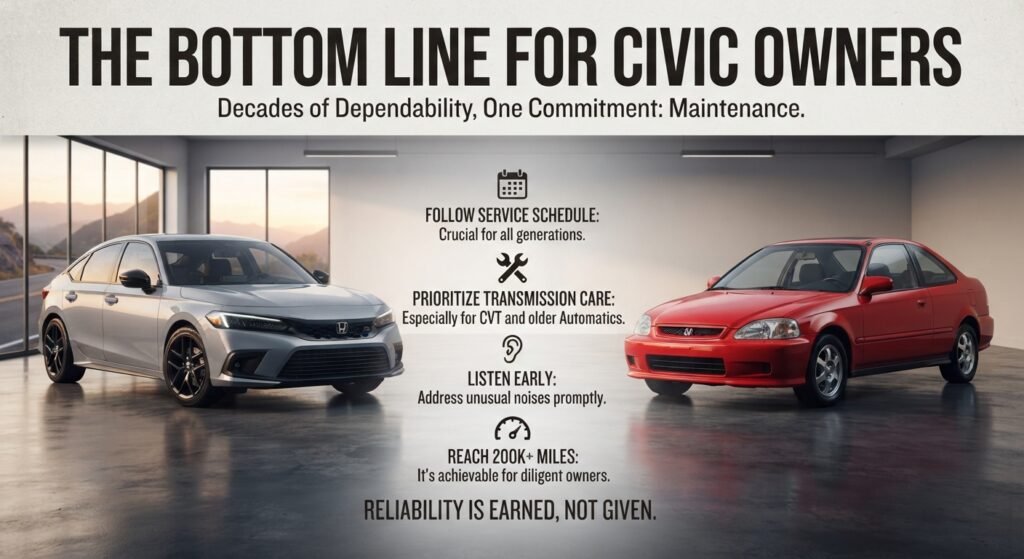
No matter which generation you own, the pattern is clear across decades of Honda engineering. Civics reward owners who stay ahead of routine maintenance and punish owners who skip it, especially when it comes to transmission fluid. Follow the service schedule, listen for unusual noises early, and a Civic from almost any generation can comfortably cross the 200,000 mile mark.