
Introduction
Driving a Honda Civic should always feel smooth, responsive, and completely effortless on the open road. If your steering wheel feels slightly crooked or your car drifts to one side, you know immediately that something is wrong.
Many drivers tend to ignore these minor driving symptoms until they notice bald patches destroying their expensive tires. Premature tire wear stands out as one of the frustrating and costly problems for everyday car owners. Fixing alignment issues early saves you hundreds of dollars in needless tire replacements and suspension repairs.
Who This Guide Is For
This guide is written specifically for US-based Honda Civic owners, DIY mechanics, and dedicated automotive enthusiasts. Whether you drive a daily commuter 9th-generation sedan or a sporty 11th-generation hatchback, precise wheel alignment matters. Potholes on interstate highways and rough city streets quickly knock modern suspension systems out of their factory alignment place.
Understanding Honda Civic Wheel Alignment Specs
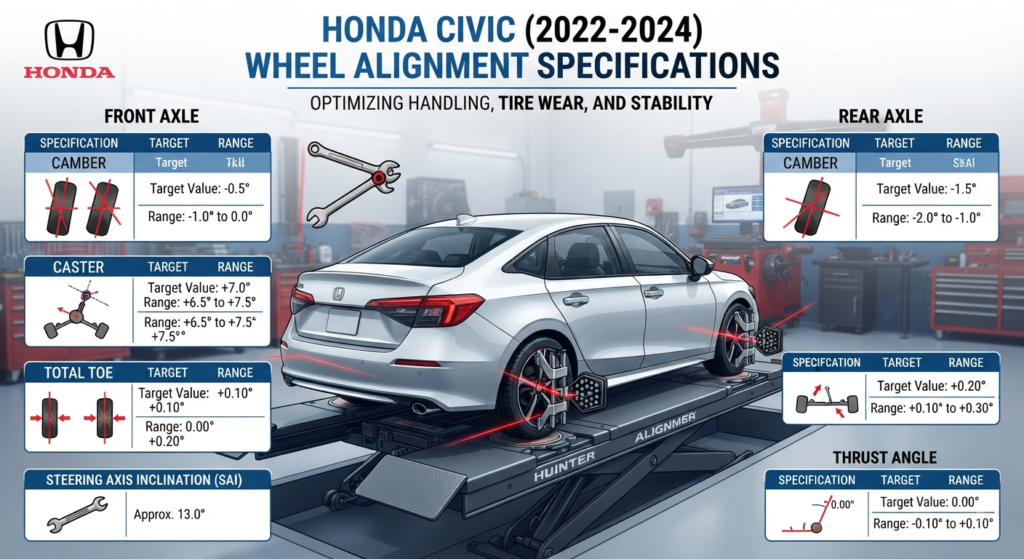
Proper wheel alignment relies entirely on three primary geometric angles working in harmony together. Understanding these core angles helps you communicate much better with your mechanic or your own garage alignment setup.
- Camber Angle:
The inward or outward tilt of the tire when viewed directly from the front of the vehicle.- Front Camber: Typically ranges from −0.8° to +0.2° depending on your specific trim level.
- Rear Camber: Usually ranges from −1.25° to −0.25° to maintain stability and cornering grip during sharp turns.
- Toe Settings:
The exact direction your tires point relative to the centerline of the vehicle when looking from above.- Front Total Toe: Tightly regulated around 0.16° to ensure stable straight-line driving on long highway commutes.
- Rear Total Toe: Sits between 0.08° and 0.32° to prevent the rear end of the car from wandering around.
- Caster Angle Dynamics:
The angle of your steering axis when viewed from the exact side profile of the car.- Front Caster: Usually non-adjustable on base models, but standard factory specs hover around 4.75° to 5.75°.
- Function: Correct caster ensures your steering wheel automatically returns to the center position after completing a sharp turn.
Note for Future Revisions: Add specific track or lowered suspension alignment parameters here as aftermarket suspension kits evolve.
Top Signs Your Honda Civic Needs a Wheel Alignment
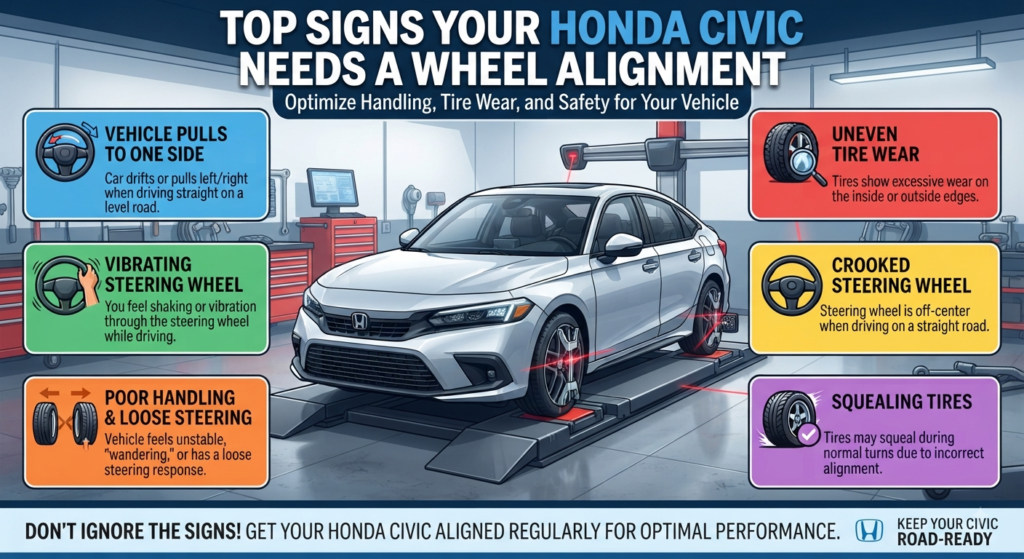
Your car constantly communicates alignment problems through subtle changes in driving behavior and steering feedback. Learning to spot these early symptoms prevents long-term suspension damage and sudden tire failure on the highway.
- The Persistent Pulling Drift:
Does your Civic drift to the left or right when you gently let go of the steering wheel on a flat highway? This pulling motion usually points directly to an incorrect front toe setting or a cross-camber issue. - Off-Center Steering Wheel:
Your steering wheel should always sit perfectly straight when you are driving down a flat and level road. If the wheel is crooked while your car goes straight ahead, your steering angles are completely out of sync. - High-Speed Steering Vibrations:
Bad toe angles create a constant, unnatural scrubbing motion between your rubber tread and the hot asphalt. This continuous friction translates directly into annoying steering wheel shakes and vibrations at high highway speeds.
Detailed Tire Wear Signs and What They Reveal
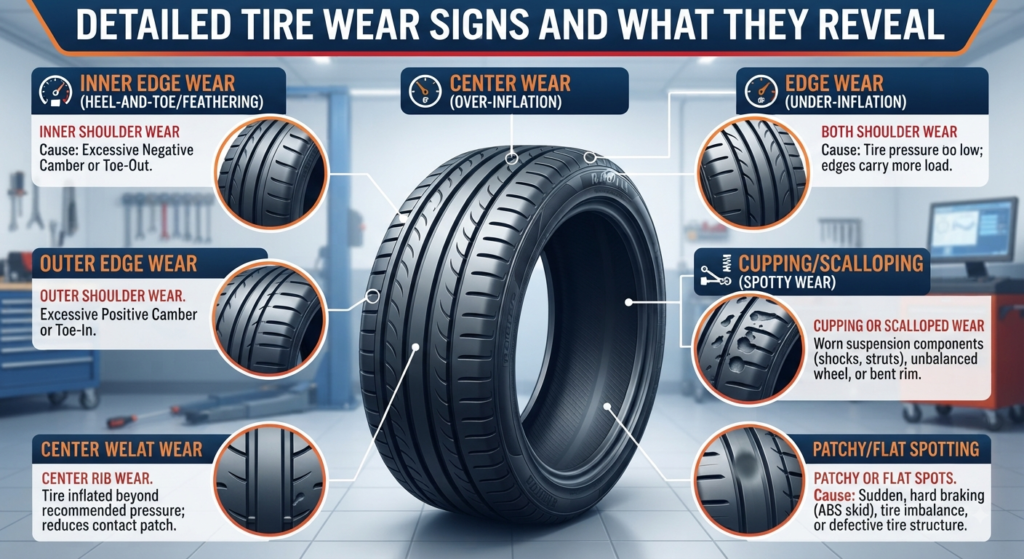
Your tires act as the ultimate visual report cards for your overall suspension health and alignment condition. Inspecting your tread patterns closely reveals exactly what kind of mechanical stress is happening beneath your car.
| Wear Pattern | Visual Characteristic | Primary Root Cause |
| Inner/Outer Shoulder Wear | Excessive wear on just one edge of the tire | Severe camber misalignment (negative eats inner edge, positive eats outer) |
| Feathering Patterns | Tread ribs smooth on one side, sharp on the other (sawtooth texture) | Incorrect toe settings |
| Cupping & Scalloping | Patchy, dipping divots and high spots around the tread circumference | Worn out shocks, struts, or severely unbalanced wheel assemblies |
Hidden Culprits Behind Repeated Misalignment
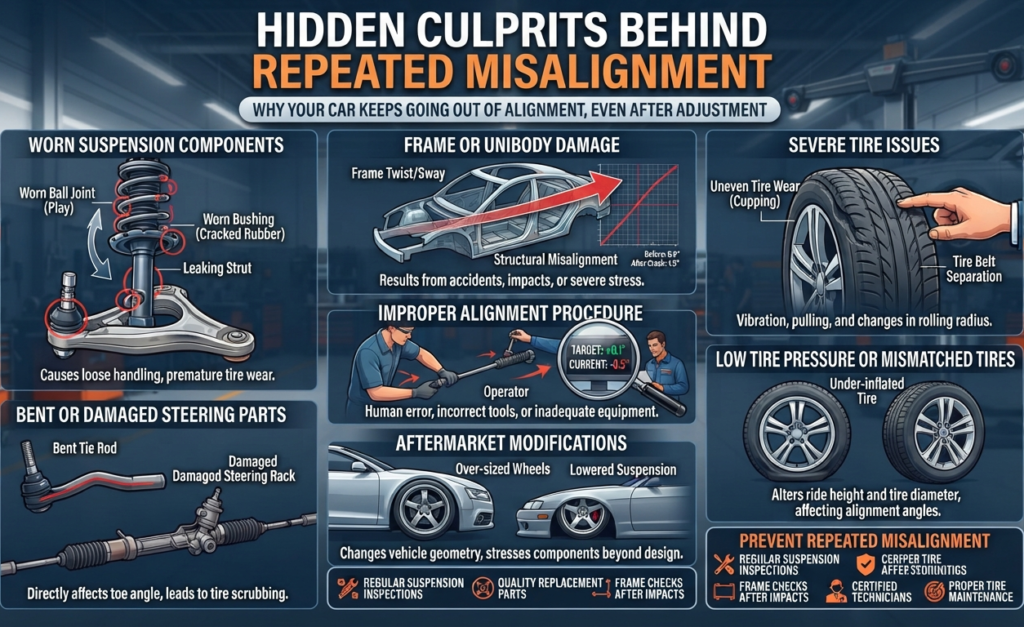
Sometimes you get a professional alignment done, but your car goes right back out of spec a few weeks later. Several hidden mechanical issues cause this frustrating pattern of persistent alignment failure:
- Worn Suspension Bushings and Joints:
Soft, cracked, or deteriorated lower control arm bushings allow your heavy wheels to shift dangerously under braking loads. Old ball joints and worn tie rod ends introduce massive amounts of loose play into the steering system. - Severe Impact Damage:
Hitting deep potholes, striking concrete curbs, or driving over aggressive speed bumps violently bends metal components. Even minor daily impacts can bend tie rods or knock vehicle subframes slightly out of their factory alignment slots. - Aftermarket Suspension Modifications:
Installing lowering springs or cheap coil overs drastically alters your factory suspension geometry and ride height. Without adding adjustable aftermarket camber arms, your tires will ride on extreme angles and wear out extremely fast.
Essential Maintenance Tips for Long Tire Life
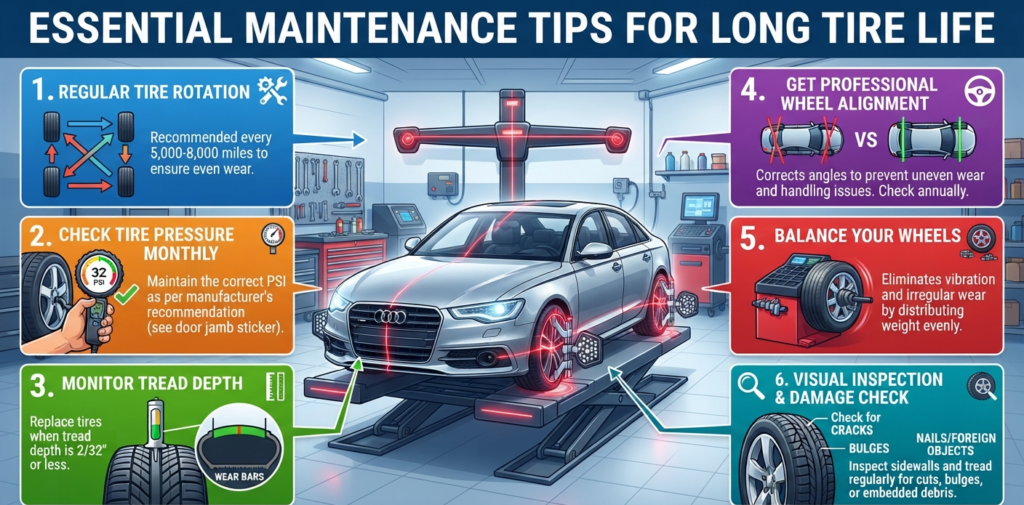
Maximizing the lifespan of your tires requires a proactive approach to routine vehicle maintenance:
- Check your tire pressures at least once a month because low pressure mimics uneven wear patterns.
- Rotate your tires every 5,000 to 7,000 miles to promote even tread wear across all four corners.
- Keep a close eye on your suspension parts whenever you take your car in for a routine oil change.
Conclusion and Final Maintenance Checklist
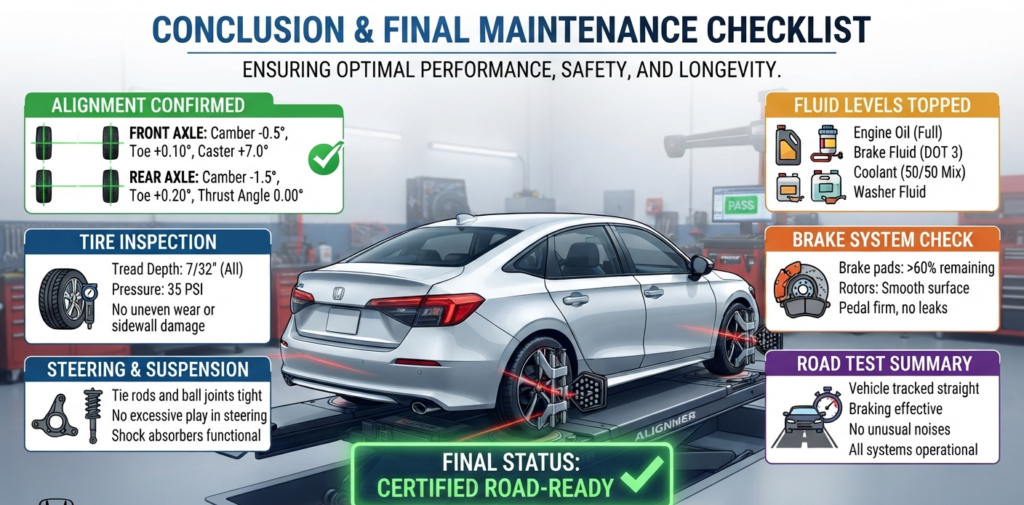
Proper wheel alignment keeps your Honda Civic safe, fuel-efficient, and fun to drive every single day. Schedule a professional alignment check every 5,000 to 10,000 miles or whenever you install a brand-new set of tires. Taking great care of your vehicle suspension today protects your bank account and safety tomorrow.