
Ever turned the key and felt like your Civic was struggling to wake up? Or maybe you noticed a weird stutter when you step on the gas to pass someone on the highway.
Those frustrating little hiccups are often your car’s way of telling you something is wrong with the fuel system specifically, a clogged or failing fuel filter.
When your engine is starved of clean gasoline, performance drops fast. Let’s break down how often you actually need to change your Civic’s fuel filter, the warning signs to look out for, and why older and newer models are completely different beasts.
The Short Answer: When to Replace It
The maintenance schedule for a Honda Civic fuel filter comes down to one major factor: the model year.
- Older Civic:
Feature an external inline filter that needs routine changes. - Modern Civic:
Use an in-tank fuel strainer built to last the lifetime of the vehicle (unless ruined by bad gas).
If you drive an older model, mechanics generally recommend swapping out the external filter every 30,000 to 50,000 miles to keep fuel pressure steady. Always check your specific owner’s manual for the exact mileage recommended by the factory.
5 Clear Signs Your Honda Civic Fuel Filter Is Clogged
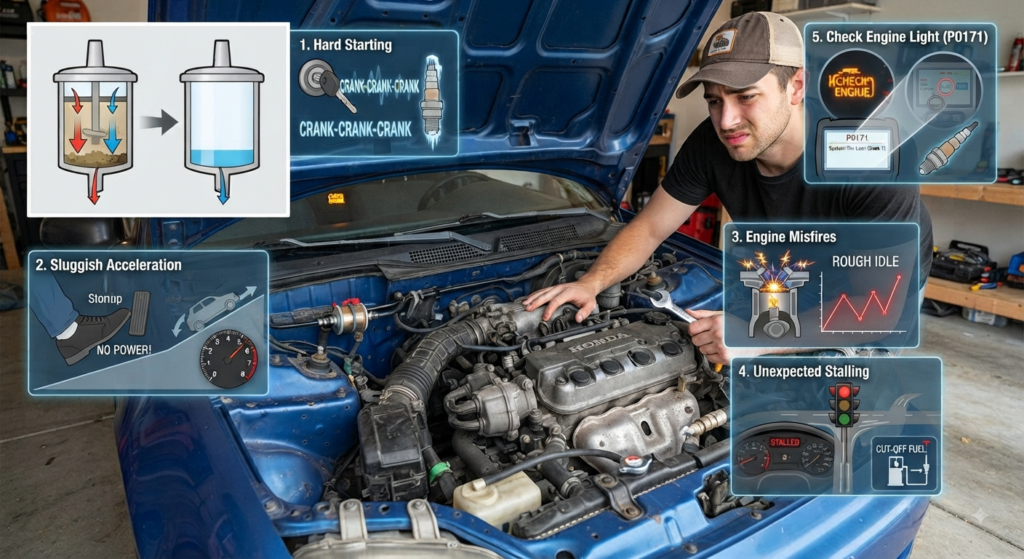
Catching a failing filter early can save you from a major roadside headache. Watch out for these common warning signs during your daily commute:
1. Hard Starting or Long Cranking
When sediment clogs your filter, fuel pressure drops during ignition. Instead of firing up right away, your starter motor might have to crank for several extra seconds before the engine finally catches. This is usually even worse on cold mornings.
2. Sluggish Acceleration Under Load
Does your Civic struggle when you try to merge onto a fast-moving highway or climb a steep hill? An obstructed filter starves the engine of the extra fuel it desperately needs under heavy throttle, causing the car to hesitate, jerk, or stutter instead of responding smoothly.
3. Engine Misfires and Rough Idling
Low fuel pressure creates a “lean” air-fuel mixture (too much air, not enough gas). This imbalance leads to random misfires and annoying, harsh vibrations while you’re sitting at a red light. You might even watch your RPM needle bounce up and down.
Warning:
Unburned fuel from misfires can eventually ruin your expensive catalytic converter.
4. Unexpected Engine Stalling
If the fuel restriction gets severe enough, the motor gets completely cut off from gasoline. Your Civic might suddenly stall out while you’re slowing down or idling at city speeds. It might start right back up after a minute, but the problem will keep coming back until you fix the filter.
5. Check Engine Light (P0171 Code)
Your car’s computer constantly monitors fuel levels using oxygen sensors. If it detects a consistently lean condition caused by low fuel pressure, it will light up the check engine dash icon. Running a diagnostic scan will often pop up a P0171 code.
Generation Breakdown: Old vs. New Civic
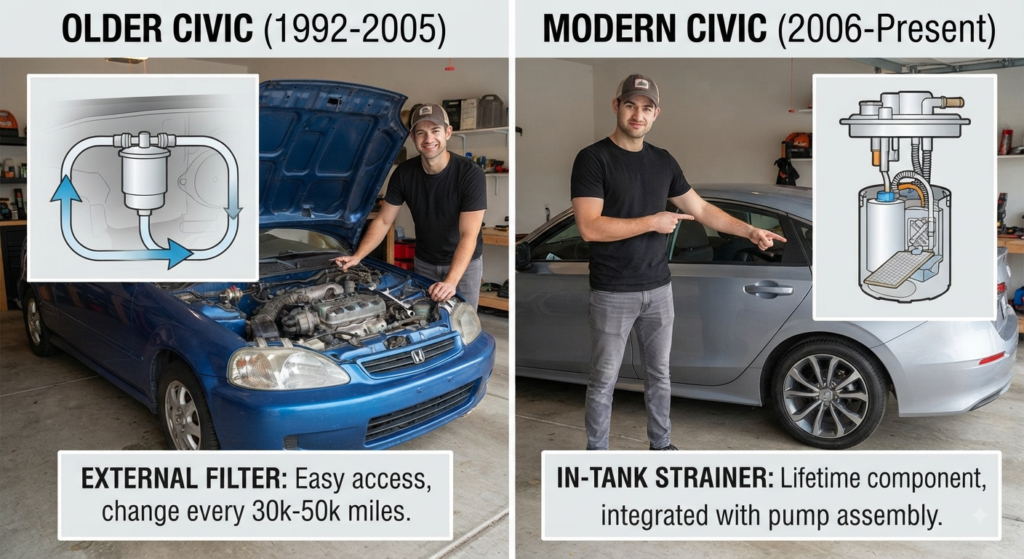
Maintenance requirements changed drastically over the years:
- 1992 to 2005 Models:
These classic generations have an external fuel filter mounted securely in the engine bay or near the rear chassis. Changing them every 30,000 to 50,000 miles is standard practice, and it’s a quick job that takes less than an hour with basic hand tools. - 2006 to Present Models:
Newer generations integrate the filter as a mesh strainer sock directly inside the fuel pump assembly. Honda considers this a lifetime component. You only need to touch it if heavy tank rust or heavily contaminated fuel ruins the assembly.
What Causes Premature Failure?
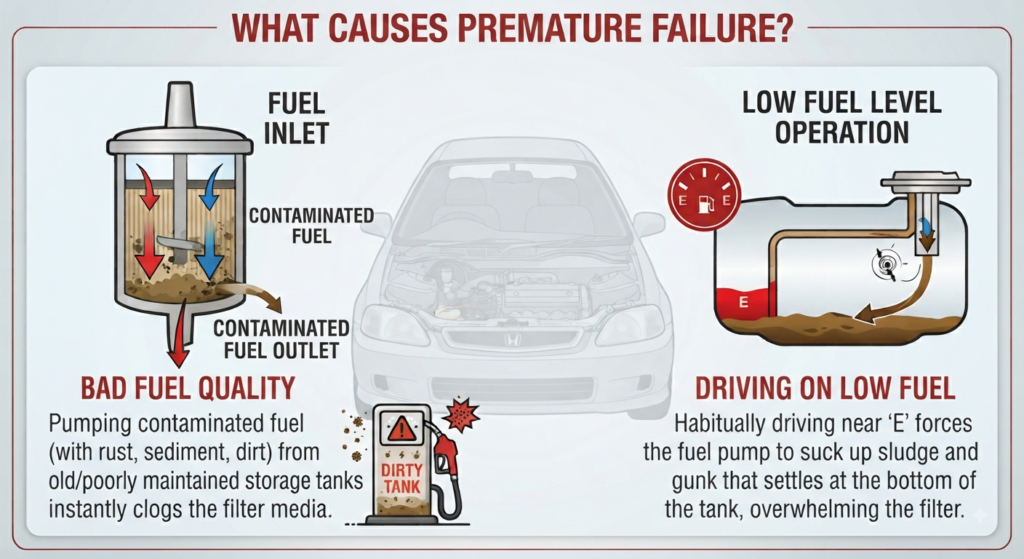
Filters don’t usually fail on their own; they get destroyed early by two main culprits:
- Bad Fuel Quality:
Pumping gas from stations with dirty underground storage tanks sucks heavy sediment, dirt, and rust straight into your system, clogging the filter media way ahead of schedule. - Driving on Low Fuel:
Habitually riding on empty forces your electric fuel pump to suck up all the sludge and gunk that settles at the bottom of the gas tank. Try to keep your fuel level above the quarter-mark whenever possible.
Frequently Asked Questions
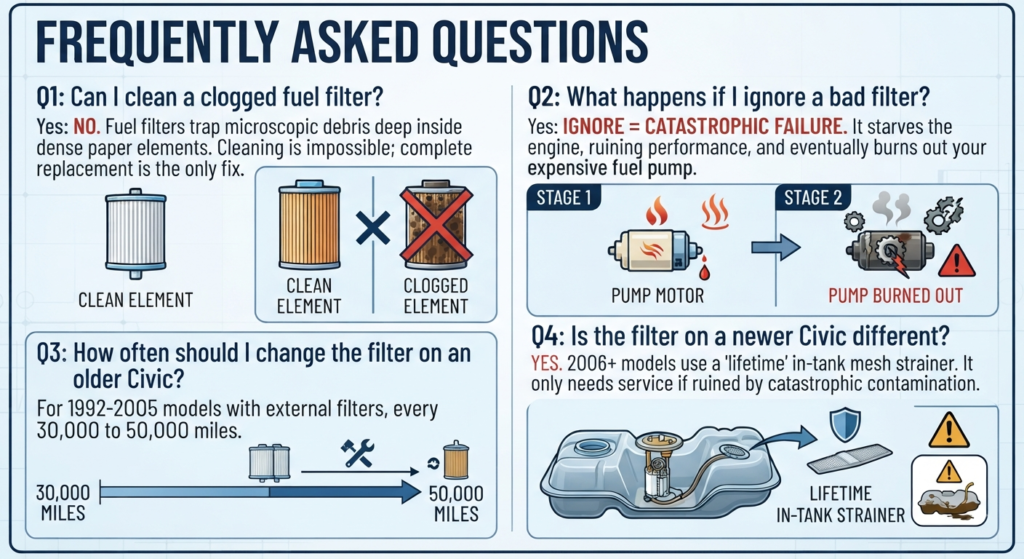
- Can I clean a clogged Honda Civic fuel filter?
No. Fuel filters trap microscopic debris deep inside dense paper elements. Cleaning them is impossible complete replacement is the only fix. - Will a bad fuel filter ruin my fuel pump?
Yes. A blocked filter forces your electric fuel pump to work twice as hard to push gas through the restriction, leading to premature motor burnout and total pump failure.
Conclusion
A healthy fuel delivery system is what keeps your Honda Civic running smoothly and efficiently. If you notice starting delays, a loss of power, or unexpected engine stuttering, don’t ignore it. Check your owner’s manual, keep an eye on your maintenance intervals, and keep your ride reliable for the long haul.