
The Honda Civic is widely considered the gold standard of compact car reliability. However, even the most legendary engineering has its blind spots. As a senior automotive technical writer, I have analyzed NHTSA data, service bulletins, and owner feedback to help you navigate the used market with confidence.
Being an informed owner does not mean avoiding the Civic entirely. It means knowing which specific years require a closer look and which mechanical gremlins are actually cost-effective to manage.
Quick Reference: Which Honda Civic Years Have Known Issues?
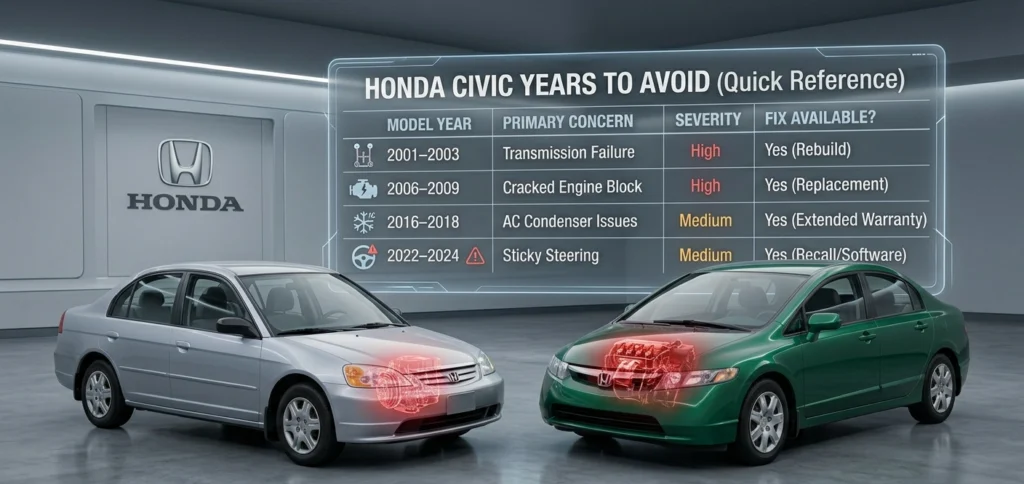
| Model Year | Primary Concern | Severity | Fix Available? |
| 2001–2003 | Transmission Failure | High | Yes (Rebuild) |
| 2006–2009 | Cracked Engine Block | High | Yes (Replacement) |
| 2016–2018 | AC Condenser Issues | Medium | Yes (Extended Warranty) |
| 2022–2024 | “Sticky” Steering | Medium | Yes (Recall/Software) |
7th Generation (2001–2005): The Transmission Warning
The early 2000s marked a rare stumble for Honda. Specifically, the automatic transmissions in the 2001 to 2003 model years are notorious for premature failure due to a design flaw that prevented adequate cooling of the gear sets.
Additionally, this generation was heavily impacted by the Takata airbag recall. This is a critical safety item that demands immediate attention.
Buying Strategy: The 7th Gen
If the transmission has already been replaced by a reputable shop with an updated unit, these cars can be excellent budget commuters. Crucial: Always check the VIN on the NHTSA website to ensure the Takata airbag recall has been performed. If not, budget to have it done immediately at a Honda dealer for free.
8th Generation (2006–2009): The Cracked Engine Block
The 2006 to 2009 Civics are fantastic cars in terms of handling and ergonomics, but they suffer from a well-documented casting defect in the engine block. Over time, these blocks could develop cracks, leading to coolant leaks and overheating.
Honda did issue a major extended warranty for this issue, and many engines were replaced free of charge by dealerships.
Buying Strategy: The Cracked Block
Do not let this reputation scare you away from a great deal. If you find a 2006–2009 Civic with service records showing the engine was replaced under Honda’s extended warranty, you are effectively buying a car with a much newer heart than the odometer suggests. Verify the repair via the VIN at a local Honda service department.
10th Generation (2016–2018): AC Condenser Failures
The 10th generation is widely praised, but many owners have experienced premature AC condenser failures. The factory-installed condensers were prone to leaking, leading to a loss of cooling performance.
This is a common point of contention where buyers walk away from perfectly good cars. However, Honda recognized this flaw and issued a 10-year, unlimited-mileage warranty extension for the AC condenser in many affected vehicles.
Buying Strategy: The AC Fix
If you are looking at a 2016–2018 model, check if the AC is blowing cold. If it is not, ask the seller if the condenser has been replaced. If it hasn’t, you can often use this as a leverage point to lower the price, then take it to a dealer to have the repair performed under the extended warranty program.
11th Generation (2022–2025): The Steering Recall
The 11th generation is currently the benchmark for the segment. However, some 2022 to 2025 models were subject to a recall regarding the Electric Power Steering (EPS) rack. Drivers reported a “sticky” sensation or increased effort required to center the steering wheel while driving at highway speeds.
This is an issue managed by NHTSA recall 24V-744. It is not an engine-destroying mechanical failure, but it does impact driver comfort and safety.
Buying Strategy: The Steering Fix
This is a software and hardware update issue. If you are considering a newer Civic, simply input the VIN into the NHTSA lookup tool. If the recall is listed as “Open,” require the seller to have the work completed at a dealership before you finalize the purchase. Once the recall is satisfied, these vehicles are highly reliable.
The “Rescue Plan”: How to Safely Buy a “Problem Year”
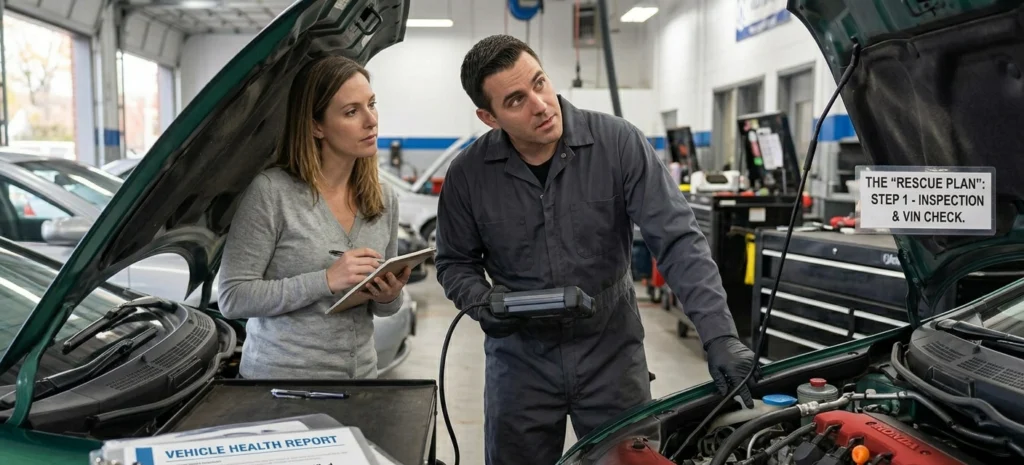
Buying a car with a known issue is not a mistake if you do it intentionally. Use this checklist to protect your investment:
- Run the VIN: Use the official NHTSA website to check for any outstanding safety recalls. Never skip this step.
- Verify Service Records: Look for receipts that specifically mention the repair of the known issue (e.g., “Engine block replaced per TSB” or “AC condenser replaced”).
- Pre-Purchase Inspection (PPI): Pay an independent mechanic $150 to $200 to inspect the car. Tell them explicitly to look for the known issues mentioned in this guide.
- Negotiate: Use the findings of your inspection as leverage. If a repair is needed, deduct the cost of that repair from your offer.
Which Years Are the “Goldilocks” Civics?
If you prefer to avoid the stress of “rescue” vehicles, these years represent the best of Honda’s reliability:
- 2012–2015 (9th Generation): These years are often called the most reliable Civics ever built. They utilize a mature platform with no major catastrophic engine or transmission flaws.
- 2019–2021 (10th Generation Refresh): By 2019, Honda had refined the 10th generation, resolving the AC condenser issues found in earlier models and fine-tuning the CVT transmissions.
These “Goldilocks” years offer a perfect balance of modern safety features, fuel efficiency, and the long-term mechanical peace of mind that Honda is famous for.