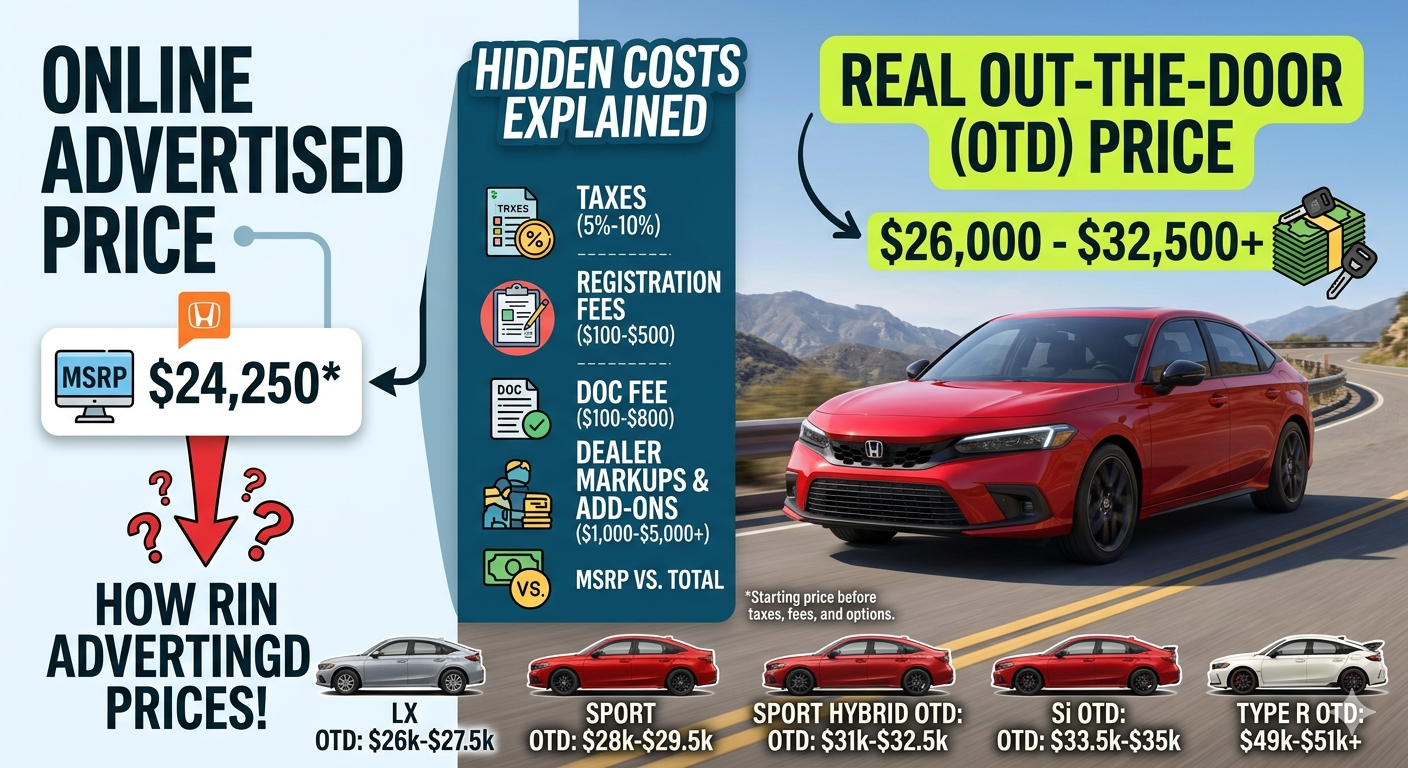
You found a Honda Civic online for $24,250. Great price, right?
Not so fast.
That number is just the starting point. By the time you drive off the lot, the real price is often thousands of dollars more. Taxes, fees, and dealer add-ons can quietly push the total way past what you expected.
This guide breaks it all down. We cover the MSRP for every trim level, the hidden fees dealers charge, and the true out-the-door cost you will actually pay. We also look at long-term costs like insurance and maintenance so you know the full picture before you sign anything.
No fluff. No confusing jargon. Just straight answers.
Honda Civic MSRP by Trim Level (2025)

The 2025 Honda Civic comes in several versions. Each one is built for a different type of driver. Here is what you can expect to pay at the starting price before any fees.
Standard Gas Trims (LX and Sport)
These are the most popular Civic models. They run on a regular gas engine and are great for everyday driving.
- LX: Starts at $24,250 MSRP. Best for first-time car buyers or anyone who wants a reliable daily driver at the lowest possible price.
- Sport: Starts at $26,250 MSRP. Best for drivers who want a bit more style and sportier features without spending extra on a hybrid.
Both trims use a 2.0-liter four-cylinder engine rated at 150 horsepower. Fuel economy is around 32 city and 41 highway for the LX, and 31 city and 39 highway for the Sport.
The New Civic Hybrids
2025 is a big year for the Civic. Honda brought back the hybrid after nearly 10 years away. It is now the most fuel-efficient option in the lineup.
- Sport Hybrid: Starts at $28,750 MSRP. Best for daily commuters who want strong fuel savings and bonus features like heated seats and a moonroof.
- Sport Touring Hybrid: Starts at $31,750 MSRP. Best for buyers who want everything, including a premium Bose sound system, wireless Apple CarPlay, and Google Built-In tech.
Both hybrid trims deliver up to 50 city and 47 highway MPG. That is a massive jump from the gas-only versions and can save real money over time at the pump.
Performance Trims (Si and Type R)
These trims are for drivers who want more power and a more exciting experience behind the wheel.
- Civic Si: Starts around $31,100 MSRP. Best for enthusiasts who want a fun manual-transmission sedan that is still practical for everyday use.
- Civic Type R: Starts at $45,895 MSRP. Best for serious performance drivers who want the most powerful Civic ever made, with 315 horsepower and race-tuned handling.
Keep in mind that both the Si and Type R come with manual transmissions only. There is no automatic option.
The Hidden Costs: What Is the Actual Out-The-Door (OTD) Price?

Here is the part most car ads leave out. The MSRP is never what you actually pay. There are several costs added on top that can add $2,000 to $5,000 or more to your total bill.
State Taxes and Registration
Every state charges sales tax on car purchases. In most states, this runs between 5% and 10% of the vehicle price. On a $26,250 Civic Sport, a 7% tax alone adds over $1,800 to your cost.
On top of that, you will pay title and registration fees. These vary by state but usually range from $100 to $500.
You will also see a documentation fee, sometimes called a doc fee. Dealers charge this for paperwork processing. It can be anywhere from $100 to $800 depending on the state.
A simple way to estimate your out-the-door price is to add 8% to 12% on top of the MSRP. So a $24,250 LX could realistically cost $26,200 to $27,160 after all fees and taxes in many states.
Dealer Markups and Forced Add-ons
Quick Tip: Before you sign, ask for a full itemized quote. Then politely say: “I would like to purchase at MSRP with no additional dealer add-ons.” If they refuse, you can walk away and try another dealer. Many Honda dealers will work with you, especially if inventory is healthy.
This is where buyers often get surprised. Some dealers add extra charges that have nothing to do with the actual car.
Watch out for these common add-ons:
- Nitrogen tire fill: Dealers may charge $150 to $300 to fill your tires with nitrogen instead of regular air. Regular air works just fine.
- Pin striping: A decorative stripe painted on your car. Often priced at $200 to $500. Most buyers do not want this.
- Fabric protection or paint sealant: These are usually sprayed on before you even see the car and billed at $300 to $800.
- Market Adjustment fees: Some dealers add thousands of dollars above MSRP just because demand is high. This is legal, but you do not have to accept it.
Long-Term Ownership: Insurance and Maintenance Costs
The purchase price is just one part of what you spend on a car. Over five years, insurance and maintenance add up fast. The good news is the Civic is one of the most affordable cars to own long-term.
Why Civic Insurance Can Be Expensive
The Honda Civic is popular, which makes it a target for theft in some areas. Insurance companies know this and price policies accordingly.
For a driver in their 30s with a clean record, annual insurance on a Civic runs roughly $1,200 to $1,800 per year. But for younger drivers under 25, that number can jump to $2,500 to $3,500 or more per year.
The Type R is the most expensive to insure. It is a high-performance car, which means higher risk in the eyes of insurance companies. Expect to pay significantly more for coverage on that trim.
Shopping around and comparing multiple quotes can save you hundreds of dollars a year. Always get at least three quotes before choosing a policy.
5-Year Maintenance Expectations
This is where the Civic really shines. Honda has a strong reputation for making cars that are cheap and easy to maintain.
For the first two years, Honda includes complimentary maintenance as part of the Honda Maintenance Minder program. This covers oil changes and tire rotations at no extra cost.
After that, typical annual maintenance costs are around $300 to $500 per year. This covers oil changes, filters, and routine inspections.
Over five years, most Civic owners spend between $1,500 and $2,500 on maintenance. That is well below average for compact cars. Brakes, tires, and the occasional unexpected repair may add to this, but the Civic has a solid reliability track record.
The hybrid models may have slightly lower fuel costs but similar maintenance needs. The hybrid battery is covered under Honda’s warranty for 8 years or 100,000 miles.
Is the Civic Hybrid Worth the Extra Money?

This is one of the most common questions from shoppers comparing the Sport at $26,250 versus the Sport Hybrid at $28,750. That is a $2,500 difference upfront.
Here is the honest answer for a daily commuter in the US.
The Sport Hybrid gets around 49 MPG combined. The regular Sport gets around 34 MPG combined. If you drive 12,000 miles per year and gas costs around $3.50 per gallon, the hybrid saves you roughly $350 to $450 per year in fuel alone.
At that savings rate, it takes about 5 to 7 years to break even on the price difference. If you plan to keep the car for a long time, the hybrid wins financially and you get extra features like heated seats and a sunroof included.
If you only plan to keep the car for 3 to 4 years, the standard Sport may make more financial sense. You spend less upfront and still get a highly reliable, fun car.
Bottom line: The hybrid is the better long-term value. The gas Sport is the better short-term buy.
Final Verdict: How to Get the Best Price on a Civic Today

The 2025 Honda Civic is one of the smartest compact car buys on the market right now. But the sticker price is only the beginning. Add taxes, fees, and insurance, and the real cost of ownership looks quite different.
Here is a quick summary of real costs to expect:
- LX: $24,250 MSRP, roughly $26,000 to $27,500 out the door
- Sport: $26,250 MSRP, roughly $28,000 to $29,500 out the door
- Sport Hybrid: $28,750 MSRP, roughly $31,000 to $32,500 out the door
- Si: $31,100 MSRP, roughly $33,500 to $35,000 out the door
- Type R: $45,895 MSRP, roughly $49,000 to $51,000+ out the door
Before you head to the dealership, use these three tips to make sure you get the best deal:
- Always negotiate the out-the-door price, not just the monthly payment. The total price is what matters.
- Shop at the end of the month. Dealers often have sales targets to hit, which means they are more willing to negotiate in the final days of the month.
- Get pre-approved for a car loan from your bank or credit union before visiting the dealer. This gives you real leverage and stops dealers from building profit into your financing rate.
Have you recently bought a 2025 Honda Civic or gotten a dealer quote? Drop your out-the-door price in the comments below. Sharing your experience helps other buyers know what to expect in their area.