Published for US Car Buyers | Auto Insurance Analysis
The Short Answer and Why It Matters for Your Premium
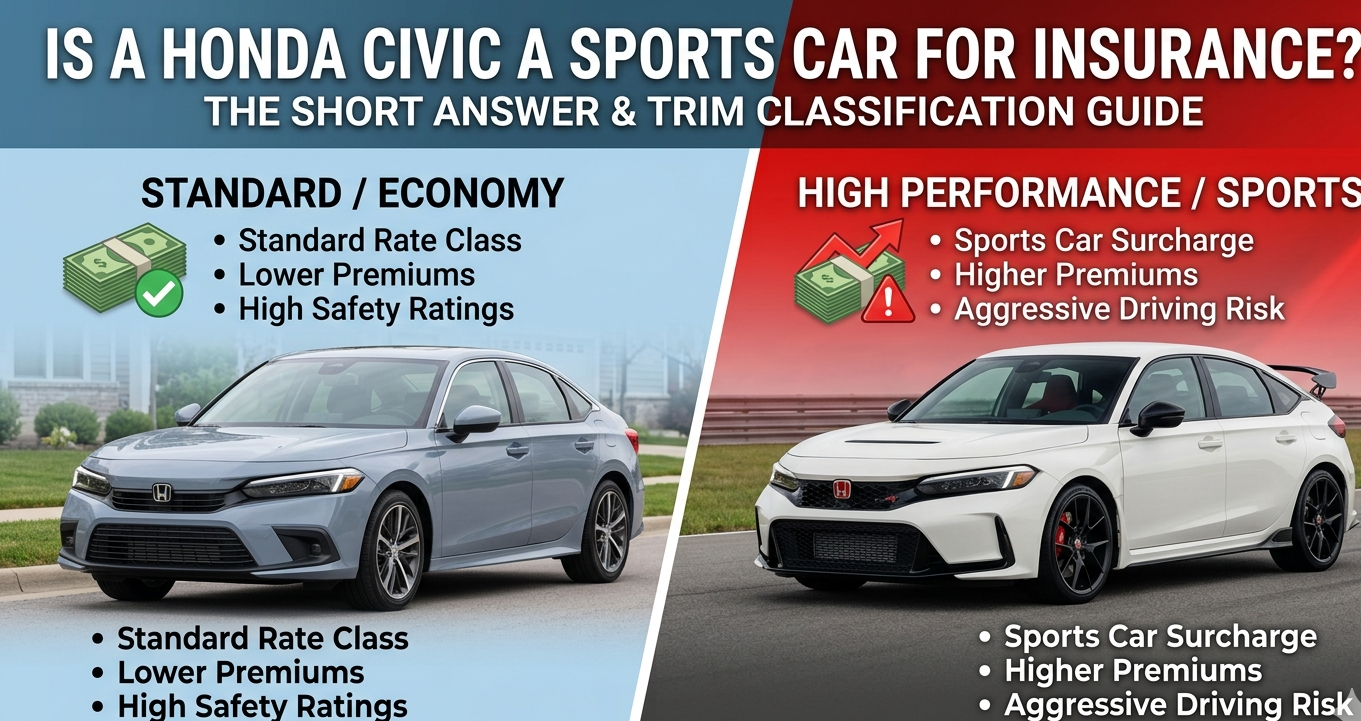
No a standard Honda Civic is not classified as a sports car for insurance purposes. Insurers categorize it as a compact car or economy sedan, which is one of the most affordable vehicle classes to insure in the United States. However, there are two notable exceptions: the Honda Civic Si and the Honda Civic Type R. Both carry turbocharged, high-output engines and are explicitly flagged by underwriters as high-performance vehicles, which triggers a measurable surcharge on premiums. Understanding exactly where your trim level falls on that spectrum can save you hundreds of dollars per year.
This distinction matters most for young and first-time car buyers. Insurance agents and automated rating systems do not always explain why your quote is higher than expected. If you are shopping for a Civic or already own one, knowing how your specific trim is classified gives you the knowledge to dispute a misclassification, choose the right trim for your budget, and negotiate discounts confidently.
The sections below walk through how US insurers classify the Civic’s full trim lineup, what underwriting criteria actually determine sports car status, what you can expect to pay in 2026, and how to bring your premium down regardless of which Civic you drive.
How Auto Insurers View Each Honda Civic Trim
Insurance companies do not price vehicles by model name alone. They decode your Vehicle Identification Number (VIN) to access factory build data engine displacement, horsepower rating, body style, and safety equipment. That data, not the name on the badge, determines your rate classification. Here is how each Civic tier is treated.
Standard Trims (LX, EX, Touring)
The LX, EX, and Touring trims are powered by a naturally aspirated 2.0-liter four-cylinder engine producing approximately 158 horsepower. That output falls well within the compact economy category. All three are available as four-door sedans or five-door hatchbacks, both of which are body styles associated with lower actuarial risk profiles.
Insurers treat these trims as standard passenger vehicles. They do not receive a sports car surcharge, and in most states they qualify for the lowest vehicle classification tier, resulting in lower comprehensive, collision, and liability base rates.
The Sport Trim: Clearing Up a Common Misconception
One of the most persistent myths among Civic buyers is that the Sport trim carries higher insurance rates because of the word “Sport” in its name. This is factually incorrect.
The Civic Sport uses the same 158-horsepower, 2.0-liter engine as the base LX. The Sport designation refers to aesthetic and equipment differences a rear spoiler, larger wheels, a sport-tuned exhaust note, and specific interior trim none of which are factors in insurance underwriting. When an insurer decodes your Sport’s VIN, they see identical mechanical specifications to the LX. Your rate will reflect that.
If a quote for a Civic Sport comes back substantially higher than a comparable LX quote from the same insurer, verify that the agent has entered the correct VIN. The difference should be negligible, driven only by features like standard Honda Sensing on the Sport trim, which can marginally affect repair costs.
High-Performance Trims (Civic Si and Type R)
The Civic Si and Civic Type R occupy an entirely different risk tier. Both are turbocharged, both are driver-focused performance vehicles, and both are rated accordingly by virtually every major US carrier.
The Si uses a 1.5-liter turbocharged four-cylinder producing 200 horsepower and comes exclusively as a four-door sedan. The Type R uses a 2.0-liter turbocharged engine producing 315 horsepower in its current generation and is sold only as a five-door hatchback. The Type R’s power-to-weight ratio, racing-derived suspension, and track-oriented design place it squarely in sports car territory for insurance classification purposes.
Expect a meaningful premium increase for both trims relative to the standard lineup typically 15 to 30 percent higher for the Si and 30 to 50 percent higher for the Type R, depending on the carrier and the driver’s history.
What US Insurance Underwriters Actually Use to Classify a Sports Car
No single federal standard defines “sports car” for insurance purposes. Each insurer uses proprietary rating algorithms, but the following factors are consistently applied across the industry.
Horsepower and Power-to-Weight Ratio
Horsepower is the most direct trigger for a performance surcharge. Most carriers apply elevated classifications to vehicles exceeding 200 to 230 horsepower, though thresholds vary. The power-to-weight ratio horsepower relative to curb weight is a secondary metric that captures turbo-light sports cars with smaller engines but aggressive performance characteristics.
The Civic Type R’s 315 horsepower in a vehicle weighing approximately 3,100 pounds produces a ratio that flags it as high-performance in virtually every carrier’s system. The base Civic’s 158 horsepower in a similarly weighted chassis does not.
Number of Doors and Body Style
Two-door coupes and convertibles historically carry higher premiums than four-door sedans and hatchbacks, because statistical loss data shows coupe drivers on average file more high-speed and at-fault collision claims. The Honda Civic coupe was discontinued after the 2020 model year, but older two-door Civics from 2016 through 2020 may still carry a minor surcharge under some carriers’ classification systems, even on the base engine, solely because of the two-door body style.
Modern Civics (2022 onward) are available only as four-door sedans or five-door hatchbacks. That change in body style eliminated the coupe classification concern for new buyers, contributing to the current generation’s generally favorable insurance rates.
Historical Accident and Theft Rates
Insurance rating is fundamentally actuarial. Underwriters consult ISO (Insurance Services Office) and internal loss data to assess how often a given vehicle model and trim is involved in claims collisions, thefts, liability events, and comprehensive losses.
The Honda Civic has historically performed well in theft statistics, particularly since the advent of engine immobilizers. Its collision frequency is consistent with the broader compact car segment. High-performance trims like the Type R introduce different loss data: when they are involved in accidents, repair costs are substantially higher due to specialized components, which factors into collision and comprehensive premium calculations.
2026 Honda Civic Insurance Costs: What to Expect
The Honda Civic is consistently one of the most cost-effective vehicles to insure in the compact car category. For 2026 model year vehicles with full coverage comprehensive, collision, and liability national averages range from approximately $1,900 to $3,051 annually. The wide range reflects variation in state regulations, driver age, credit score (where permitted), and local claims frequency.
Young drivers aged 18 to 25 will typically sit at the higher end of that range. A 20-year-old insuring a 2026 Civic LX in a mid-density urban area can realistically expect to pay $2,400 to $3,051 annually with full coverage, compared to $1,900 to $2,300 for a driver in their 30s with a clean record. State minimums-only policies can drop the annual cost considerably, though they leave you exposed to out-of-pocket costs in an at-fault accident.
IIHS Safety Ratings and Crash Prevention Technology
The 2024 and 2025 Honda Civic received a Top Safety Pick+ designation from the Insurance Institute for Highway Safety (IIHS), the highest available rating. This matters directly to your premium. Vehicles with strong IIHS ratings statistically generate fewer and less severe injury claims, which insurers reward through lower bodily injury liability rates.
All current Civic trims include Honda Sensing as standard equipment. This suite covers adaptive cruise control, forward collision warning, automatic emergency braking, lane keeping assist, and road departure mitigation. Carriers such as Allstate, Progressive, and Nationwide factor active safety equipment into their ratings algorithms. The presence of automatic emergency braking, in particular, has been shown to reduce rear-end collision frequency by up to 50 percent in real-world studies, and some carriers apply an explicit discount for it.
Affordable Replacement Parts
A major but underappreciated driver of insurance costs is the cost to repair a vehicle after a collision not just the cost of the vehicle itself. Honda Civic parts are among the most widely available and least expensive in the compact car segment. Aftermarket alternatives are abundant, OEM parts are competitively priced, and labor hours for common repairs are well-documented, keeping shop estimates lower than for luxury or low-volume vehicles.
This translates directly into lower collision and comprehensive premiums. For a budget-conscious buyer, choosing a vehicle with low repair costs is as meaningful a financial decision as negotiating the sticker price and the Civic’s parts ecosystem works in your favor.
How to Lower Your Honda Civic Insurance Premiums
The following strategies are specific to the US market and are most impactful for drivers in their teens and twenties. Not every tactic applies to every carrier, but each one is worth a direct inquiry.
- Good Student Discount. Most major carriers State Farm, GEICO, Allstate, USAA offer a discount ranging from 8 to 25 percent for full-time students with a GPA of 3.0 or higher. You will typically need to submit a transcript or grade report annually. Ask your agent explicitly whether this discount has been applied to your policy.
- Defensive Driving Course Discount. Completing a state-approved defensive driving or driver improvement course can reduce your premium by 5 to 15 percent. In several states including New York, California, and Texas, these courses also reduce points on your driving record. Online options are widely available for under $40 and can be completed in a single day.
- Telematics and Usage-Based Insurance Programs. Programs such as Progressive Snapshot, State Farm Drive Safe & Save, and Allstate Drivewise monitor your actual driving behavior speed, braking, time of day, and mileage through a mobile app or OBD-II device. Safe drivers typically save 10 to 30 percent. If you drive infrequently or mainly during daytime hours, these programs are especially advantageous.
- Increase Your Deductible. Raising your collision deductible from $500 to $1,000 can reduce your collision premium by 10 to 20 percent. This is an effective strategy if you have an emergency fund sufficient to cover the higher out-of-pocket cost.
- Bundle Your Policies. Combining auto insurance with renters or homeowners insurance from the same carrier typically yields a multi-policy discount of 5 to 20 percent on both policies.
- Shop the Market Annually. Insurance rates change year over year, and loyalty does not always reward the policyholder. Running a comparison quote through your state insurance commissioner’s website, an independent broker, or a comparison platform every 12 months ensures you remain at a competitive rate.
Frequently Asked Questions
Will aftermarket modifications raise my insurance rates?
Yes and potentially more than you expect. Aftermarket modifications that increase performance (cold air intakes, exhaust systems, ECU tunes, suspension upgrades) or alter the vehicle’s value (custom wheels, body kits, audio systems) can void your standard policy’s coverage for those components and may trigger a reclassification of the vehicle’s risk profile.
You are required to disclose significant modifications to your insurer. Failure to do so can result in a denied claim. If you plan to modify your Civic, speak with your agent beforehand and ask whether a specialty or modified car endorsement is available. Companies like Hagerty, Heacock Classic, and American Collectors Insurance specialize in modified vehicle coverage.
Is the Civic Hatchback more expensive to insure than the Sedan?
In most cases, no the difference in premium between the Civic Sedan and Civic Hatchback of the same trim level is negligible. Both share the same engine, the same safety equipment, and similar repair cost profiles. The hatchback’s slightly larger cargo area does not affect insurance classification. Any premium difference you observe between quotes for the two body styles is more likely attributable to regional variation in claims data than to an intrinsic cost differential.
The exception is the Civic Type R, which is only available as a hatchback and carries a higher premium but that premium reflects the Type R’s performance specifications, not the hatchback body style itself.
What if an agent misclassifies my base Civic as a sports car?
Misclassification does occur, particularly with automated systems that flag certain model names or model years without drilling into trim-level data. If you believe your standard Civic (LX, EX, Sport, or Touring) has been incorrectly rated as a sports car or high-performance vehicle, follow these steps.
First, obtain your full VIN from your title or dashboard. Second, visit the NHTSA VIN decoder at vpic.nhtsa.dot.gov to pull the official factory specifications body class, engine displacement, and horsepower. Third, contact your agent with the following language:
“I’d like to review how my 2025 Honda Civic [trim level] is currently classified on my policy. My VIN is [VIN]. According to NHTSA records, the factory engine is a [displacement]-liter, naturally aspirated unit rated at [horsepower] horsepower. I do not believe this vehicle meets your criteria for a high-performance or sports car classification. Can you confirm the vehicle class on my policy and correct it if necessary?”
If the agent confirms a misclassification and corrects it, request the updated declarations page in writing and ask whether you are owed a retroactive premium credit. If the issue is not resolved, file a complaint with your state’s Department of Insurance. State regulators require that insurers apply rates consistently according to filed and approved rating manuals misclassification is a ratable error, not a judgment call.
Final Takeaway
A standard Honda Civic in LX, EX, Sport, or Touring trim is not a sports car for insurance purposes, and it should be rated accordingly: as a reliable, safe, and economical compact car with one of the best insurance cost profiles in its class. Only the Si and Type R trims cross into high-performance territory, and even then, knowledgeable shopping and targeted discounts can offset much of the additional cost.
The most valuable tools available to you are your VIN, the NHTSA database, and a willingness to ask your insurer direct questions about how your vehicle is classified. Armed with that information, you are in a strong position to ensure your premium accurately reflects the car you actually own.
This article is intended for general informational purposes. Insurance rates vary by state, carrier, and individual driver profile. Consult a licensed insurance agent for personalized guidance.