
For decades, the Honda Civic has been a total staple of everyday driving. You see them parked outside high schools, packed into grocery store lots, and cruising down the highway.
To millions of drivers, the Civic is the ultimate reliable commuter car. It sips gas, lasts practically forever, and costs very little to keep on the road. Yet, walk into any local car meetup, and you will instantly spot Civics lowered to the ground with roaring custom exhausts.
This dual personality creates a massive question for new car buyers and insurance agents alike: Is a Honda Civic actually a sports car? And more importantly, do insurance companies treat it like one when you need a policy?
Let’s break down what actually defines a sports car, how insurance underwriters look at the Civic lineup, and what you can expect to pay.
Is a Honda Civic Actually a Sports Car?
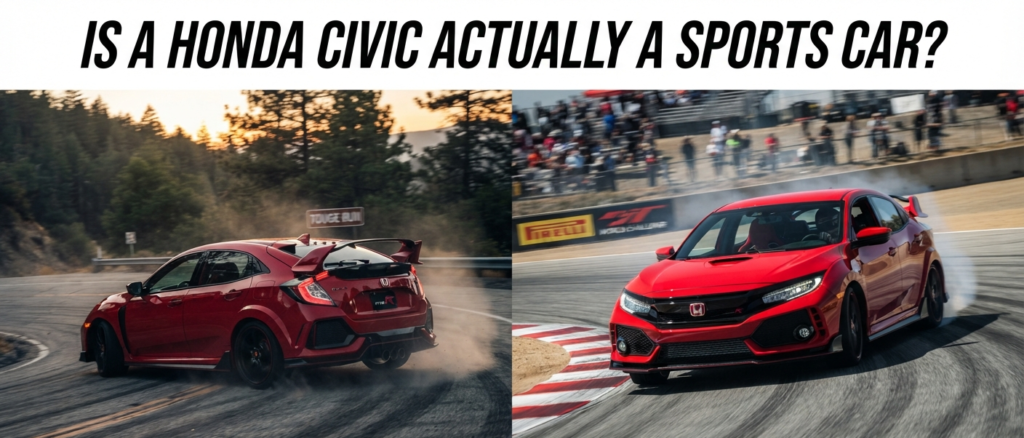
The short answer is no. A standard Honda Civic is definitely not a sports car.
By definition, a sports car is a low-slung, two-door vehicle built strictly for high-speed handling and performance. Meanwhile, a standard Civic is a compact sedan or hatchback engineered for practical, daily driving.
However, Honda splits the Civic line up into entirely different categories meaning you cannot judge every trim by the same standard:
- The Commuter Trims (LX, Sport, EX):
These are pure economy cars. They put fuel efficiency, comfort, and everyday safety way ahead of raw horsepower. - The Civic Si:
Best described as a “warm hatch” or sporty compact car. It comes with a manual transmission, a stiffer suspension, and a turbocharged engine built for driving enthusiasts. - The Civic Type R:
At the top of the food chain, this is a genuine, track-ready performance car. It boasts over 300 horsepower, aggressive aerodynamic styling, and massive Brembo brakes.
So, while the base models are strictly reliable commuters, the higher performance trims definitely blur the lines.
How US Insurance Companies View the Honda Civic
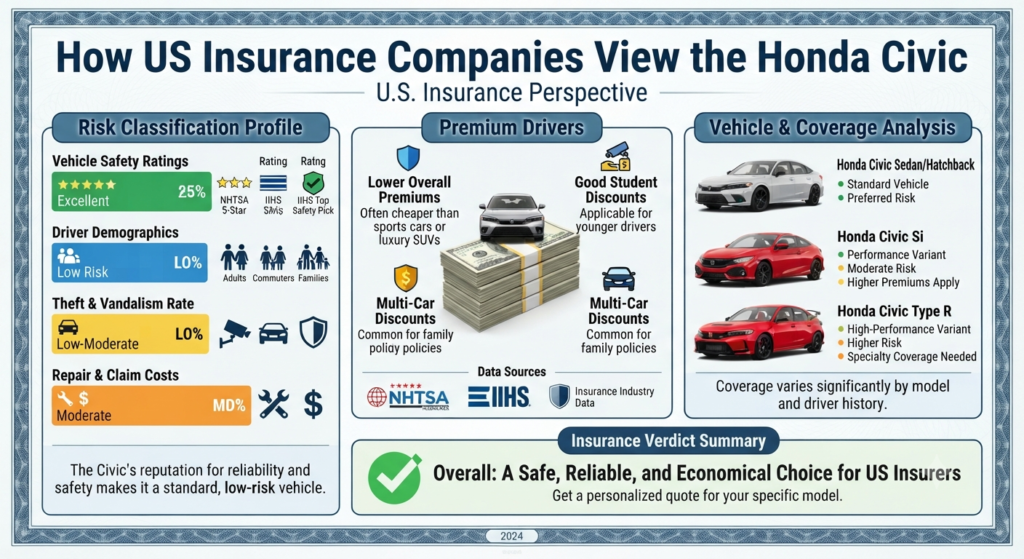
Insurance companies don’t care about internet debates or dealership marketing badges. They rely strictly on hard data, safety ratings, and risk assessment algorithms.
When an insurance system processes a Civic VIN, it looks at historical claims data: How often does that exact model get into accidents? How expensive are the injury claims? How much do replacement parts cost?
- Standard Trims:
Enjoy some of the lowest insurance rates in the country because millions of people drive them safely every day. They also come packed with advanced safety tech like automated emergency braking and lane-keep assist, which insurance companies love. - Performance Trims:
The story changes drastically here. Underwriters know that the Si and Type R attract drivers who love speed and aggressive driving, pushing these models into a completely different risk bracket.
Insurance Costs: Standard Civic vs. Civic Si vs. Type R
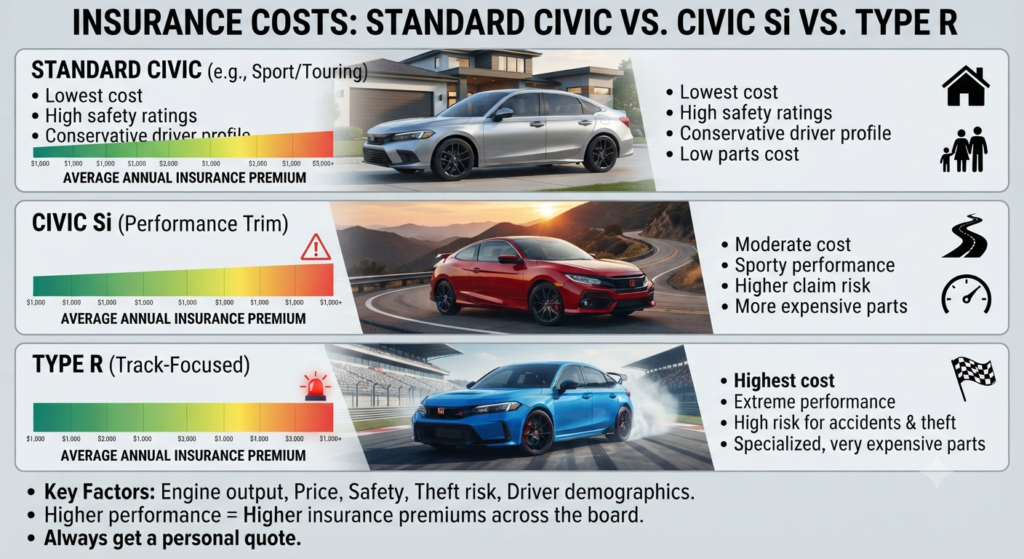
Your monthly bill will change dramatically depending on which Civic you buy:
- Standard Civic:
Usually costs an average driver around $100 to $130 a month for full coverage. Insurers view these as low-risk investments. - Civic Si:
Expect your rates to jump noticeably. The sportier engine and younger average demographic push the monthly premium higher. - Civic Type R:
Sits in an entirely different financial league. Because it’s a high-horsepower car with expensive body panels and limited production, insuring a Type R can rival the cost of insuring a luxury sports car.
Note for younger drivers: Anyone under the age of 25 faces severe insurance spikes on the Si and Type R. In some cases, the insurance payment can nearly match the monthly car financing payment!
Why Demographics and Aftermarket Mods Play a Huge Role

Insurance companies analyze your age and gender, but they also look very closely at what you do to the car.
1. Driver Demographics
Teenagers and drivers in their early twenties face the highest barriers. If a young driver buys a standard Civic, rates are manageable. If they buy a Civic Si, underwriters see a red flag because high-horsepower compact cars driven by younger demographics statistically experience a higher frequency of collision claims.
2. Aftermarket Modifications
Many owners buy a standard Civic Sport and immediately install aftermarket turbos, lowered suspension kits, loud exhausts, and engine tunes.
- If you get into an accident, insurance adjusters inspect the vehicle thoroughly.
- Unreported performance mods can cause your claim to be denied entirely, or even lead to your policy being canceled if the car no longer matches the insurer’s risk profile. Always declare your upgrades!
Location, Credit, and Driving History

Your vehicle model is only half the equation. Where you live and who you are dictate the rest:
- Location:
Insuring a Civic in a quiet rural town costs a fraction of what it costs in busy metro areas like Miami or Los Angeles, where uninsured drivers and heavy traffic drive up rates. - Credit and History:
Drivers with clean credit scores and zero moving violations secure the best possible rates. However, even a single speeding ticket in a Civic Si can trigger a massive rate increase that sticks around for three years.
Proven Ways to Lower Your Civic Insurance
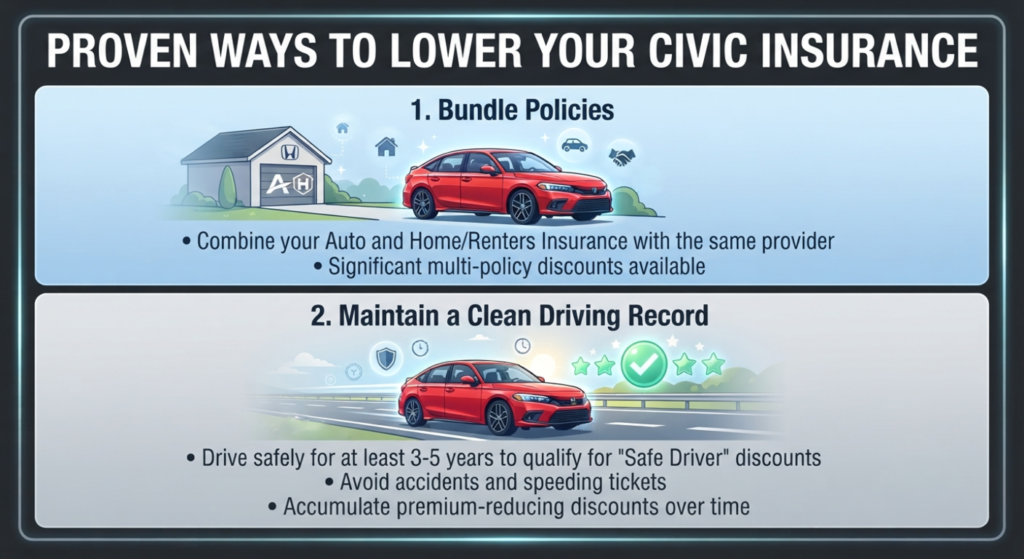
If you want to own a sporty Honda Civic without letting insurance drain your bank account, keep these tips in mind:
- Keep a clean record: A spotless history free of tickets and accidents is your best tool.
- Raise your deductible: Moving your deductible from $500 to $1,000 lowers your monthly bill immediately (just make sure you have that cash saved for emergencies).
- Bundle policies: Combine your auto insurance with renters or homeowners insurance for multi-policy discounts.
- Ask about discounts: Look into good student discounts or safe-driving telematics apps offered by your provider.
Final Verdict
So, is a Honda Civic a sports car?
The base models are practical, reliable daily commuters. The Civic Si is a fun, sporty everyday driver. Only the Civic Type R truly earns the title of a sports car.
When shopping for insurance, remember that companies look at hard safety stats and driver behavior rather than badges. Choose the trim that fits your budget, keep your modifications transparent, and drive safely to keep your monthly bills under control!