
The 2025 Honda Civic Hybrid is a remarkable vehicle. It blends fuel efficiency with a fun driving experience. One of its most interesting features is the regenerative braking system.
Many drivers see the paddle shifters behind the steering wheel and feel confused. They often wonder if these are for changing gears. In reality, they are the secret to controlling your car deceleration.
This guide will help you understand how to use these paddles. You will learn how to maximize your fuel economy and enjoy a smoother ride.
Understanding Regenerative Braking Technology
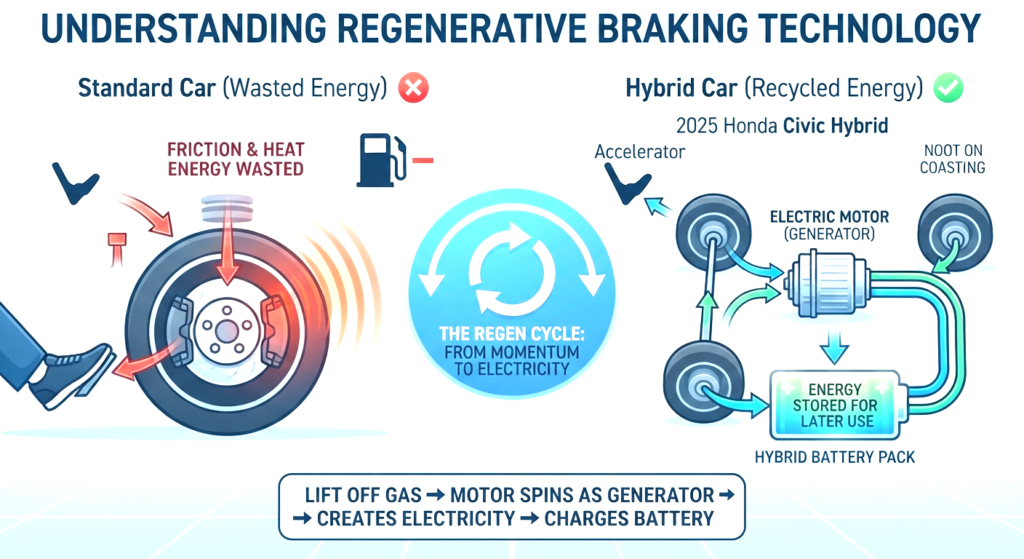
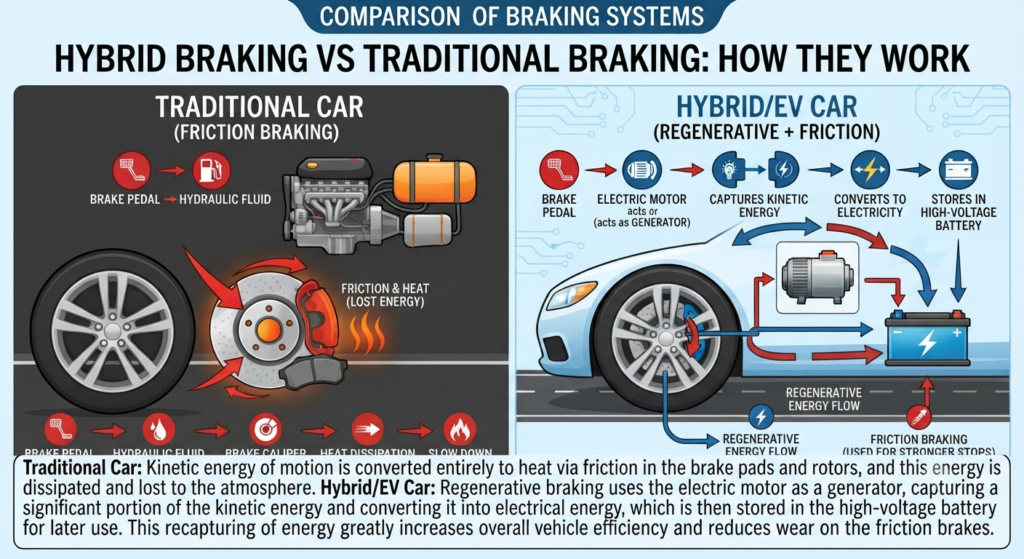
Regenerative braking is a smart piece of engineering. In a standard car, when you hit the brakes, the brake pads grip the wheels. This creates heat and slows the car down. All that energy is essentially wasted.
The 2025 Honda Civic Hybrid works in a different way. When you lift your foot off the gas pedal, the electric motor acts like a generator.
It uses the momentum of the car to create electricity. This process provides natural resistance that slows the vehicle down. The energy created is then sent back to charge the hybrid battery. You are basically recycling your own energy.
The Role of Paddle Shifters
In sports cars, paddle shifters are used to change gears. That is not the case here. In the 2025 Civic Hybrid, these are known as Deceleration Selectors.
They give you direct control over how much the car slows down when you let off the gas. You have two paddles to work with.
The left paddle, which has a minus sign, increases the braking intensity. The right paddle, which has a plus sign, decreases the braking intensity. This allows you to adjust the feel of the car to match your specific driving needs.
Why You Should Master These Settings
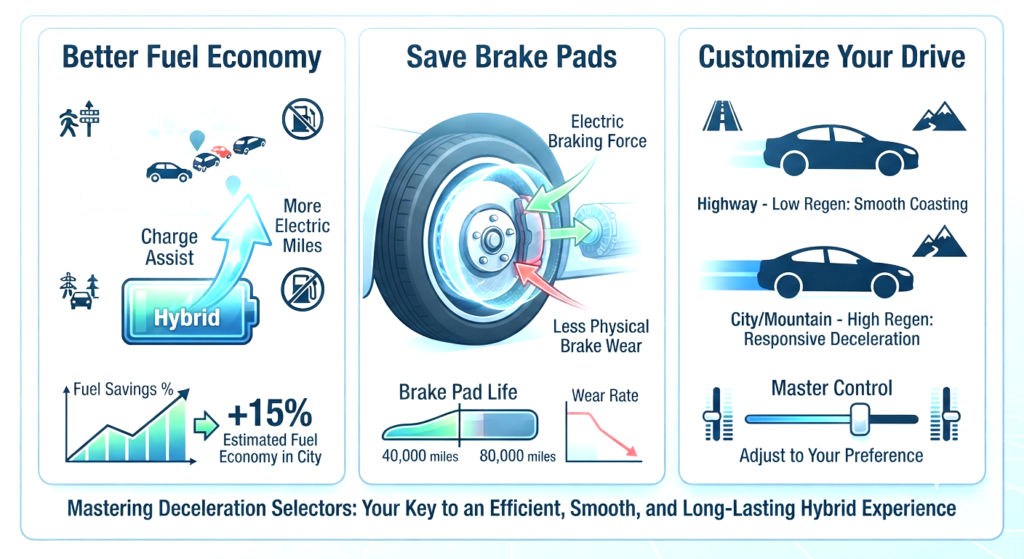
Most drivers leave the car in the default setting. However, taking control of your regen levels offers real benefits.
Better Fuel Economy
Using higher levels of regeneration in city traffic keeps your battery charged more often. This allows the electric motor to assist the gas engine more frequently. Your engine does not have to work as hard, which saves you money at the pump.
Saving Your Brake Pads
Mechanical brake pads wear out over time. They can be expensive to replace. When you use the regenerative system to slow down, you put less wear on your physical brakes. Your pads and rotors will last much longer.
Customizing Your Drive
Every driver has a different preference. Some people like a car that coasts freely on the highway. Others want the car to slow down immediately when they lift their foot. You can now choose exactly how your car feels.
How to Manage Settings in Different Scenarios
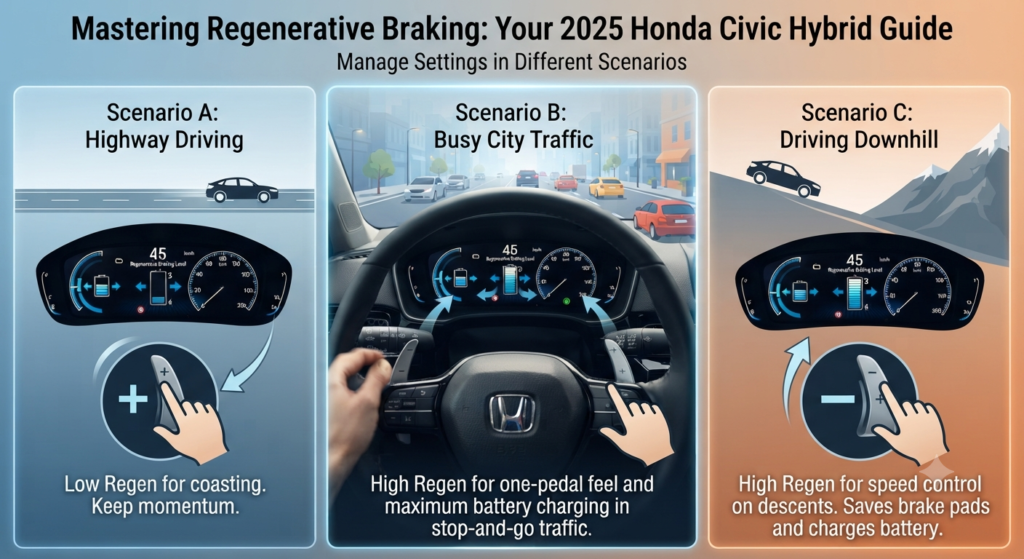
You can change these settings while you are driving. Here are the best ways to use them in daily life.
Highway Driving
On the open road, you want to keep your speed. Use the right paddle to lower the regeneration level. This allows the car to coast for longer distances without slowing down. It is the most efficient way to drive at steady highway speeds.
Busy City Traffic
In stop and go traffic, the situation changes. Use the left paddle to increase the regeneration level. This creates a stronger braking effect when you let off the gas. It helps you keep pace with the flow of traffic without constantly switching your foot to the brake pedal.
Driving Downhill
Descending a long hill can be hard on a car. If you use the highest level of regeneration, the motor will do the hard work for you. It keeps your speed in check and charges your battery at the same time. This prevents your physical brakes from overheating.
Visual Cues on Your Dashboard
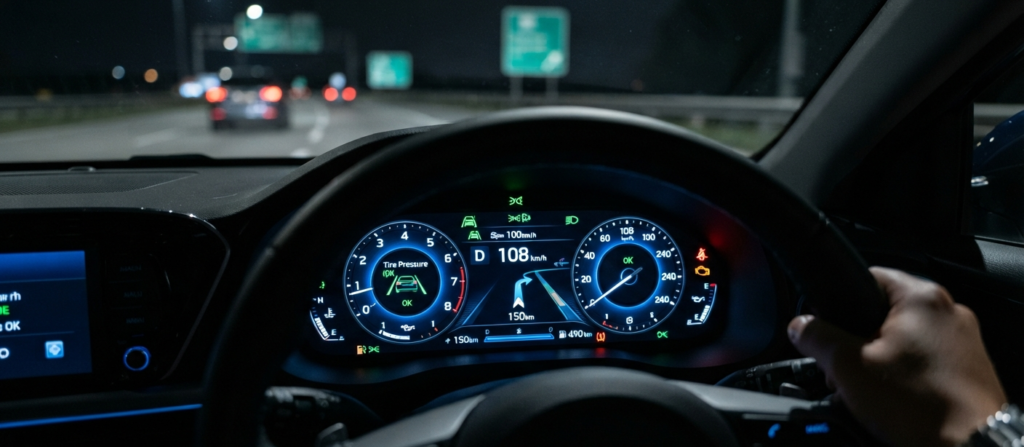
The 2025 Civic Hybrid is very good at communicating with the driver. When you tap a paddle, look at your instrument cluster.
You will see icons that show your current regeneration level. These indicators tell you how much braking force is active. You do not need to guess or memorize where the setting is. A quick glance at the screen is all it takes to stay informed.
Important Safety Tips
Regenerative braking is helpful, but it is not a safety system. It cannot replace your actual brake pedal.
Rely on Physical Brakes
If you need to stop in an emergency, always use the brake pedal. The physical brakes provide the maximum stopping power that your car is capable of. Do not rely solely on the paddles to stop the vehicle in a dangerous situation.
Wet and Slippery Roads
Be cautious when using high levels of regen on slick surfaces. If the road is covered in ice, snow, or heavy rain, your tires can lose grip.
Strong regenerative force applied to the wheels can make the car feel unstable on wet roads. In these conditions, it is best to keep your regeneration settings at a lower level. This helps you maintain better control of your vehicle.
Comparing Hybrid Braking to Traditional Cars
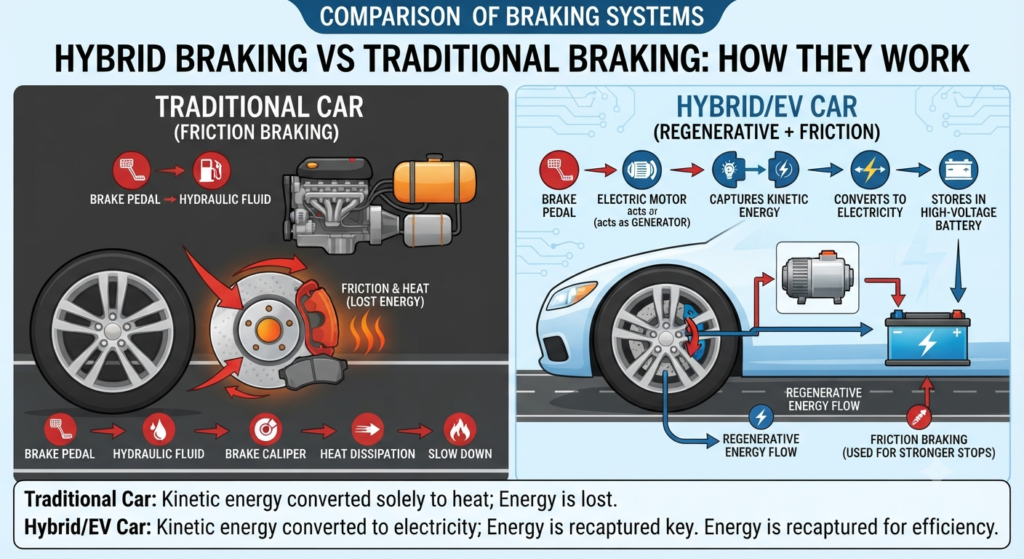
Many people worry that a hybrid will feel strange to drive. They fear the transition between the motor and the brakes will feel jerky.
Honda has designed this system to be seamless. The transition is so smooth that most drivers cannot feel it at all. Compared to a regular gas car, the hybrid offers more control. You have the standard pedal for stopping and the paddles for fine tuning your speed.
Common Questions Answered
Do the settings save when I park?
Usually, the system resets to a neutral default when you turn the car off. This is a safety measure to ensure the car drives the same way every time you start it.
Can I hurt the car by using the paddles too much?
No, you cannot. The paddles are designed for frequent use. You can change the settings as many times as you like during a single trip.
Does this affect my top speed?
Not at all. The system only works when you are not pressing the gas. It has zero impact on your ability to reach higher speeds.
How do I know if the battery is full?
Your dashboard displays the battery charge level. If your battery is completely full, the car might temporarily reduce the regen intensity. This is because there is no more room to store the electricity.