
Upgrading the wheels on your Honda Civic is one of the most exciting modifications you can make. It transforms the appearance of your car and can significantly improve handling.
However, buying the wrong wheels is a very expensive mistake. It can lead to safety hazards, damaged fenders, or a ride quality that feels terrible.
To get the perfect fit, you must understand more than just the bolt pattern. This guide is designed to be your complete resource for Civic wheel fitment. We will dive deep into generations, center bores, offsets, and the critical safety details that most other blogs completely ignore.
Why Bolt Pattern Knowledge Is Vital
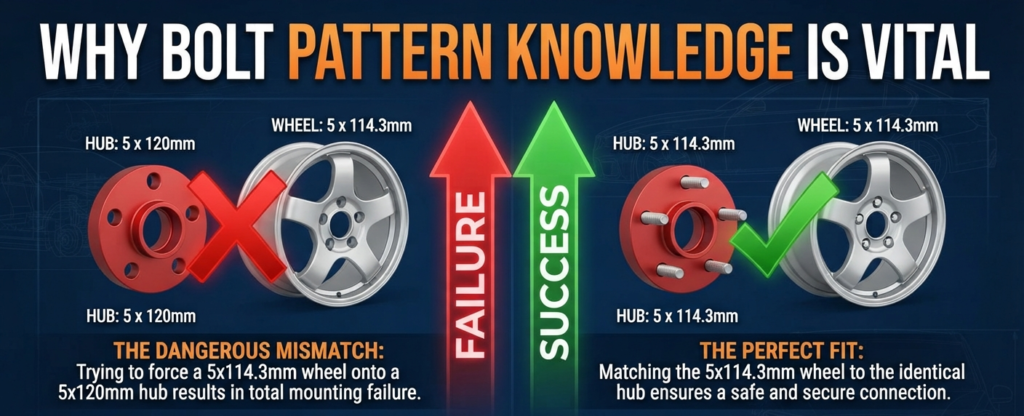
A bolt pattern is the specific arrangement of the lug nut holes on your wheel. It is described using two numbers. The first number tells you how many lug holes are present. The second number represents the diameter of the circle they form in millimeters.
For example, a 5 x 114.3 pattern is the standard for most modern Civics. It means there are 5 holes arranged in a circle with a diameter of 114.3 millimeters.
If you purchase a wheel with the wrong pattern, it will not physically mount to your car. Even a slight error, such as trying to fit a 114.3 mm wheel onto a 120 mm hub, will result in total failure. Understanding this is your first step toward a successful upgrade.
The Honda Civic Bolt Pattern Master Chart
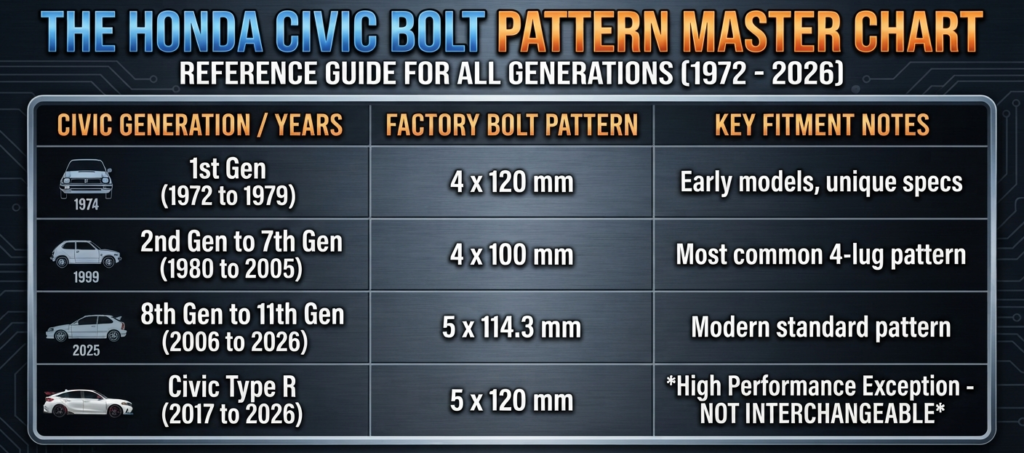
Honda has adjusted its wheel specifications multiple times over the decades. What worked for a 1990 model will not work for a 2024 model. Always match your specific year to the list below.
Standard Civic Fitment Data
| Civic Generation / Years | Factory Bolt Pattern |
| 1st Gen (1972 to 1979) | 4 x 120 mm |
| 2nd Gen to 7th Gen (1980 to 2005) | 4 x 100 mm |
| 8th Gen to 11th Gen (2006 to 2026) | 5 x 114.3 mm |
High Performance Exceptions
The high-performance models require special attention. The modern Civic Type R is a beast that demands a different setup.
- Civic Type R (2017 to 2026): These models use a larger 5 x 120 mm bolt pattern.
- Important Warning: Never assume a standard Civic wheel will fit a Type R. The studs and the hub are engineered differently to handle higher track loads. Standard Civic wheels will not provide the safety or strength required for a Type R.
Beyond the Bolt Pattern: Critical Fitment Factors
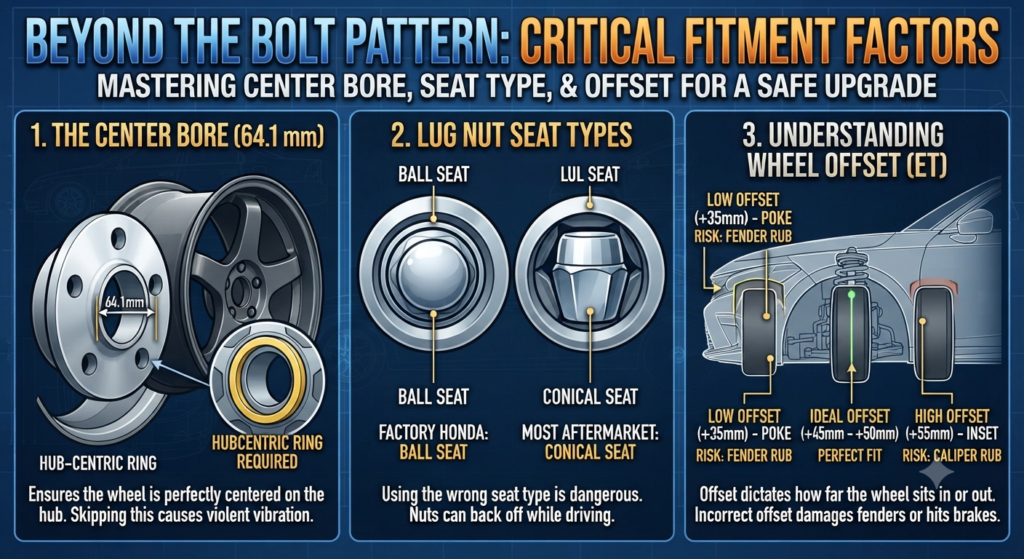
Many blogs provide a table and call it a day. That is dangerous advice. If you only look at the bolt pattern, you are likely to encounter major mechanical issues. You must master these three additional factors.
1. The Center Bore (64.1 mm)
The center bore is the large circular hole in the middle of the wheel. For almost all modern Honda Civics, this hole must be exactly 64.1 millimeters.
Honda designs its vehicles to be hub-centric. This means the weight of the car is carried by the center hub itself, not by the lug nuts.
Aftermarket wheels often come with a much larger center hole to fit many different car brands. You must use hub-centric rings to bridge this gap. If you skip this, your steering wheel will shake violently at highway speeds. It also puts massive stress on your wheel studs.
2. Lug Nut Seat Types
This is a detail that causes thousands of dollars in damage every year. Factory Honda wheels are designed to use a Ball Seat lug nut. This nut has a rounded, spherical bottom.
Most aftermarket wheels require a Conical Seat lug nut. This nut has a tapered, V-shaped bottom.
If you use a ball seat nut on a conical wheel, it will not seat properly. The nut will only make contact on a tiny surface area. This leads to the lug nuts backing off while you drive. Always confirm the seat type of your new wheels before you install them.
3. Understanding Wheel Offset (ET)
The offset, often marked as ET, dictates how far the wheel sticks out toward the fender or sits inside toward the suspension.
Standard Civics usually perform best with an offset between +45mm and +50mm.
If your offset is too low, the wheel will poke out past the fender. This causes the tire to rub against the metal fender, which ruins your tires and paint. If the offset is too high, the inside of the wheel can crash into your brake calipers or strut assembly.
Exploring Wheel Width and Diameter
While bolt patterns define the mounting, width and diameter define the look. Most stock Civics come with 16 or 17-inch wheels. Upgrading to 18-inch wheels is a popular choice for the aggressive look.
Remember that changing the wheel diameter changes your speedometer accuracy. You may need to adjust your tire aspect ratio to keep your speedometer reading correctly.
A wider wheel also requires a lower offset to keep it from rubbing against the inside suspension components. Balancing width, offset, and tire size is the art of the perfect fitment.
The Role of Tire Weight and Performance
When you pick new wheels, do not just look at how they look. Look at how much they weigh. Heavier wheels act as unsprung weight. This makes your suspension work much harder to keep your tires on the road.
If you add massive wheels, your car will accelerate slower and your fuel economy will drop. Try to find flow-formed or forged wheels. These are much lighter than cast wheels. They make the car feel more agile and responsive during cornering.
Common Pitfalls and How to Avoid Them
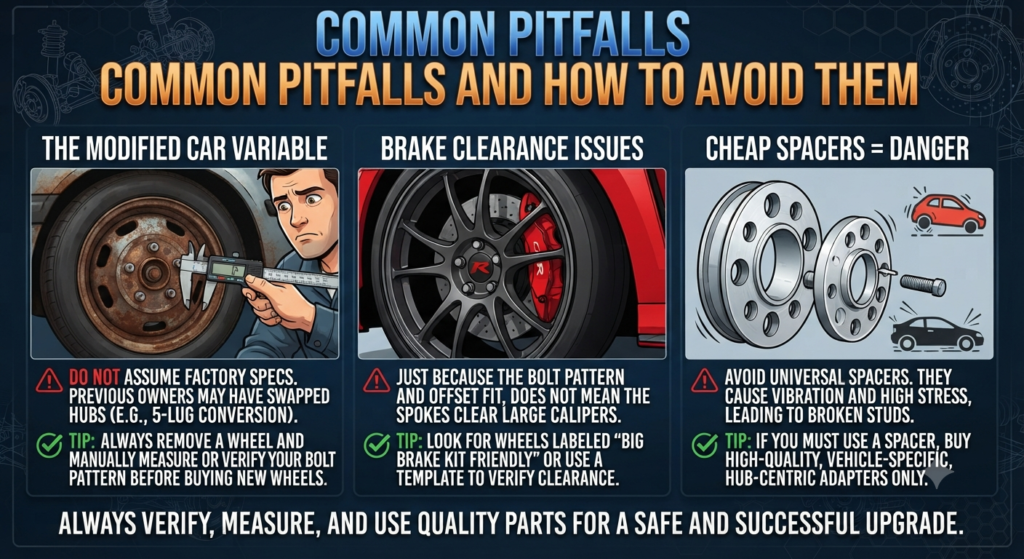
Even with the right data, people still make mistakes. Here are the most frequent traps we see in the Honda community.
The Modified Car Variable
Always check if your car has been modified by a previous owner. Some older Civics have undergone a 5-lug conversion. If you rely solely on your car’s factory year, you might buy the wrong parts. Always pull a wheel off and verify your bolt pattern manually if you bought the car used.
Brake Clearance Issues
If you drive a Civic Si or a Type R, your car has larger brake calipers than a base model. You might buy a wheel that fits the bolt pattern and the offset, but the spokes of the wheel might hit the brake caliper. Always look for wheels that are advertised as Big Brake Kit Friendly.
Cheap Spacers
Many people buy cheap, non-hub-centric spacers to get that flush look. This is a massive mistake. These spacers introduce play into the wheel assembly. They will cause vibrations and drastically increase the risk of your wheel studs snapping off while driving. If you must use a spacer, buy a high-quality, hub-centric adapter.
How to Measure Your Wheel Specs Manually
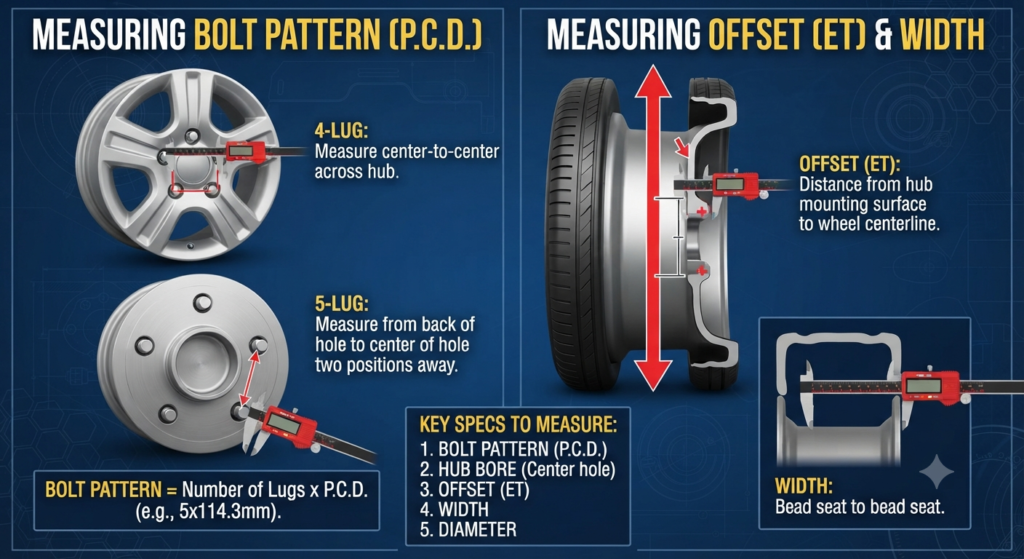
If you are ever in doubt, you can measure your bolt pattern yourself. It is easier than you think.
For a 4-lug wheel, simply measure the distance between the center of one hole to the center of the hole directly across from it.
For a 5-lug wheel, it is slightly more complex. You must measure from the back of one hole to the center of the hole two positions away. This will give you the circle diameter.
Maintaining Your Wheel and Tire Setup
Once you have your dream wheels installed, you need to maintain them. Torque your lug nuts to the manufacturer’s specification. For most Civics, this is around 80 to 90 foot-pounds.
Do not guess this. Use a torque wrench. If you over-tighten, you risk snapping a stud. If you under-tighten, the wheel can become loose.
Also, inspect your wheels for cracks or bends after hitting large potholes. Low-profile tires offer less protection to the rim than standard factory tires.
Final Tips for Your Upgrade
Before you finalize your order, perform these final checks.
Check the weight rating of the new wheels. Ensure they can handle the weight of your specific Civic model. Verify the lug nut thread pitch. Honda typically uses a 12×1.5 thread pitch.
If you are unsure about any measurement, reach out to the wheel manufacturer. They have technical departments that can verify fitment for your specific VIN.
A successful wheel upgrade is a rewarding experience. It changes how your car looks and how it handles. Take your time, verify your numbers, and enjoy your new ride.
Frequently Asked Questions
Can I run different sized wheels on the front and back?
Generally, no. This is called a staggered setup. It is very common for rear-wheel-drive cars, but it is not recommended for the front-wheel-drive platform of the Honda Civic. It will mess up your handling and tire rotation.
Do I need an alignment after changing wheels?
Yes. If you change your wheel offset or diameter, your suspension geometry changes slightly. Getting a professional alignment ensures your tires wear evenly and your car drives straight.
Are cheap replicas worth it?
Usually, no. Replica wheels are often heavy, brittle, and prone to cracking under stress. It is always safer and better to buy reputable brands that prioritize structural integrity.