
Selecting the right tires for your Honda Civic is one of the most important maintenance decisions you will make. Your tires are the only point of contact between your car and the road.
If you choose the wrong size, you risk poor handling, reduced fuel efficiency, and even safety hazards. This guide is designed to help you navigate tire sizes for every Honda Civic trim level with ease.
Why Your Tire Size Matters
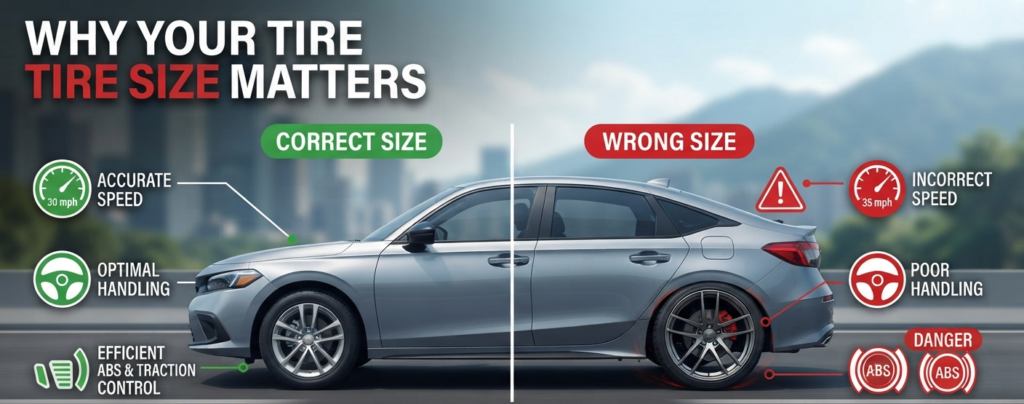
Many drivers think any tire of the same diameter will work on their car. This is a common misconception that can lead to problems.
Your Civic is engineered with specific suspension geometry and gear ratios. The tire size plays a vital role in how the vehicle calculates speed, ABS (Anti-lock Braking System), and traction control.
Using the factory-recommended size ensures your car performs exactly as Honda intended. It also keeps your speedometer accurate.
Locating Your Factory Tire Specifications
Before you start shopping for new tires, you need to verify your specific requirements. The most reliable information is not found in a search engine but on your vehicle.
Every Honda Civic has a tire information placard located on the driver’s side door jamb. Open your door and look for a sticker on the pillar.
This sticker provides the official tire size, speed rating, and recommended cold tire pressure (PSI) for both front and rear tires. Always prioritize these numbers over any online guide.
Honda Civic Tire Size by Trim Level
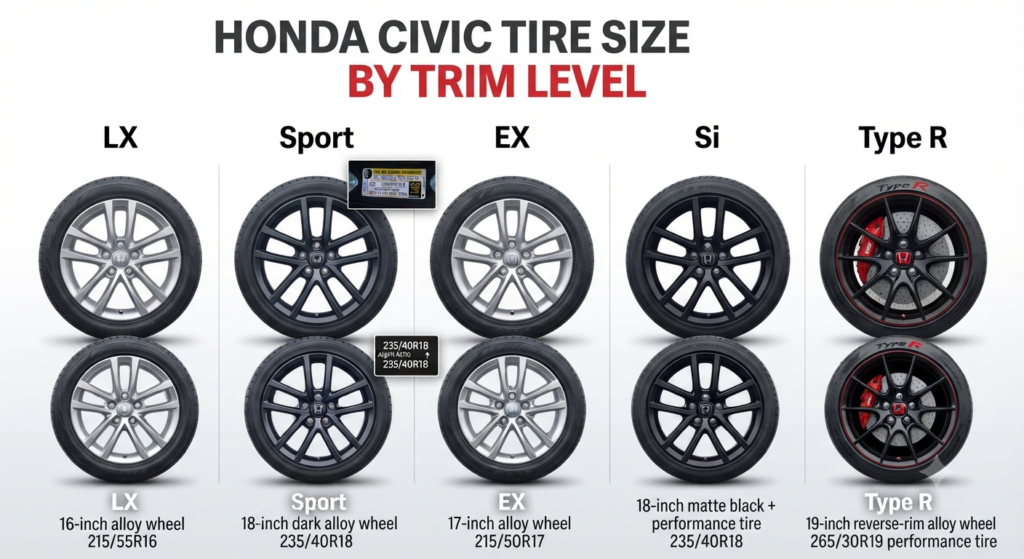
Honda has introduced various trims over the years, each designed for different driving experiences. Below is a breakdown of the standard tire sizes for the most common 2026 Honda Civic configurations.
1. Honda Civic LX Trim
The LX is the entry-level trim designed for comfort and efficiency. It typically uses smaller wheels to provide a smoother ride and better fuel economy.
- Standard Size: 215/55R16
- Focus: Ride comfort and tire longevity.
2. Honda Civic Sport Trim
The Sport trim features larger wheels to enhance the aggressive look of the car. It requires a lower-profile tire to maintain the correct overall diameter.
- Standard Size: 235/40R18
- Focus: Handling and aesthetic appeal.
3. Honda Civic EX Trim
The EX trim offers a balance between the comfort of the LX and the features of the top-tier trims.
- Standard Size: 215/50R17
- Focus: Balanced performance and fuel efficiency.
4. Honda Civic Si Trim
The Si is built for driving enthusiasts. It uses performance-oriented tires to ensure maximum grip during cornering and acceleration.
- Standard Size: 235/40R18
- Focus: Maximum grip and performance.
5. Honda Civic Type R
The Type R is a high-performance machine that requires specialized rubber to handle its power output.
- Standard Size: 265/30R19
- Focus: Track performance and extreme precision.
Understanding the Tire Sidewall Code
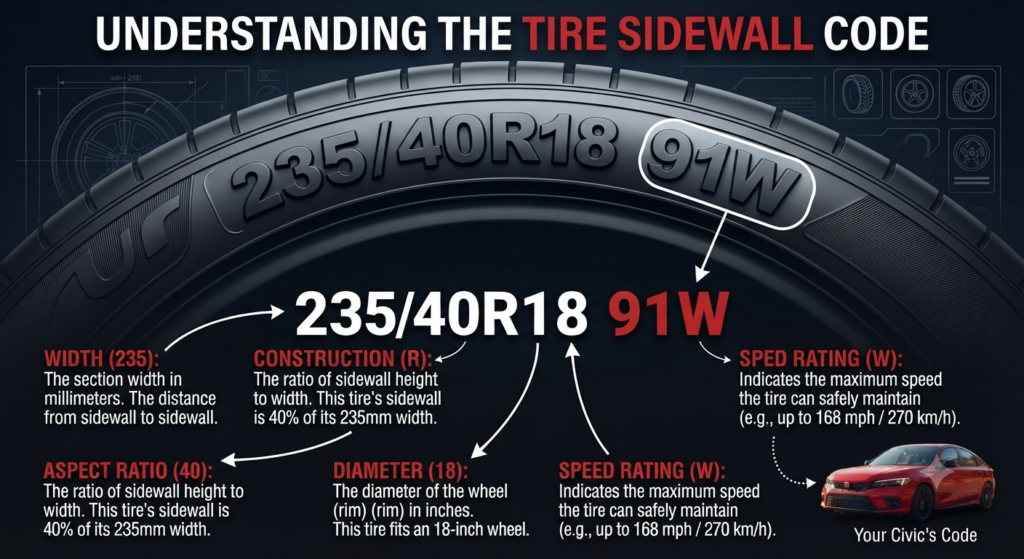
If you look at the side of your tire, you will see a code like 235/40R18. Understanding this code will make you a smarter buyer.
- 235: This is the width of the tire in millimeters.
- 40: This is the aspect ratio. It means the sidewall height is 40 percent of the width.
- R: This indicates the internal construction is Radial.
- 18: This is the diameter of the wheel in inches.
Knowing these numbers helps you avoid buying the wrong tires during a quick replacement.
Can You Upsize Your Wheels?
Many Civic owners want to install aftermarket wheels or go for a larger rim size. This is commonly known as plus-sizing.
While you can change the size, you must follow the 3 percent rule. Your new tire and wheel combination should not be more than 3 percent larger or smaller than the factory diameter.
Exceeding this range can lead to significant issues. Your tires might rub against the inner wheel well, and your speedometer will show the incorrect speed.
Seasonal Tire Choices for Your Civic
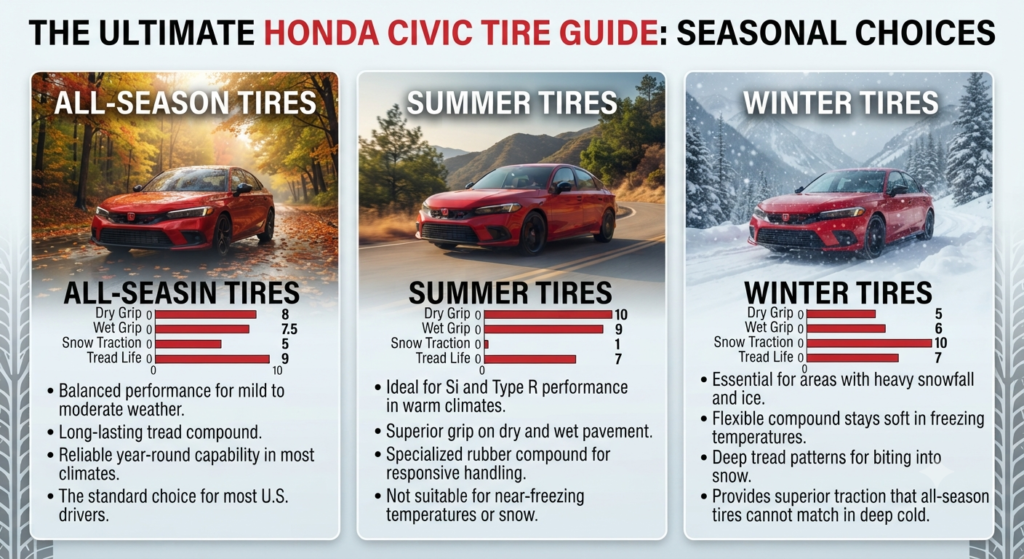
The climate in the United States varies significantly. Your choice of tire should depend on where you live and drive.
- All-Season Tires: The standard choice for most US drivers. They offer a great balance for mild to moderate weather conditions.
- Summer Tires: Ideal for the Si or Type R if you live in warm climates. They provide superior grip on dry and wet pavement.
- Winter Tires: If you live in areas with heavy snowfall, you need dedicated winter rubber. Their compound stays soft in freezing temperatures, providing traction that all-season tires cannot match.
Maintenance Tips for Longevity
Investing in high-quality tires is useless if you do not maintain them. Proper care saves you money in the long run.
Check your tire pressure once a month. Under-inflated tires cause uneven wear and increase your fuel consumption. Always check pressure when the tires are cold.
Rotation is another critical task. Rotate your tires every 5,000 to 7,500 miles to ensure that they wear down evenly. This helps you get the maximum possible mileage out of every set.
Common Mistakes to Avoid
One of the most frequent mistakes is buying tires solely based on price. While budget tires might look good, they often lack the durability and safety features of premium brands.
Another mistake is mixing tire types. Always try to have the same brand and model of tire on all four wheels. Mixing them can ruin the balance and handling of your Civic.
Lastly, never ignore the wear indicators. If your tread depth reaches 2/32 of an inch, it is time to replace your tires immediately for your safety.
Frequently Asked Questions
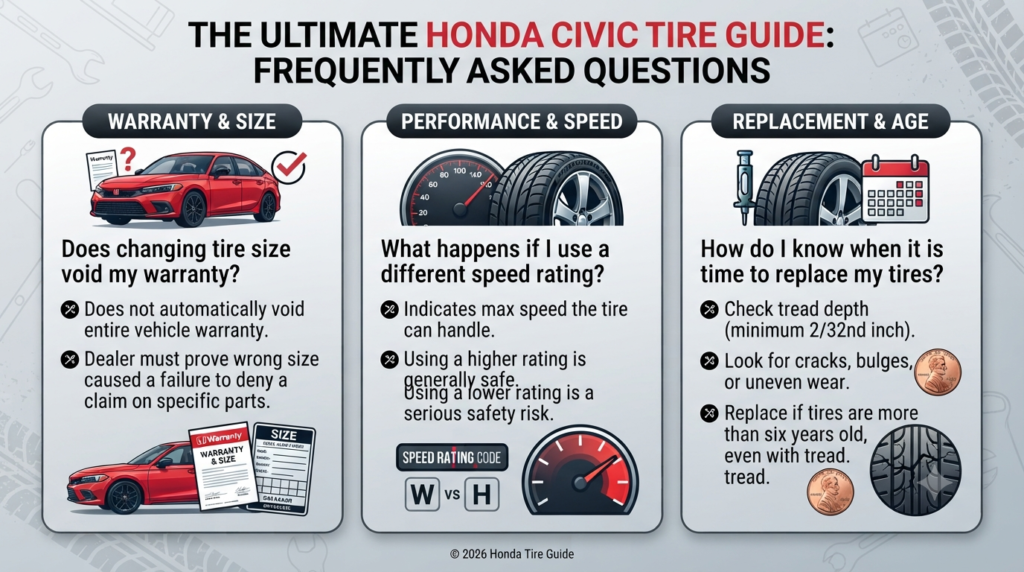
Does changing tire size void my warranty?
Changing your tire size does not automatically void your entire vehicle warranty. However, if a dealer can prove that the wrong tire size caused a suspension or drivetrain failure, they may deny a warranty claim for those specific parts.
What happens if I use a different speed rating?
The speed rating indicates the maximum speed the tire can handle. Using a tire with a higher speed rating is generally safe, but using one with a lower rating than what your car came with is a safety risk.
How do I know when it is time to replace my tires?
Besides checking the tread depth, you should look for cracks, bulges, or uneven wear patterns. If your tires are more than six years old, consider replacing them even if they still have tread.