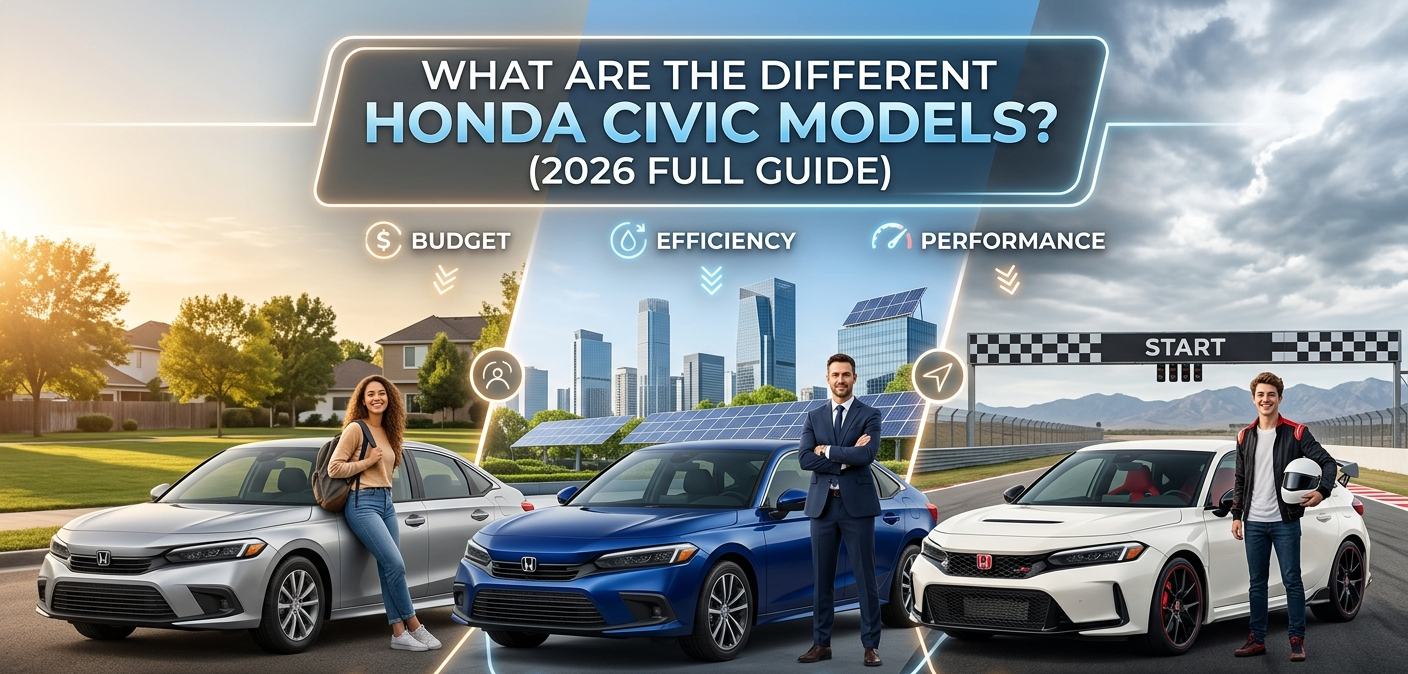
If you’re shopping for a reliable, stylish, and affordable car in the US, the Honda Civic is probably already on your list and for good reason. The Civic has been one of America’s best-selling cars for decades, and the 2026 lineup takes things to the next level.
Whether you want great gas mileage, sporty looks, or serious performance, there’s a Civic built just for you. From the budget-friendly LX to the track-ready Type R, each model brings something different to the table. In this guide, we’ll break down every 2026 Honda Civic model in plain English no confusing car jargon, no fluff.
Let’s start with a quick side-by-side look at three of the most popular options:
| Model | Key Feature | Estimated MPG |
| 2026 LX | Affordable entry-level, Honda Sensing safety suite standard | 32 city / 42 hwy |
| 2026 Sport Hybrid | 200-hp hybrid powertrain, sporty style with fuel savings | 50 city / 47 hwy |
| 2026 Type R | 315-hp turbocharged engine, track-ready performance | 22 city / 28 hwy |
Two Ways to Drive: Civic Sedan vs. Civic Hatchback
Honda no longer offers the Civic Coupe that body style was discontinued a few years back. Today, buyers choose between two body styles: the classic Sedan and the practical Hatchback. Here’s how they compare:
Civic Sedan
- Sleek, traditional three-box design with a separate trunk
- Trunk holds 14.8 cubic feet great for groceries and luggage Cargo space:
- More rear headroom thanks to the taller roofline Rear-seat comfort:
- Classic, professional look that suits commuters and families Style:
- Best for drivers who prioritize a clean exterior and don’t need a folding cargo area
Civic Hatchback
- Sporty five-door design with a rear liftgate
- 60/40 folding rear seats expand cargo from 24.5 to 46.2 cubic feet Cargo space:
- Slightly less headroom due to the sloped roofline Rear-seat comfort:
- Younger, more dynamic look popular with urban drivers Style:
- Best for people who carry bikes, strollers, or bulky gear regularly
Bottom line: If you need maximum cargo flexibility, go Hatchback. If you want a quieter, more traditional feel, go Sedan. Both share the same engines and safety tech the choice is purely lifestyle.
Breaking Down the 2026 Honda Civic Trim Levels
The 2026 Civic comes in six distinct trim levels, each targeting a different type of driver. Here’s everything you need to know about each one:
1. LX The Affordable Entry
Engine: 2.0L naturally aspirated 4-cylinder | Horsepower: 158 hp
The LX delivers Honda’s legendary reliability at the lowest price point in the lineup. It comes standard with Honda Sensing (collision mitigation, lane keeping assist, adaptive cruise control), a 7-inch touchscreen, Apple CarPlay, and Android Auto.
Who it’s for: First-time car buyers, college students, or anyone who wants dependable daily transportation without stretching their budget.
2. Sport — The Stylish Commuter
Engine: 2.0L naturally aspirated 4-cylinder | Horsepower: 158 hp
The Sport adds visual flair to the LX foundation — you get 18-inch alloy wheels, a sport grille, LED fog lights, and a 9-inch touchscreen with wireless Apple CarPlay and Android Auto. It costs just a little more but looks noticeably sharper on the road.
Who it’s for: Drivers who want a polished, head-turning daily driver without jumping to a premium price tag.
3. Sport Hybrid The Fuel Saver
Engine: 2.0L Atkinson-cycle + electric motor hybrid system | Horsepower: 200 hp
Here’s where things get interesting. The Sport Hybrid pairs a fuel-efficient Atkinson-cycle engine with an electric motor for a combined 200 horsepower plus estimated fuel economy around 50 city / 47 highway. You get more power and less money spent at the pump. It includes everything from the Sport trim plus the hybrid powertrain.
Who it’s for: Long-distance commuters, eco-conscious drivers, and anyone who spends a lot of time in city traffic.
4. Sport Touring Hybrid The Tech Leader
Engine: 2.0L Atkinson-cycle + electric motor hybrid system | Horsepower: 200 hp
The Sport Touring Hybrid is the top-of-the-line hybrid variant. It adds a Bose premium audio system, a heated steering wheel, heated and ventilated front seats, wireless phone charging, and a 12-speaker sound system. If you want the best comfort and tech without going full performance, this is your trim.
Who it’s for: Drivers who want luxury-adjacent features in a practical, fuel-efficient package think professionals and frequent road-trippers.
5. Civic Si — The Driver’s Sedan
Engine: 1.5L turbocharged 4-cylinder | Horsepower: 200 hp
The Si is a driver’s car. It comes exclusively as a sedan with a 6-speed manual transmission no automatic option. You get a sport-tuned suspension, limited-slip differential, Brembo front brakes, and adaptive dampers. It’s engineered for people who actually enjoy the act of driving.
Who it’s for: Enthusiasts who want a fun-to-drive manual sports sedan that’s still practical enough for everyday use.
6. Type R The Performance King
Engine: 2.0L turbocharged 4-cylinder | Horsepower: 315 hp
The Civic Type R is a full-blown performance machine. With 315 horsepower, a 6-speed manual, Brembo brakes, an adaptive suspension, and track-tuned aerodynamics (that massive rear wing isn’t just for show), the Type R holds a lap record at several tracks worldwide. It only comes as a hatchback.
Who it’s for: Performance drivers and enthusiasts who want a factory-built hot hatch capable of embarrassing sports cars that cost three times as much.
Beyond the Sticker Price: Insurance and Maintenance Costs
Most car buyers focus on the monthly payment but smart shoppers look at the total cost of ownership. Two big factors that blogs often skip: insurance and maintenance. Here’s the real talk.
Insurance: Why Your Trim Choice Matters
Not all Civics cost the same to insure. A base LX will typically run $100–$140/month for a standard driver in most US states. A Type R? Budget $180–$240/month or more. Why the difference?
- Performance trims (Type R, Si) have higher repair costs and attract more aggressive driving claims
- The Type R uses specialized parts (Brembo brakes, custom suspension) that cost more to replace after an accident
- A Rebuilt Title Civic any trim will cost significantly more to insure than a clean-title vehicle, often 20–40% higher. Lenders may also refuse financing on rebuilt-title cars
- Young drivers under 25 face additional surcharges, especially on sporty trims
Pro tip: Get insurance quotes before you finalize your trim choice. Sometimes the difference between Sport and Sport Hybrid is $30/month in insurance savings which offsets the sticker price gap over time.
Maintenance: What to Expect
- Oil changes: Every 5,000–7,500 miles for non-hybrid models. Hybrids can go up to 10,000 miles between changes due to reduced engine stress
- Tire rotations: Every 5,000–7,500 miles. The Type R uses wider performance tires that wear faster budget $800–$1,200 per set
- Brake pads: Non-performance Civics typically need pads every 40,000–60,000 miles. The Type R, driven hard, may need them every 20,000 miles
- Hybrid battery: Honda covers the battery for 10 years / 150,000 miles. Don’t let dealers upsell unnecessary extended warranties on the hybrid system
What Real Owners Say: Common Issues and Fixes
Spend any time on revhondacivic or popular forums like CivicX.com, and you’ll find the same topics coming up again and again. Here are three common pain points and what to do about them.
1. Road Noise
Many 10th and 11th-gen Civic owners report wind and tire noise at highway speeds, especially in the sedan. Honda’s cabin insulation is good but not class-leading at this price point.
Quick fix: Add Dynamat or similar sound deadening material to the door panels and floor. This is a 2–3 hour DIY job and runs about $80–$120 in materials. Many owners report a dramatic improvement.
2. TPMS Calibration
After seasonal tire swaps or significant pressure changes, the TPMS (Tire Pressure Monitoring System) light can stay on even when tires are properly inflated.
Quick fix: With the car stationary and ignition on, press and hold the TPMS calibration button (usually located in the glove box or under the steering wheel) for about 3 seconds until the TPMS light blinks twice. Then drive normally for 30+ minutes. The system will recalibrate itself.
3. Infotainment Lag
Some owners experience lag or freezing in the Honda touchscreen infotainment system, particularly when connecting via Bluetooth or switching between apps quickly.
Quick fix: First, try a soft reset press and hold the Home and Back buttons simultaneously for 10 seconds. If the problem persists, check for a system update at your Honda dealer (OTA updates aren’t always automatic). Switching to a wired Car Play/Android Auto connection instead of wireless also eliminates most lag complaints.
Which Honda Civic Model Should You Buy?
The best Civic is the one that fits your actual life. Here are three real-world buyer scenarios to help you decide:
The College Student on a Budget
Recommended trim: 2026 Civic LX (Sedan)
You need something reliable that won’t drain your bank account at the pump or in the repair shop. The LX checks every box Honda Sensing safety tech is standard, the 2.0L engine is nearly bulletproof, and resale value is strong if you need to sell it in a few years. Insurance costs are among the lowest in the Civic lineup. This is the smart, responsible choice.
The Long-Distance Commuter
Recommended trim: 2026 Sport Hybrid or Sport Touring Hybrid
If you’re driving 30+ miles each way to work, the hybrid powertrain pays for itself. With around 50 mpg in city driving and 200 hp for confident highway merging, the Sport Hybrid gives you the best of both worlds. Step up to the Sport Touring Hybrid if you want heated seats, premium audio, and wireless charging for those long daily drives your back and your ears will thank you.
The Weekend Enthusiast
Recommended trim: 2026 Civic Type R (or Si for budget-conscious enthusiasts)
You want to feel alive behind the wheel. The Type R delivers 315 hp, razor-sharp handling, and the kind of feedback through the steering wheel that makes every on-ramp feel like a racetrack. If the Type R’s price tag is a stretch, the Si offers a 6-speed manual, sport-tuned suspension, and legitimate driving fun at a significantly lower cost. Either way, you won’t be bored.
Ready to find your perfect Civic? Head to your local Honda dealership for a test drive. Bring this guide along, compare the trims in person, and don’t be afraid to ask your sales rep to put you behind the wheel of two or three models. The 2026 Civic is one of the most well-rounded cars on the market at any price there’s genuinely a version for everyone. Your perfect Civic is waiting.