
The Honda Civic is globally celebrated for its legendary reliability. However, keeping this machine running smoothly for the long haul requires consistent, proper maintenance.
Modern Civics rely on a Continuously Variable Transmission (CVT). If you neglect routine fluid changes, you risk severe transmission failure and a massive repair bill down the road.
This guide breaks down the exact change intervals, expected costs, and key warning signs to help protect your investment and maximize your mileage.
Official Honda Civic CVT Transmission Fluid Change Interval

Honda vehicles feature a built-in smart system called the Maintenance Minder. Once your mileage reaches the service threshold, a Code 3 indicator pops up on your dashboard, signaling that it is time for a transmission service.
- Recommended Interval:
Most mechanics and transmission specialists recommend changing the fluid every 30,000 to 45,000 miles. - Severe Driving Conditions:
If you frequently drive in heavy stop-and-go traffic, extreme heat, or hilly terrain, you should service your transmission more often, as harsh conditions degrade the fluid much faster. - The “Lifetime Fluid” Myth:
Some car manuals label CVT fluid as “lifetime.” However, professional mechanics strongly advise against this. Changing the fluid every 30,000 miles protects internal components and drastically extends the overall lifespan of the transmission.
Warning Signs Your Civic Needs a CVT Fluid Change
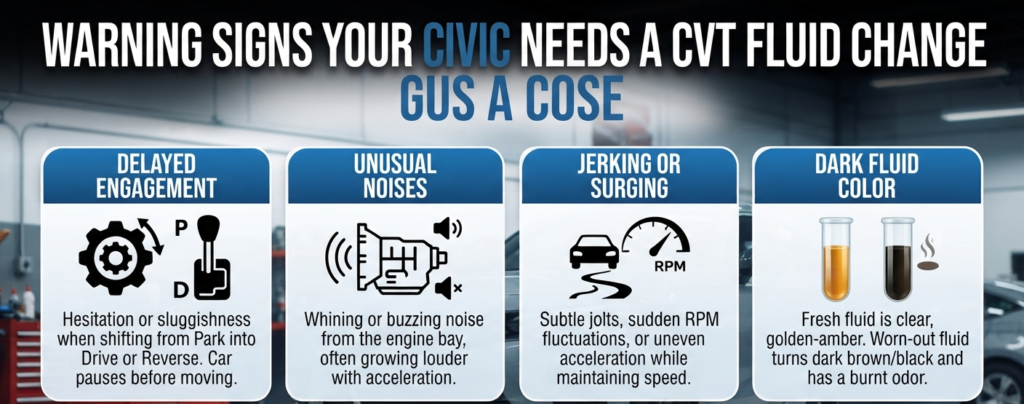
Waiting for a dashboard light or Maintenance Minder prompt isn’t always safe. Your car will often display physical warning symptoms when the fluid begins to break down. Watch out for these red flags:
- Delayed Engagement: When you shift from Park into Drive or Reverse, the car hesitates or responds sluggishly before finally moving.
- Unusual Noises: You might hear a distinct whining or buzzing noise coming from the engine bay during acceleration that grows louder as your speed increases.
- Jerking or Surging: While maintaining a steady speed on the highway, the car might exhibit subtle jolts or sudden RPM fluctuations.
- Dark Fluid Color: Fresh CVT fluid is clear with a clean, golden-amber hue. Worn-out fluid turns dark brown or black and emits a strong, burnt odor.
CVT Fluid Change Cost Breakdown
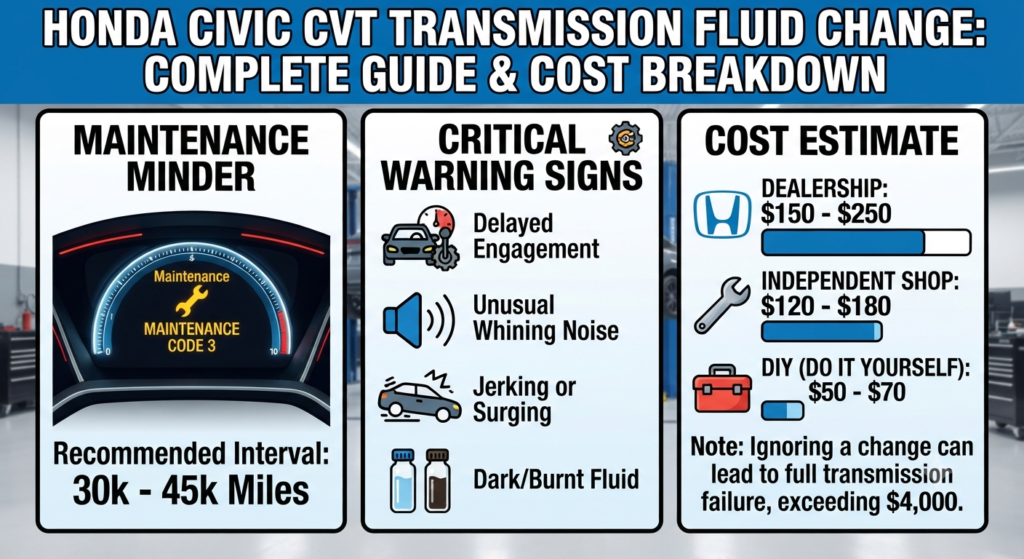
Servicing your transmission isn’t as expensive as many think. The total price depends on whether you visit a dealership, an independent mechanic, or tackle the job yourself.
| Service Option | Estimated Cost | Details |
| Dealership Pricing | $150 – $250 | Uses factory-trained technicians, but labor rates are higher. |
| Independent Mechanic | $120 – $180 | A cost-effective alternative if you want to save on labor. |
| Do It Yourself (DIY) | $50 – $70 | Cost of genuine fluid and crush washers only. |
Note: Ignoring a simple fluid change can lead to complete transmission failure, where a full replacement can easily exceed $4,000. Timely maintenance is always the cheaper route.
Why You Must Use Genuine Honda HCF-2 Fluid

Modern CVTs operate under extreme pressure and high friction. A steel belt moves back and forth between two variable pulleys, requiring precise chemical balance to prevent slipping.
You must always use genuine Honda HCF-2 CVT fluid. Pouring generic or standard automatic transmission fluid into a CVT will cause the internal belt and pulleys to slip, ultimately burning out the transmission.
Step-by-Step DIY Overview
If you have some basic mechanical experience, you can easily handle this job in your garage.
Tools and Supplies Needed:
- 4 to 5 quarts of genuine Honda HCF-2 fluid
- Fluid transfer pump or a long-reach funnel
- Socket set and a drain pan
- New crush washers
Step-by-Step Instructions:
- Warm Up the Car: Drive the vehicle for about 10 minutes so the fluid warms up and drains smoothly.
- Raise the Vehicle: Safely lift the car using a jack and jack stands. Make sure the vehicle is completely level.
- Drain the Old Fluid: Locate the transmission drain plug underneath, open it, and let the old oil drain completely into your pan. Reinstall the plug once finished.
- Install New Washers: Always put a new crush washer on the drain plug to prevent any future fluid leaks.
- Fill with Fresh Fluid: Remove the fill plug from the engine bay and pump in the exact amount of fresh HCF-2 fluid that you drained out.
- Check Levels: Start the car, cycle through the gears, check the fluid level, and you’re good to go!
Frequently Asked Questions

- Can I change just part of the CVT fluid?
Yes. A standard drain-and-fill process replaces about two-thirds of the fluid because some oil remains trapped inside the torque converter. This is completely normal and entirely safe. - How long does a Honda Civic CVT last?
If you consistently change the fluid every 30,000 miles, a modern Civic transmission can easily surpass 200,000 miles without running into major issues. - Can I drive my Civic if the service is overdue?
Going slightly past your interval won’t cause instant failure. However, pushing it too long causes the fluid to overheat and break down, which can permanently lock up and destroy the transmission.