
Modifying a Honda Civic is a rite of passage for almost every car enthusiast. Whether you drive a classic model or the latest 11th-generation sedan, the first thing most owners want to do is close that unsightly gap between the tire and the fender.
Lowering your car does more than just improve the aesthetics. It lowers your center of gravity, improves handling, and gives your car a planted, aggressive stance.
However, the debate between choosing lowering springs versus coilovers is endless. If you search for the best option, you will find conflicting advice from forum users and amateur mechanics.
As a daily driver, your needs are different from a track car builder. You need reliability, comfort, and the ability to clear speed bumps without damaging your bumper.
In this guide, we will break down the engineering, costs, and real-world trade-offs between these two systems so you can make the right choice for your daily commute.
What Are Lowering Springs?
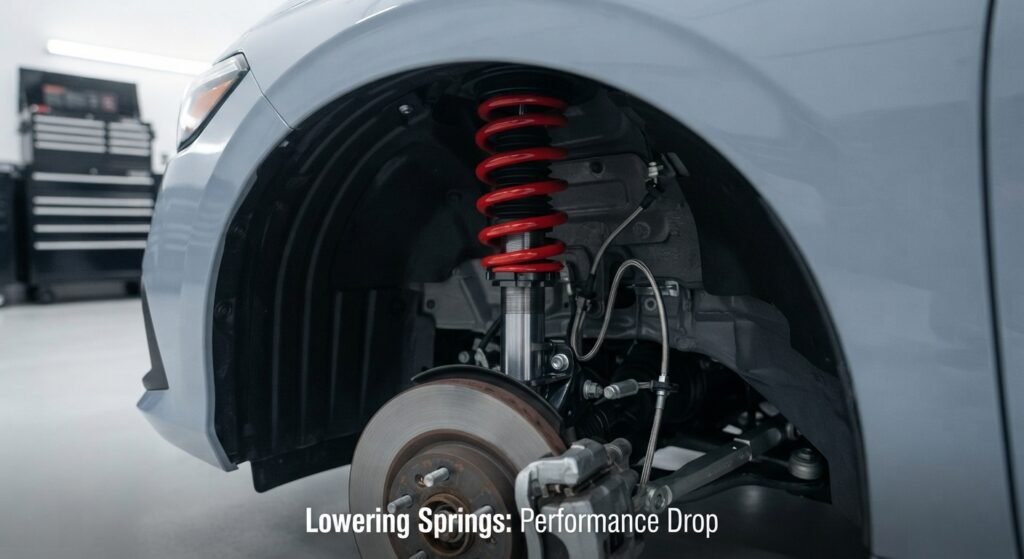
Lowering springs are the most straightforward way to drop your ride height. When you buy a set of lowering springs, you are simply purchasing four new, shorter, and stiffer metal coils.
You remove your factory springs and install these new ones onto your existing factory struts. In the car community, these are often called dampers or shocks.
The Appeal of Springs
The primary appeal is the price. A quality set of lowering springs is significantly cheaper than any coilover system.
For a student or someone on a budget, this allows you to achieve that lowered look without emptying your bank account.
The Hidden Trap
The biggest misconception about springs is that they are a simple bolt on solution. Many owners install them on high-mileage factory struts.
Factory struts are designed to work with factory springs. When you put a shorter, stiffer spring on an old strut, the shock absorber is forced to work in a range it was not built for.
This leads to a bouncy ride, poor handling, and eventually, the complete failure of your factory struts. If you choose springs, you must budget for upgraded struts too.
What Are Coilovers?
A coilover system is a complete suspension assembly. The name comes from the design: a coil spring that goes over the shock absorber.
Instead of reusing your factory parts, you remove the entire strut assembly and replace it with a pre-assembled unit.
Why Enthusiasts Prefer Coilovers
Coilovers are designed as a balanced system. The spring rate and the damping force of the shock are engineered to work together perfectly.
Because the system is integrated, you gain the ability to adjust your ride height. If you live in a place where it snows, you can raise your car in the winter to clear slush and snowdrifts.
The Complexity Factor
Coilovers are more complex to install. They also require periodic maintenance.
If you live in a region with heavy road salt, the adjustment threads on the coilover body can rust. If you do not clean them regularly, they will seize up, and you will lose your ability to adjust the height.
Comparing Ride Quality for Daily Use
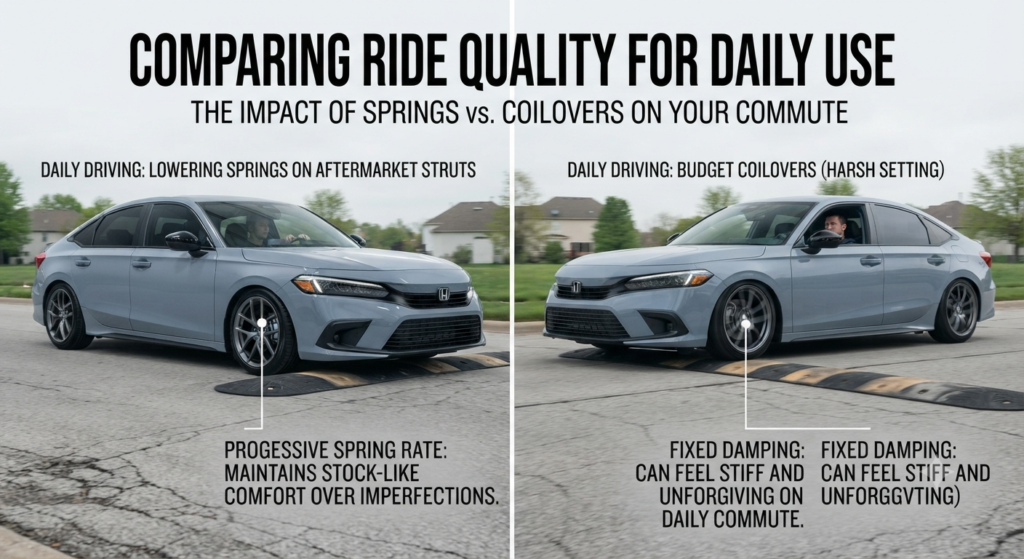
For a daily driver, comfort is non-negotiable. You spend hours in your car every week. If your back hurts after a twenty minute drive, the modifications are not worth it.
The Springs Experience
High-quality springs, like those from Eibach or Swift, maintain a ride quality very close to stock. They are progressive, meaning they stay soft during normal driving and get stiffer as you corner harder.
If you pair them with performance-oriented struts like Bilstein or Koni, the ride can actually feel better than the factory setup.
The Coilover Experience
Entry-level coilovers are notorious for being harsh. Many cheap brands prioritize stiffness over comfort, which makes the car feel like a wooden wagon on bumpy roads.
However, high-end coilovers offer damping adjustment. You can set them to soft for your daily commute and firm for a weekend canyon run.
Essential Components Often Overlooked
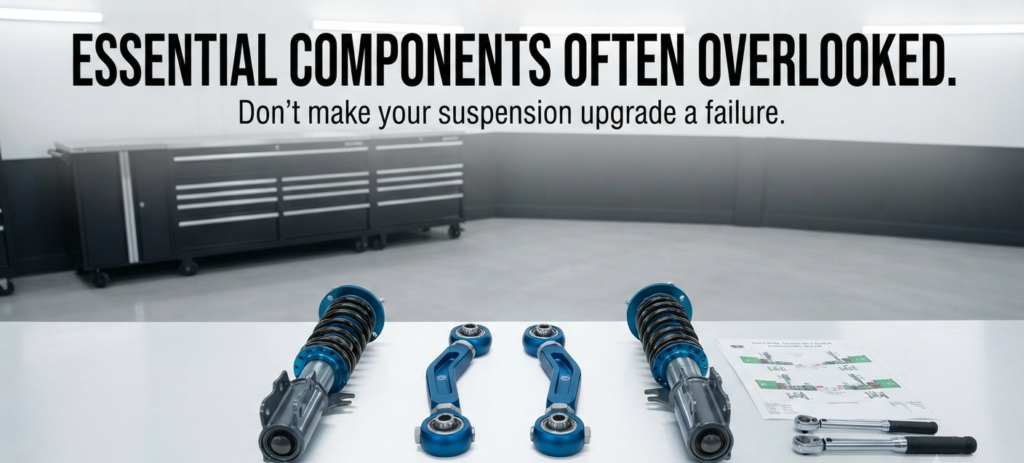
Many Civic owners focus entirely on the springs or coilovers and forget about the supporting parts. If you want your car to handle well and last long, you need to budget for these.
Adjustable Rear Camber Arms
When you lower a Civic, the geometry of the suspension changes. The wheels naturally lean inward, which is called negative camber.
If you do not install an adjustable camber kit, your rear tires will wear out unevenly. You might ruin a set of high-performance tires in less than five thousand miles.
Aftermarket Struts
If you choose to go the lowering spring route, do not try to save money by keeping your old, stock struts.
Budget for a set of dedicated aftermarket struts. They are valved to handle the shorter spring travel and will prevent that annoying, bouncy feeling.
Professional Alignment
You must get a four-wheel alignment after your suspension work. Even a slight variation in toe settings can cause your car to wander on the highway.
It also affects your fuel economy. An improperly aligned car creates more rolling resistance, which means your engine has to work harder.
The Financial Breakdown
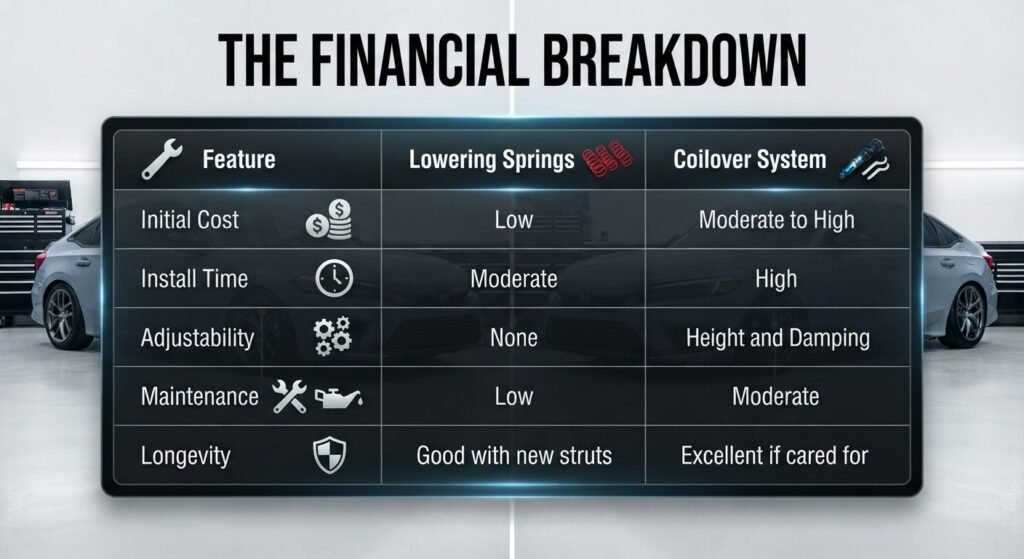
Let us look at the numbers for a typical Honda Civic project.
| Feature | Lowering Springs | Coilover System |
| Initial Cost | Low | Moderate to High |
| Install Time | Moderate | High |
| Adjustability | None | Height and Damping |
| Maintenance | Low | Moderate |
| Longevity | Good with new struts | Excellent if cared for |
Final Verdict: Which One Should You Choose?
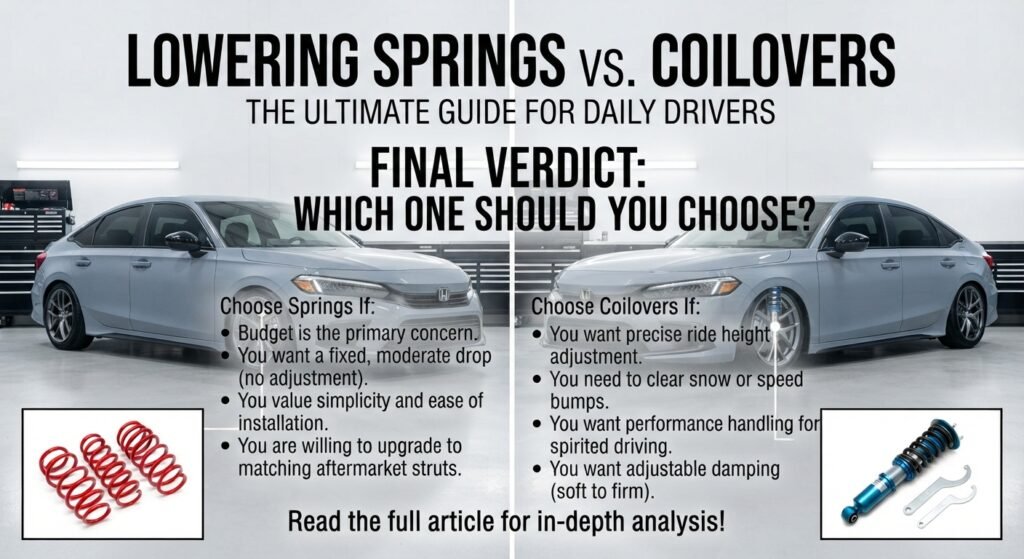
The right choice depends on your long-term goals for the car.
Choose Lowering Springs If:
You want a simple set it and forget it solution. You like the look of a lowered car but do not care about extreme fine-tuning.
You are on a strict budget and want to spend money on other mods like wheels or intake systems.
Choose Coilovers If:
You are a car enthusiast who enjoys the tuning process. You want your car to sit perfectly flush with your wheels.
You live in an area with changing weather conditions where you might need to raise your car height occasionally.
You want a setup that offers better handling response for spirited driving.
Maintaining Your Investment
Regardless of what you choose, keep your suspension clean. If you live in a snowy climate, spray your suspension components with a rust inhibitor spray during the winter months.
Check your bolts every time you rotate your tires. Suspension components move constantly and can loosen over time.
By keeping an eye on your hardware, you ensure that your daily driver remains safe and fun for years to come.
Common Mistakes to Avoid
The most common mistake is buying the cheapest parts found on online marketplaces. Suspension is the only thing keeping your car connected to the road.
Cheap metal and poor engineering can lead to component failure. Always stick to reputable brands with good track records in the Honda community.
Another mistake is neglecting the break-in period. New springs and coilovers need time to settle. Do not finalize your ride height until you have driven at least five hundred miles.
Conclusion
Whether you choose springs or coilovers, the biggest upgrade you can make to your daily driver is a proper professional alignment. It makes more of a difference in how your car drives than any brand of spring ever could.
Take your time with the research. Look at photos of similar Civic builds to see how specific brands sit on the car.
A well-planned suspension build will transform your daily driver into a car that is both beautiful to look at and a joy to drive every single day.