
Introduction
You are a responsible driver. You follow the speed limits, you keep your Honda Civic in great shape, and you practice defensive driving every single day.
Yet, when your latest renewal notice arrives from Progressive, you notice a frustrating and significant jump in your premium.
It feels personal. You might be asking yourself why you are being penalized for driving one of the most popular vehicles in America.
The truth is that insurance companies look at data far beyond just your personal driving history.
In the current economic climate of 2026, insurance carriers are navigating a complex web of inflation, rising repair costs, and changing theft patterns.
This guide will explain exactly why your Honda Civic premium is spiking and, more importantly, provide you with an actionable roadmap to fight back and lower your costs.
The Anatomy of an Insurance Premium Spike
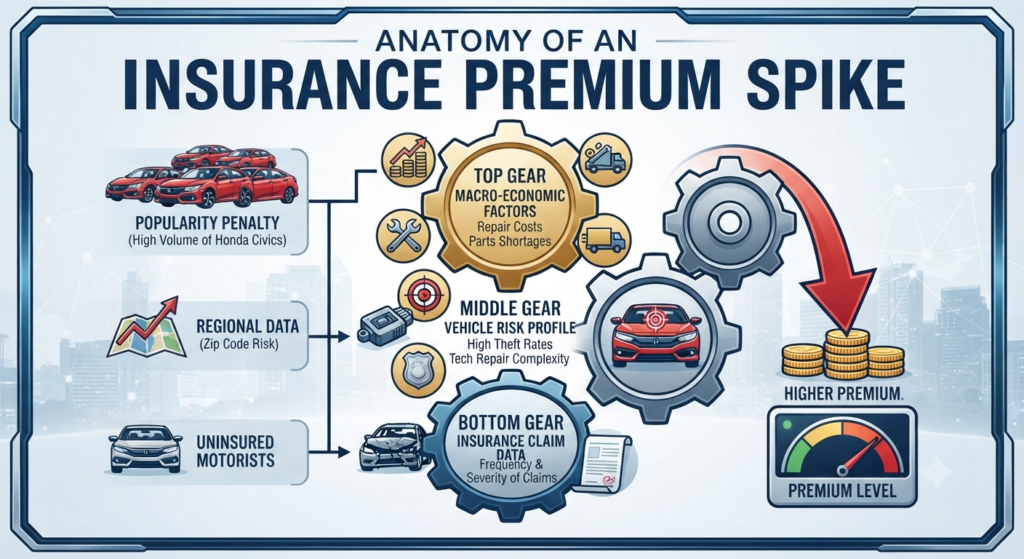
Many policyholders assume that an insurance rate increase is a direct response to their own driving record.
While that is certainly a factor, it is rarely the only one.
When you see your premium increase, it is often a result of a macro-level recalculation by your insurance carrier.
Insurance companies operate on massive pools of data.
They do not just look at you; they look at every other person in your zip code who drives a similar model.
This is where the “Popularity Penalty” comes into play for Honda Civic owners.
Because the Honda Civic is one of the most purchased vehicles in the United States, it is everywhere.
High volume creates a specific kind of risk profile that insurers take very seriously.
When you factor in national inflation, the cost of medical care for accidents, and legal fees, the baseline for premiums across the industry has shifted upward.
The “Popularity Penalty” and Theft Rates
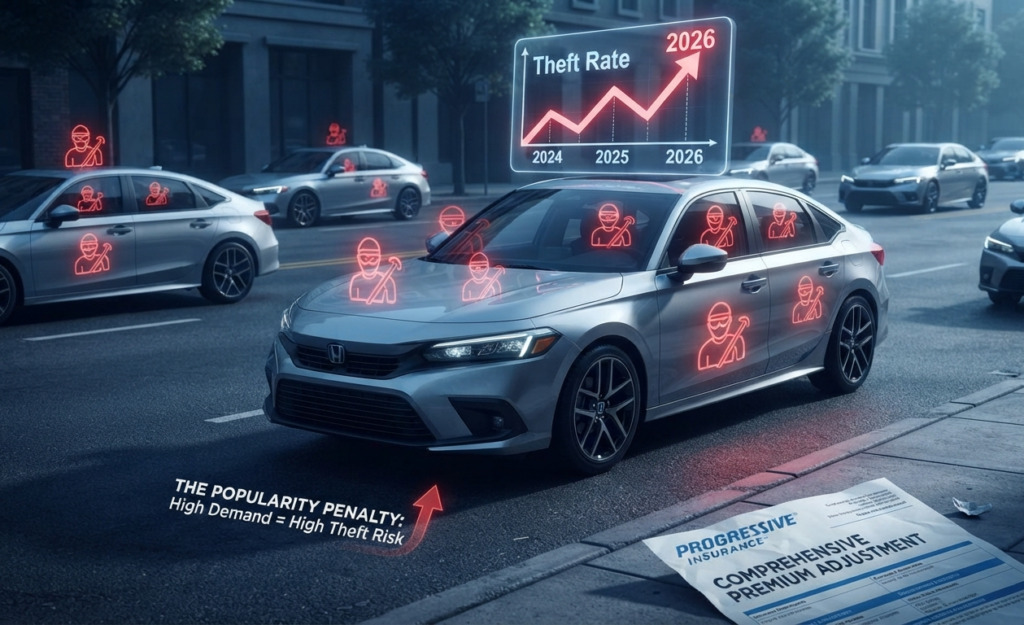
Why does being a popular car owner lead to higher costs?
It starts with theft statistics.
Unfortunately, because there are so many Honda Civics on the road, they are a frequent target for car thieves.
Thieves find them easy to blend in with traffic, and there is a high demand for parts in the black market.
When theft rates for a specific model spike in a particular region, Progressive and other insurers adjust their comprehensive coverage rates to compensate for the higher probability of a claim.
If you live in an area where Civic thefts have increased, your comprehensive premium will rise.
This happens even if your specific car has an advanced alarm system or if you park in a locked garage.
The insurer is pricing the collective risk of the model, not just the specific security of your individual vehicle.
It is a statistical game where your premium is determined by the behavior of thousands of other drivers you have never even met.
Why Modern Civics Are More Expensive to Repair
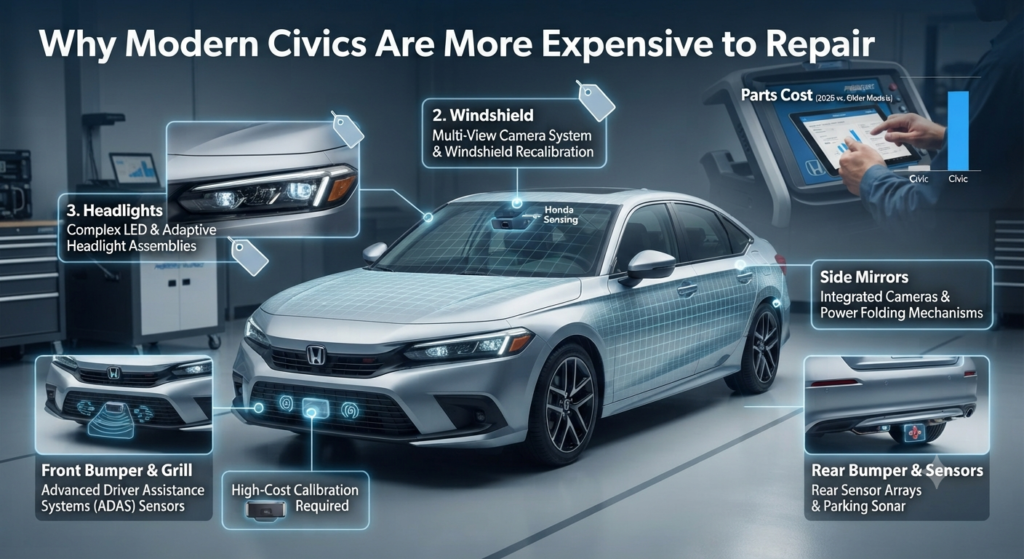
There is another massive factor at play in 2026: the technology inside your car.
Modern Honda Civics are packed with sensors, cameras, and sophisticated safety technology like the Honda Sensing suite.
While these features make your daily commute significantly safer, they make your car much more expensive to repair after a collision.
Replacing a single bumper sensor or recalibrating a windshield camera can cost thousands of dollars.
In the past, a minor fender bender meant a simple trip to a body shop for some paint and metal work.
Today, that same collision involves complex electronic diagnostics and specialized parts.
As a result, the average cost of a claim has skyrocketed, and insurance companies pass those costs on to policyholders.
Even a minor “parking lot tap” can now result in a multi-thousand dollar repair bill.
The Impact of Your Zip Code

Your location is arguably just as important as the car you drive.
In 2026, insurance companies are increasingly using “micro-segmentation” to set rates.
This means they are looking at risk factors on a neighborhood or zip code level.
If your specific area has seen a rise in crime, uninsured motorists, or frequent extreme weather events, your rates will likely go up.
These regional rate hikes are often independent of your driving behavior.
Even if you have a perfect driving record, you are essentially subsidizing the risk of your geographic area.
Understanding this is key because it changes how you should approach insurance shopping.
You are not just insuring a car; you are insuring a car in a specific environment.
Always keep in mind that moving to a different zip code even one just a few miles away can sometimes result in a drastically different insurance quote.
The Progressive Factor: Leveraging Your Policy
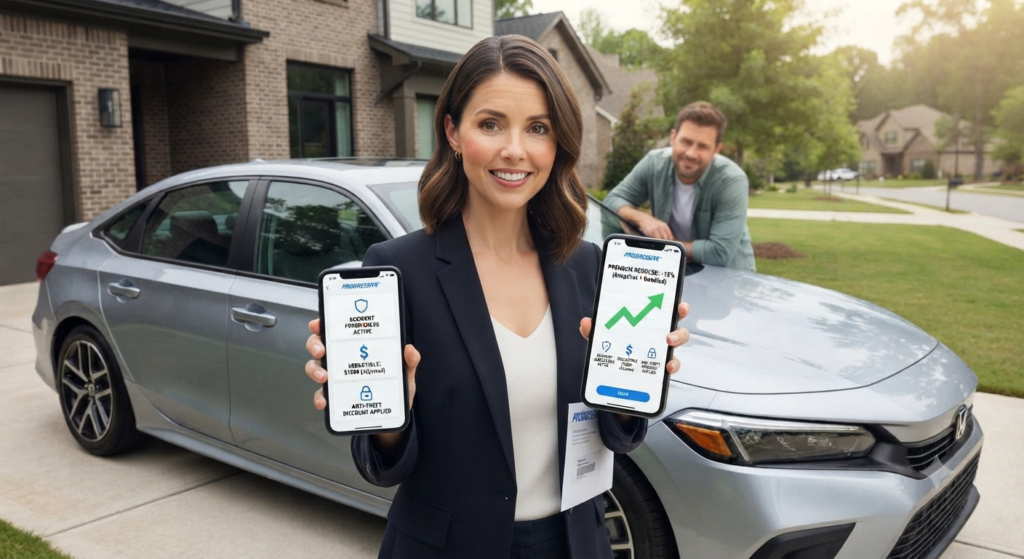
Progressive offers several specific features that can help cushion the blow of rising premiums.
The first thing you should do is open your online portal and review your current policy details.
Look for “Accident Forgiveness.” If you have been with Progressive for a certain period, this feature can prevent your rate from increasing after your first at-fault accident.
It is a massive safety net that many people forget they have.
Next, consider your Comprehensive coverage settings.
This is the specific part of your policy that covers theft and vandalism.
If you have a very low deductible, like $100 or $250, your monthly premium will naturally be higher.
Increasing your deductible to $500 or $1,000 can lead to immediate and noticeable savings on your monthly bill.
However, only do this if you have the savings set aside to cover that amount in the event of a theft or a total loss.
Finally, ensure you have “Loan or Lease Payoff” coverage.
If your Civic is stolen and the insurance payout does not cover your full remaining auto loan, this coverage saves you from being stuck with a debt for a car you no longer possess.
Strategies to Proactively Lower Your Premium
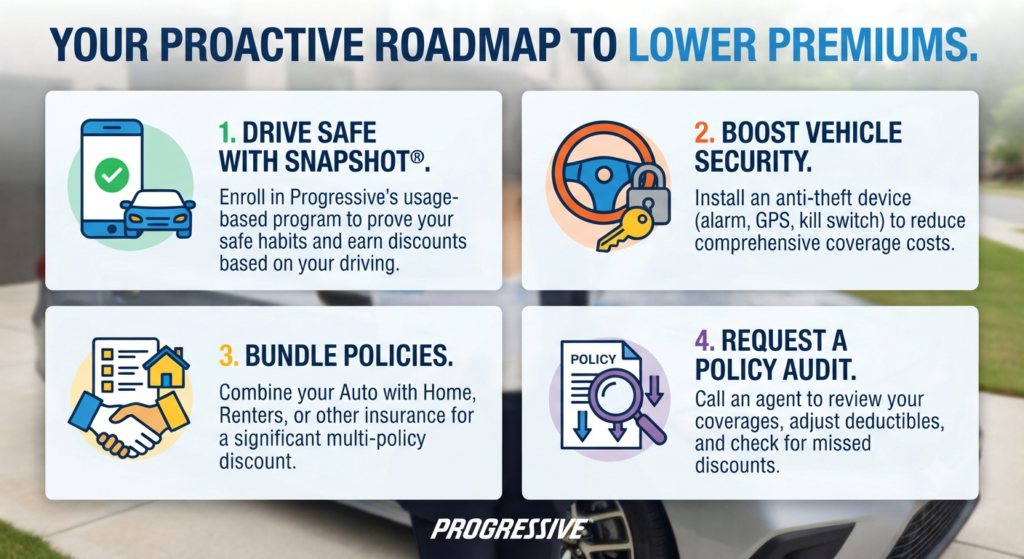
You do not have to accept a price hike as an inevitable part of life.
You have tools at your disposal to force your rate down, but it requires you to be proactive.
1. Enroll in Usage-Based Insurance
Consider signing up for the Progressive Snapshot program.
This program tracks your actual driving habits—such as hard braking, speed, and time of day—through an app or a small device.
If you are a safe, cautious driver, this is the most effective way to offset general rate increases.
It effectively proves to the insurer that your personal risk is lower than the average Civic owner in your area.
2. Invest in Advanced Security
Insurance companies love it when you take steps to secure your vehicle.
Beyond the standard factory alarm, consider installing a secondary steering wheel lock, a kill switch, or an aftermarket GPS tracker.
Some carriers offer specific “anti-theft device” discounts that can shave a percentage off your comprehensive premium.
Always reach out to your agent to confirm if your specific security upgrade qualifies for a discount.
3. Request a Full Policy Audit
The most underutilized tool is the human agent.
Call your Progressive agent and ask for a line-by-line review of your policy.
Ask them, “What discounts am I missing?”
Sometimes, simple things like updating your annual mileage estimate or proving your car is parked in a garage can trigger savings.
4. Bundle Your Policies
If you have renters, homeowners, or boat insurance, bundling those with your auto policy can lead to significant multi-policy discounts.
This is often one of the easiest ways to drop your monthly bill without changing your coverage limits.
Navigating Claims and Renewals

When your policy is up for renewal, do not just pay the bill automatically.
This is the most critical time to negotiate.
If your premium has increased significantly, ask your agent for a breakdown.
Sometimes, an increase is based on outdated information, such as an incorrect annual mileage estimate or a failure to account for new safety equipment installed on your car.
If you have stayed with Progressive for many years, remind them of your loyalty.
While loyalty discounts aren’t always a “written” rule, many agents have the discretion to apply additional credits to keep a long-term customer.
Also, be mindful of how you handle minor damage.
If you have a small scratch or a minor dent, calculate the repair cost versus your deductible.
Filing a small claim can sometimes lead to a rate increase that costs more over three years than the repair would have cost out-of-pocket.
Managing the Long-Term Outlook
Insurance pricing in 2026 is volatile.
We are living in an era where parts availability, labor shortages, and climate events are constantly shifting.
Because of this, you should make it a habit to audit your insurance twice a year.
Do not wait for a renewal notice to be surprised by a 15% increase.
Check your current policy against competitor quotes every six months to ensure you are still getting a competitive rate.
If you find that your current rate is significantly higher than others, use that information to negotiate with your current agent.
Loyalty is good, but it should not cost you thousands of dollars a year.
Keep an eye on industry news as well.
If new legislation is passed in your state regarding insurance caps or consumer rights, it might give you more leverage during your next renewal.
Conclusion
A premium spike on your Honda Civic is rarely a reflection of your personal character or your skill as a driver.
It is a complicated mix of national economic trends, high theft volume for your specific car model, and the rising cost of high-tech vehicle repairs.
By understanding how Progressive calculates these risks, you can stop feeling like a victim of the system and start acting as a manager of your own financial health.
Review your policy today, look into telematics programs, increase your deductible if your savings allow, and keep your vehicle’s security updated.
You have more control over your insurance rate than you might think.
Take these steps today, and you will likely see the relief in your next billing statement.
By being informed, proactive, and willing to advocate for yourself, you can keep your Honda Civic on the road without breaking the bank.